
Practice Exam Course 3.6 Neuropsychology
Problem 1
Question 1
Areas 1, 2, 3 and 43 are part of the somatosensory cortex.
A. True
B. False
Question 2
There are several visual areas in the visual cortex. V4 detects motion and V5 is the color area.
A. True
B. False
Question 3
Egocentric visual space is related to vision before action and allocentric properties of objects
are associated with areas of visual recognition.
A. True
B. False
Question 4
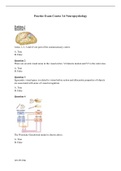
The Wernicke-Geschwind model is shown above.
A. True
B. False
Lara de Jong
, Question 5
Initiating motion goes via this route:
Posterior cortex – prefrontal cortex – premotor cortex – primary motor cortex.
A. True
B. False
Question 6
Parkinson's disease has hypokinetic symptoms and Huntington's disease has hyperkinetic
symptoms.
A. True
B. False
Question 7
The picture above is also called flocculus (little human).
A. True
B. False
Question 8
Afferent neurons are neurons that go away from the brain and efferent neurons go towards the
brain.
A. True
B. False
Question 9
Astereognosis is the inability to recognize an object without touching it. Once it is touched,
people with astereognosis know what it is almost immediately.
A. True
B. False
Question 10
Finger agnosia is an example of autopagnosia.
A. True
B. False
Lara de Jong
Problem 1
Question 1
Areas 1, 2, 3 and 43 are part of the somatosensory cortex.
A. True
B. False
Question 2
There are several visual areas in the visual cortex. V4 detects motion and V5 is the color area.
A. True
B. False
Question 3
Egocentric visual space is related to vision before action and allocentric properties of objects
are associated with areas of visual recognition.
A. True
B. False
Question 4
The Wernicke-Geschwind model is shown above.
A. True
B. False
Lara de Jong
, Question 5
Initiating motion goes via this route:
Posterior cortex – prefrontal cortex – premotor cortex – primary motor cortex.
A. True
B. False
Question 6
Parkinson's disease has hypokinetic symptoms and Huntington's disease has hyperkinetic
symptoms.
A. True
B. False
Question 7
The picture above is also called flocculus (little human).
A. True
B. False
Question 8
Afferent neurons are neurons that go away from the brain and efferent neurons go towards the
brain.
A. True
B. False
Question 9
Astereognosis is the inability to recognize an object without touching it. Once it is touched,
people with astereognosis know what it is almost immediately.
A. True
B. False
Question 10
Finger agnosia is an example of autopagnosia.
A. True
B. False
Lara de Jong


