

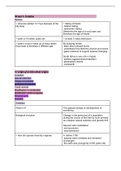
Strand 4: Evolution………………………………………………………………………………………(
Revision
> Universe started 13.7 bya because of the > dating of fossils
big bang -relative dating
-radiometric dating
Determine the age of a rock layer and
therefore the age of fossils
> earth is 4.6 billion years old > at least 5 mass extinctions
> earth’s crust is made up of many layers By studying fossils:
Each layer is therefore a different age -learn about ancient forms
-understand how lifeforms chance and evolve
-gains evidence to support species changing
South Africa is very rich in fossils
-earliest organisms(stromatolites)
-glossopteris leaves
-coelacanth
4.1 origin of an idea about origins
Evolution
Natural selection
Theory of evolution
Evidence of evolution
Fossil records
Modification in vertebrates
Modification within a species
Biogeography
Genetics
Evolution
What is it? The gradual change or development of
something
Biological evolution Change in the gene pool of a population
during the course of the time by such process
as mutation,natural selection and genetic drift
Descent with modicifation
-microevolution
-macroevolution
> How did species diversity originate A: before 1700
-species were unrelated and remained
unchanged
-the earth was young(only 6 000 years old)
,A: before 1700 A: before 1700
-species were unrelated and remained
unchanged
-the earth was young(only 6 000 years old)
B:1700-1800 B:1700-1800
Erasmus Darwin and Jean-Baptiste Lamarck
began to challenge these concepts
-species had changed gradually over time
-the earth was millions of years old
Erasmus Darwin
-put forward the idea that life on earth
descended from a common ancestor
-he suggested that species must have
changed over time but he offered no
mechanism for what he termed ‘tranformation’
Jean-Baptiste Lamarck
-living species are different to fossil types, sp
life forms must have changed
-domestication and selective breeding
resulted in animals and plants changing
-cross-breeding of plant and animal species
often led to new characters appearing
Inheritance of acquired characteristic(called
Lamarckism)
-phenotypic changes or characteristics
acquired by parents during their lifetime were
then passed on
e.g) short necked giraffes to long necked
giraffes
C. early 1800 to early 1900 An acceptable mechanism was put forward
for this ‘transformation’
Charles Darwin
(think southern hemisphere)
Collected data that made him aware of:
- Immense diversity among organisms
- Variation of individuals of same
species
- Often puzzling distribution
He realised from study of geology:
- The earth is extremely old
, - Has been great geological change
- Isolation leads to species changing
Wrote a very famous book:
The Origin of Species
-He had two accepted hyphothesis
1)Modification of descent
-all organisms come from a common ancestor
-adapted to new local conditions
-diversification was by branching
-some species died out
2) Natural selection
the process whereby organisms better
adapted to their environment tend to survive
and produce more offspring. The theory of its
action was first fully expounded by Charles
Darwin, and it is now regarded as be the main
process that brings about evolution. Compare
with survival of the fittest
Evidence of the theory of evolution
Supported by many lines of evidence from: Fossil records
Biogeography
DNA
Homologies and comparative anatomy
Embryology
Vestgial organs
Biodiversity
Physiology
> Fossil evidence indicates that evolution has Known as palaeontological evidence and
occured shows micro/macro evolution occurred
Provides detailed information and evidence of
systematic change through time-of descent
with modification
Fossils show:
-increase in complexity
(simplest=earliest)(most complex=latested)
-increase in diversity
(the oldest fossil bearing rocks contain a
small diversity of fossilised organisms)
(branching out in diversity =Cladogenesis)
-more extinct species as one moves back in
Revision
> Universe started 13.7 bya because of the > dating of fossils
big bang -relative dating
-radiometric dating
Determine the age of a rock layer and
therefore the age of fossils
> earth is 4.6 billion years old > at least 5 mass extinctions
> earth’s crust is made up of many layers By studying fossils:
Each layer is therefore a different age -learn about ancient forms
-understand how lifeforms chance and evolve
-gains evidence to support species changing
South Africa is very rich in fossils
-earliest organisms(stromatolites)
-glossopteris leaves
-coelacanth
4.1 origin of an idea about origins
Evolution
Natural selection
Theory of evolution
Evidence of evolution
Fossil records
Modification in vertebrates
Modification within a species
Biogeography
Genetics
Evolution
What is it? The gradual change or development of
something
Biological evolution Change in the gene pool of a population
during the course of the time by such process
as mutation,natural selection and genetic drift
Descent with modicifation
-microevolution
-macroevolution
> How did species diversity originate A: before 1700
-species were unrelated and remained
unchanged
-the earth was young(only 6 000 years old)
,A: before 1700 A: before 1700
-species were unrelated and remained
unchanged
-the earth was young(only 6 000 years old)
B:1700-1800 B:1700-1800
Erasmus Darwin and Jean-Baptiste Lamarck
began to challenge these concepts
-species had changed gradually over time
-the earth was millions of years old
Erasmus Darwin
-put forward the idea that life on earth
descended from a common ancestor
-he suggested that species must have
changed over time but he offered no
mechanism for what he termed ‘tranformation’
Jean-Baptiste Lamarck
-living species are different to fossil types, sp
life forms must have changed
-domestication and selective breeding
resulted in animals and plants changing
-cross-breeding of plant and animal species
often led to new characters appearing
Inheritance of acquired characteristic(called
Lamarckism)
-phenotypic changes or characteristics
acquired by parents during their lifetime were
then passed on
e.g) short necked giraffes to long necked
giraffes
C. early 1800 to early 1900 An acceptable mechanism was put forward
for this ‘transformation’
Charles Darwin
(think southern hemisphere)
Collected data that made him aware of:
- Immense diversity among organisms
- Variation of individuals of same
species
- Often puzzling distribution
He realised from study of geology:
- The earth is extremely old
, - Has been great geological change
- Isolation leads to species changing
Wrote a very famous book:
The Origin of Species
-He had two accepted hyphothesis
1)Modification of descent
-all organisms come from a common ancestor
-adapted to new local conditions
-diversification was by branching
-some species died out
2) Natural selection
the process whereby organisms better
adapted to their environment tend to survive
and produce more offspring. The theory of its
action was first fully expounded by Charles
Darwin, and it is now regarded as be the main
process that brings about evolution. Compare
with survival of the fittest
Evidence of the theory of evolution
Supported by many lines of evidence from: Fossil records
Biogeography
DNA
Homologies and comparative anatomy
Embryology
Vestgial organs
Biodiversity
Physiology
> Fossil evidence indicates that evolution has Known as palaeontological evidence and
occured shows micro/macro evolution occurred
Provides detailed information and evidence of
systematic change through time-of descent
with modification
Fossils show:
-increase in complexity
(simplest=earliest)(most complex=latested)
-increase in diversity
(the oldest fossil bearing rocks contain a
small diversity of fossilised organisms)
(branching out in diversity =Cladogenesis)
-more extinct species as one moves back in


