Organizational theory - PAPERS Emma Hamm 2078889
Organizational Theory - PAPERS
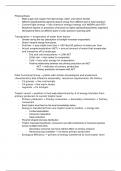
1. What is organization theory?
- Whetten → What constitutes a Theoretical Contribution?
● Organizations: social entities, goal directed, structured/coordinated activity systems, related to
external environments
● Theory: set of interrelated concepts, definitions, and propositions that explain or predict events
or situations by specifying relations among variables
small part of reality (understands BETTER), abstracts of many other relevant aspects, detail, large
theoretical context
● Building blocks theory: WHAT-HOW (conceptual model), HOW (hypotheses), WHY (arguments)
Conditions WHO, WHEN, WHERE
● Judging factors: what’s new?, so what?, why so?, well done?, done well?, why now?, who cares?
● Indicators good hypothesis: variation in hypotheses (high/low), direction (oorzaak-gevolg)
- Sutton & Staw → What theory is not
● NOT: references (why?), data (needs to be interpreted), list of variables/concepts (why?),
diagrams (just model, no explanations), only hypotheses (no theory with it)
● ASSUMPTIONS
○ Theory is good: building theory and theory on itself will give a broader understanding
○ Stronger theoretical section will help a paper have more impact (on the literature)
○ Most researchers strive to write better theory if they had more knowledge
- Mayer & Sparrowe → Integrating theories in AMJ Articles
● New theories: change what / why/ how / when. Build on previous theory
● Best way to integrate theory
1) Single phenomenon, two theoretical perspectives: same Y but different X’s
2) Two seemingly contrasting theories can appear to be not contrasting at all
3) Applying one theory to the domain of another theory
4) Two theories may address related phenomena, but draw on similar set of explanatory variables: somewhat same Y
and similar X’s
● CONCLUSION: Many phenomena and research questions cannot be adequately addressed by
drawing on a single theory
1
, Organizational theory - PAPERS Emma Hamm 2078889
It is important, however, to determine how to integrate elements from multiple theories in a
way that sheds light on one or more issues that no theory could address individually
2. Inter-Organizational Theory (IOT) → TCT + RDT
Q: How can organizations organize their interaction with the environment?
Q: When do (departments/teams in) organizations compete, and when do organizations collaborate?
⇒ “The relatively enduring transactions, flows, and linkages that occur among and between an
organization and one or more organizations in its environment.”
⇒ Combined model of Transaction Cost Theory and Research Development Theory performs best.
TCT and RDT are complementary theories.
⇒ continuous customer–supplier relationship: protection for business and presumably
TCT (economic financial resources)
- Cuypers, Hennart, Silverman, & Ertug → Transaction cost theory: Past progress, current challenges,
and suggestions for the future
● Behavioral assumptions: bounded rationality, opportunism (self-interest with bedrog)
→ Bounded reliability – Broader version of opportunism with 2 main concepts:
1) Strategic opportunism 2) Non-strategic preference reversals
Trust: reduce TC by reducing concerns about opportunism, complement effective contracting
SOLVE bounded rationality: try find more information → increases transaction costs
SOLVE opportunism (uncertainty high): rules/regulation to stop your opportunism
●
>H>The higher the uncertainty/frequency/asset specifity, the higher the chance hierarchy will be
chosen as a governance structure.
>H>The lower the uncertainty/frequency/asset specifity,, the higher the chance market will be chosen
as governance structure
WHERE: capital economies, WHEN: modern economies
Asset specificity: site, physical, human, dedicated, temporal, procedural
⇒ greater difference between 1th best and 2th best use → more specific → more hierarchical g.
Uncertainty: primary, secondary, behavioral (last 2: environmental uncertainty)
⇒ greater uncertainty → more likelihood of opportunistic behavior
⇒ NO clear evidence that environmental uncertainty (non-strategic, behavioral) has direct effect
on TC & how it might affect governance choice
REDUCED environmental uncertainty REDUCES the risk of behavioral uncertainty
2
, Organizational theory - PAPERS Emma Hamm 2078889
Horizontal (expansion into new product market) and vertical integration (stages of production)
⇒ When there is information asymmetry, firms will opt for a more hierarchical solution rather
than a market-based one
⇒ Cultural distance makes it harder to understand and predict an exchange partners’ behavior
⇒ Strong intellectual property protection, eg. patents and trademark systems, can REDUCE the
risk of behavioral uncertainty The STRONGER the appropriability regime, the LESS likely
hierarchy will be used to govern a transaction, as predicted by TCT
⇒ Likelihood of hierarchical governance should be HIGHER for more frequently recurring
transactions than for less frequently recurring ones (+development of trust and REDUCTIONS in
information asymmetry and the development of routine)
● Models/mechanisms: 1) Markets, 2) hierarchies (administrative control, union),
3) intermediate models => long-term, relational contracting, alliances/hybrids
○ Relational governance: mechanisms that REDUCE behavioral uncertainty and AFFECTS
governance choices
● INVISIBLE HAND → adam smith: “It is not from the benevolence of the butcher, the brewer, or the
baker that we expect our dinner, but from their regard to their own interest.” (egoistic)
●
Ronald Coase:
Why do org. Exist? → bv market is not for free (TC)! Search, contracting, monitoring, enforcement costs
Oliver Williamson:
Markets and hierarchies are alternative ways to organize transactions = called governance structures
RDT (social actors)
- Pfeffer & Salancik → The design and management of externally controlled organizations
* To understand behavior of organizations, one must understand how organizations relate to other social
actors in their environment
Organizations depend on their environment for acquiring resources (actors with resources: independent)
Survival – the ability to cope with this dependency, negotiation and ensuring continuation needed for
resource supply
● interlocking of the behaviors of participants (activities and behaviors, not social actors, are
organized in structures)
○ partial inclusion (part of diff organ. structures)
○ organization’s boundaries (area where org. control over participant’s actions)
3
Organizational Theory - PAPERS
1. What is organization theory?
- Whetten → What constitutes a Theoretical Contribution?
● Organizations: social entities, goal directed, structured/coordinated activity systems, related to
external environments
● Theory: set of interrelated concepts, definitions, and propositions that explain or predict events
or situations by specifying relations among variables
small part of reality (understands BETTER), abstracts of many other relevant aspects, detail, large
theoretical context
● Building blocks theory: WHAT-HOW (conceptual model), HOW (hypotheses), WHY (arguments)
Conditions WHO, WHEN, WHERE
● Judging factors: what’s new?, so what?, why so?, well done?, done well?, why now?, who cares?
● Indicators good hypothesis: variation in hypotheses (high/low), direction (oorzaak-gevolg)
- Sutton & Staw → What theory is not
● NOT: references (why?), data (needs to be interpreted), list of variables/concepts (why?),
diagrams (just model, no explanations), only hypotheses (no theory with it)
● ASSUMPTIONS
○ Theory is good: building theory and theory on itself will give a broader understanding
○ Stronger theoretical section will help a paper have more impact (on the literature)
○ Most researchers strive to write better theory if they had more knowledge
- Mayer & Sparrowe → Integrating theories in AMJ Articles
● New theories: change what / why/ how / when. Build on previous theory
● Best way to integrate theory
1) Single phenomenon, two theoretical perspectives: same Y but different X’s
2) Two seemingly contrasting theories can appear to be not contrasting at all
3) Applying one theory to the domain of another theory
4) Two theories may address related phenomena, but draw on similar set of explanatory variables: somewhat same Y
and similar X’s
● CONCLUSION: Many phenomena and research questions cannot be adequately addressed by
drawing on a single theory
1
, Organizational theory - PAPERS Emma Hamm 2078889
It is important, however, to determine how to integrate elements from multiple theories in a
way that sheds light on one or more issues that no theory could address individually
2. Inter-Organizational Theory (IOT) → TCT + RDT
Q: How can organizations organize their interaction with the environment?
Q: When do (departments/teams in) organizations compete, and when do organizations collaborate?
⇒ “The relatively enduring transactions, flows, and linkages that occur among and between an
organization and one or more organizations in its environment.”
⇒ Combined model of Transaction Cost Theory and Research Development Theory performs best.
TCT and RDT are complementary theories.
⇒ continuous customer–supplier relationship: protection for business and presumably
TCT (economic financial resources)
- Cuypers, Hennart, Silverman, & Ertug → Transaction cost theory: Past progress, current challenges,
and suggestions for the future
● Behavioral assumptions: bounded rationality, opportunism (self-interest with bedrog)
→ Bounded reliability – Broader version of opportunism with 2 main concepts:
1) Strategic opportunism 2) Non-strategic preference reversals
Trust: reduce TC by reducing concerns about opportunism, complement effective contracting
SOLVE bounded rationality: try find more information → increases transaction costs
SOLVE opportunism (uncertainty high): rules/regulation to stop your opportunism
●
>H>The higher the uncertainty/frequency/asset specifity, the higher the chance hierarchy will be
chosen as a governance structure.
>H>The lower the uncertainty/frequency/asset specifity,, the higher the chance market will be chosen
as governance structure
WHERE: capital economies, WHEN: modern economies
Asset specificity: site, physical, human, dedicated, temporal, procedural
⇒ greater difference between 1th best and 2th best use → more specific → more hierarchical g.
Uncertainty: primary, secondary, behavioral (last 2: environmental uncertainty)
⇒ greater uncertainty → more likelihood of opportunistic behavior
⇒ NO clear evidence that environmental uncertainty (non-strategic, behavioral) has direct effect
on TC & how it might affect governance choice
REDUCED environmental uncertainty REDUCES the risk of behavioral uncertainty
2
, Organizational theory - PAPERS Emma Hamm 2078889
Horizontal (expansion into new product market) and vertical integration (stages of production)
⇒ When there is information asymmetry, firms will opt for a more hierarchical solution rather
than a market-based one
⇒ Cultural distance makes it harder to understand and predict an exchange partners’ behavior
⇒ Strong intellectual property protection, eg. patents and trademark systems, can REDUCE the
risk of behavioral uncertainty The STRONGER the appropriability regime, the LESS likely
hierarchy will be used to govern a transaction, as predicted by TCT
⇒ Likelihood of hierarchical governance should be HIGHER for more frequently recurring
transactions than for less frequently recurring ones (+development of trust and REDUCTIONS in
information asymmetry and the development of routine)
● Models/mechanisms: 1) Markets, 2) hierarchies (administrative control, union),
3) intermediate models => long-term, relational contracting, alliances/hybrids
○ Relational governance: mechanisms that REDUCE behavioral uncertainty and AFFECTS
governance choices
● INVISIBLE HAND → adam smith: “It is not from the benevolence of the butcher, the brewer, or the
baker that we expect our dinner, but from their regard to their own interest.” (egoistic)
●
Ronald Coase:
Why do org. Exist? → bv market is not for free (TC)! Search, contracting, monitoring, enforcement costs
Oliver Williamson:
Markets and hierarchies are alternative ways to organize transactions = called governance structures
RDT (social actors)
- Pfeffer & Salancik → The design and management of externally controlled organizations
* To understand behavior of organizations, one must understand how organizations relate to other social
actors in their environment
Organizations depend on their environment for acquiring resources (actors with resources: independent)
Survival – the ability to cope with this dependency, negotiation and ensuring continuation needed for
resource supply
● interlocking of the behaviors of participants (activities and behaviors, not social actors, are
organized in structures)
○ partial inclusion (part of diff organ. structures)
○ organization’s boundaries (area where org. control over participant’s actions)
3