Week 1 Introduction & External Analysis
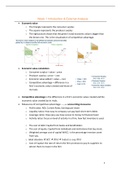
• Economic value
o The triangle represents the consumer surplus
o The square represents the producer surplus
o The right picture shows that the green’s total economic value is bigger than
the brown one. This is the visualization of competitive advantage.
• Economic value calculation
o Consumer surplus = value – price
o Producer surplus = price – cost
o Economic value added = value – cost
o Competitive advantage = difference in a
firm’s economic value created and those of
its rivals.
• Competitive advantage is the difference in a firm’s economic value created and the
economic value created by its rivals.
• Measures of competitive advantage → accounting measures
o Profit ratios: ROI, Current Ratio, Earnings per share
o Liquidity ratios: How easy to company can pay back short-term debts
o Leverage ratios: How easy you have access to money to finance/invest
o Activity ratios: focus on level of activity in a firm, how fast inventory is used.
o The cost of debt: Capital from banks and bondholders
o The cost of equity: Capital from individuals and institutions that buy stock.
o Weighted average cost of capital WACC: is the percentage investors want
from you.
o Ideal situation: 𝑊𝐴𝐶𝐶 < 𝑅𝑂𝐴 < 𝐼𝑛𝑑𝑢𝑠𝑡𝑟𝑦 𝑎𝑣𝑔 𝑅𝑂𝐴
o Cost of Capital: the rate of return the firm promises to pay its suppliers to
attract them to invest in the firm
1
, • Competitive advantage links with return
Competitive advantage Economic returns
Advantage Above normal: Exceeding expectations
Parity Normal: meeting expectations
Disadvantage Below normal: failing expectations
• Intended strategy: Strategy that you have now needs change over time
• Emergent strategy: unforeseen factor makes changes necessary
• Why should you do external analysis
o Discover opportunities and threats (trends)
o Analyze potential for profits
o Understand the nature of competition
• The levels of analysis
o General environment
o Industry (part of task environment)
o Strategic group
o Individual firm
• The General external environment
The general environment consists of broad trends in the context within which a firm
operates that can have an impact on a firm’s strategic choices. There are six elements
1. Technological change
2. Demographics: Age, sex, marital status income, ethnicity and other personal
attributes that might affect buying patterns. (purely numbers)
3. Culture: is the values and beliefs and norms that defines what is right or wrong in a
society, what is (un)acceptable, (un)fashionable.
4. The economic climate: is the overall health of the economic systems within which a
firm operates. When demand for goods and services is low, economy is relatively low
(recession and longer periods depression)
5. Legal and political conditions: which are laws and
the legal system’s impact on business together
with the general nature of the relationship
between government and business.
6. International events: these are political wars,
terrorism, civil wars, political coup, covid-19 that
have an effect on the firms ability to generate
competitive advantage.
2
,• The Structure-Conduct-Performance model (SCP MODEL)
o To spot anti-competitive conditions for anti-trust purposes
o used to assess the possibilities for above normal profits for firms within an
industry
• Industry definition
o Set of companies that fulfil a similar need with a similar production process
o Too narrow: Actual competitors are labelled substitute or new entrant
o Too broad: Actual substitutes are labelled direct competitors
• Industry analysis – 5 Forces model
1. Threat from existing competitors (rivalry)
§ Conditions that generate high threat
Þ Large number of competitors
Þ Slow or declining industry growth
Þ Low product differentiation
Þ Industry capacity added in large increments
2. Threat from new competition (entrants/entry)
§ Conditions that generate high threat
Þ High industry growth rate
Þ Low barriers of entry
o Economies of scale
o Product differentiation
o Government regulation of entry
o Retaliation of incumbent
o Proprietary technology
o Managerial know-how
o Favourable access to raw materials
o Learning-curve cost advantage
3. Threat of substitute products (different industry, same need)
§ Conditions that generate a high threat
Þ High potential of fulfilling the same need (high quality)
Þ Low switching cost for customer
4. Threat of supplier leverage
§ Conditions that generate a high threat
Þ Small number of firms in supplier’s industry
Þ Highly differentiated product
Þ Lack of close substitiutes for suppliers products
Þ Focal firm is an insignificant customer of supplier
Þ High switch costs for focal firm
3
, 5. Threat from buyers influence
§ Industry conditions that facilitate buyer power
Þ Small number of buyers
Þ Low level differentiation
Þ Low switching cost
6. Complementors as a sixth force
§ Customers value the focal firms products more when the customers
also own the product of the other firms
§ Complementors increase the size of the market. [Ps5 + Twitch]
• Drawback 5-forces
o Averages with big variance
o Unclear weight separate forces
o Highly dependent on industry definition
o Oversimplification / not complete
o Catch 22
4
• Economic value
o The triangle represents the consumer surplus
o The square represents the producer surplus
o The right picture shows that the green’s total economic value is bigger than
the brown one. This is the visualization of competitive advantage.
• Economic value calculation
o Consumer surplus = value – price
o Producer surplus = price – cost
o Economic value added = value – cost
o Competitive advantage = difference in a
firm’s economic value created and those of
its rivals.
• Competitive advantage is the difference in a firm’s economic value created and the
economic value created by its rivals.
• Measures of competitive advantage → accounting measures
o Profit ratios: ROI, Current Ratio, Earnings per share
o Liquidity ratios: How easy to company can pay back short-term debts
o Leverage ratios: How easy you have access to money to finance/invest
o Activity ratios: focus on level of activity in a firm, how fast inventory is used.
o The cost of debt: Capital from banks and bondholders
o The cost of equity: Capital from individuals and institutions that buy stock.
o Weighted average cost of capital WACC: is the percentage investors want
from you.
o Ideal situation: 𝑊𝐴𝐶𝐶 < 𝑅𝑂𝐴 < 𝐼𝑛𝑑𝑢𝑠𝑡𝑟𝑦 𝑎𝑣𝑔 𝑅𝑂𝐴
o Cost of Capital: the rate of return the firm promises to pay its suppliers to
attract them to invest in the firm
1
, • Competitive advantage links with return
Competitive advantage Economic returns
Advantage Above normal: Exceeding expectations
Parity Normal: meeting expectations
Disadvantage Below normal: failing expectations
• Intended strategy: Strategy that you have now needs change over time
• Emergent strategy: unforeseen factor makes changes necessary
• Why should you do external analysis
o Discover opportunities and threats (trends)
o Analyze potential for profits
o Understand the nature of competition
• The levels of analysis
o General environment
o Industry (part of task environment)
o Strategic group
o Individual firm
• The General external environment
The general environment consists of broad trends in the context within which a firm
operates that can have an impact on a firm’s strategic choices. There are six elements
1. Technological change
2. Demographics: Age, sex, marital status income, ethnicity and other personal
attributes that might affect buying patterns. (purely numbers)
3. Culture: is the values and beliefs and norms that defines what is right or wrong in a
society, what is (un)acceptable, (un)fashionable.
4. The economic climate: is the overall health of the economic systems within which a
firm operates. When demand for goods and services is low, economy is relatively low
(recession and longer periods depression)
5. Legal and political conditions: which are laws and
the legal system’s impact on business together
with the general nature of the relationship
between government and business.
6. International events: these are political wars,
terrorism, civil wars, political coup, covid-19 that
have an effect on the firms ability to generate
competitive advantage.
2
,• The Structure-Conduct-Performance model (SCP MODEL)
o To spot anti-competitive conditions for anti-trust purposes
o used to assess the possibilities for above normal profits for firms within an
industry
• Industry definition
o Set of companies that fulfil a similar need with a similar production process
o Too narrow: Actual competitors are labelled substitute or new entrant
o Too broad: Actual substitutes are labelled direct competitors
• Industry analysis – 5 Forces model
1. Threat from existing competitors (rivalry)
§ Conditions that generate high threat
Þ Large number of competitors
Þ Slow or declining industry growth
Þ Low product differentiation
Þ Industry capacity added in large increments
2. Threat from new competition (entrants/entry)
§ Conditions that generate high threat
Þ High industry growth rate
Þ Low barriers of entry
o Economies of scale
o Product differentiation
o Government regulation of entry
o Retaliation of incumbent
o Proprietary technology
o Managerial know-how
o Favourable access to raw materials
o Learning-curve cost advantage
3. Threat of substitute products (different industry, same need)
§ Conditions that generate a high threat
Þ High potential of fulfilling the same need (high quality)
Þ Low switching cost for customer
4. Threat of supplier leverage
§ Conditions that generate a high threat
Þ Small number of firms in supplier’s industry
Þ Highly differentiated product
Þ Lack of close substitiutes for suppliers products
Þ Focal firm is an insignificant customer of supplier
Þ High switch costs for focal firm
3
, 5. Threat from buyers influence
§ Industry conditions that facilitate buyer power
Þ Small number of buyers
Þ Low level differentiation
Þ Low switching cost
6. Complementors as a sixth force
§ Customers value the focal firms products more when the customers
also own the product of the other firms
§ Complementors increase the size of the market. [Ps5 + Twitch]
• Drawback 5-forces
o Averages with big variance
o Unclear weight separate forces
o Highly dependent on industry definition
o Oversimplification / not complete
o Catch 22
4