Test Bank for Evolution, Making Sense Of Life, 2nd Revised Edition by Carl Zimmer, Prof. Douglas Emlen.
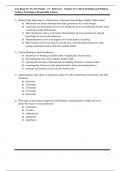
Test Bank, Chapter 1 1. Which of the following is NOT an example of evolution? (a) Beak size in a population of birds becomes larger from one generation to the next because larger beaked birds had higher reproductive success and passed the trait to their offspring (b) Over long periods of time whales gradually lost their hindlimbs (c) When traveling to high altitude, human physiology changes to accommodate lower oxygen levels (d) All of the above are examples of evolution 2. The fluke of a whale and the fluke of a shark: (a) are homologous traits (b) arose through convergent evolution (c) are the result of natural selection (d) b and c are correct (e) all are correct 3. Mammary glands in whales and humans: (a) are a synapomorphy for these species and other mammals (b) are homologous traits (c) were likely present in the most recent common ancestor of humans and whales (d) all are correct (e) none are correct 4. Based on current fossil evidence: (a) whales were likely fully aquatic before they evolved peg-like teeth or baleen (b) evolution of baleen forced whales to become fully aquatic (c) the teeth of extinct whales such as Dorudon were similar to those of extinct land mammals (d) a and c are correct (e) b and c are correct 5. One important feature that links extinct organisms such as Pakicetus and Indohyus to cetaceans is: (a) the shape of a bone in the middle ear (b) the presence of forelimb flippers (c) the lack of hindlegs (d) peg-like teeth 6. The placement of whales within the artiodactyls is supported by: (a) morphology of limb bones (e.g. the astragalus) in extinct whales (b) DNA evidence (c) the fact that some artiodactyls (e.g. hippos) spend a significant amount of time in the water (d) a and b are correct (e) all of the above 7. From examining the fossil record, scientists have postulated that long-term historic changes in cetacean diversity depended on: (a) changes in the abundance of diatoms, one of their main food sources (b) changes in the abundance of diatoms, which serve as food for animals that were preyed upon by cetaceans (c) changes in sea temperature (d) rising pollution levels in the ocean (e) changes in the abundance of organisms that prey on cetaceans 8. Which of the following would explain why viruses such as influenza evolve so rapidly: (a) they have a high mutation rate (b) they have a high replication rate (c) they can undergo viral reassortment (d) none of the above (e) all of the above 9. Which of the following statements is accurate regarding the evolution of drug resistance in a virus: (a) the drug causes mutations in the virus that make it resistant (b) even before the drug is administered, some virions might be resistant (c) an individual virion that is exposed to the drug will adapt by becoming resistant; future applications of the drug will be ineffective against this virion (d) all of the above 10. The molecular clock used to date the emergence of the 2009 H1N1 strain would be inaccurate if: (a) mutations arose at different rates in different lineages (b) the most recent common ancestor of the viral strains existed long ago (c) the most recent common ancestor of the viral strains existed recently (d) none of the above
Connected book
Written for
- Institution
-
West Coast University
- Course
-
Nursing
Document information
- Uploaded on
- December 5, 2022
- Number of pages
- 163
- Written in
- 2022/2023
- Type
- Exam (elaborations)
- Contains
- Questions & answers
Subjects
- test bank for evolution
- making sense of life
-
2nd revised edition by carl zimmer
-
prof douglas emlen