Official PTCB Practice Exam - Answers – Solutions 2022
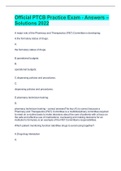
Official PTCB Practice Exam - Answers – Solutions 2022A major role of the Pharmacy and Therapeutics (P&T) Committee is developing: A.the formulary status of drugs. A. the formulary status of drugs. B.operational budgets. B. operational budgets. C.dispensing policies and procedures. C. dispensing policies and procedures. D.pharmacy technician training. D. pharmacy technician training The key (A) is correct because a Pharmacy and Therapeutics (P&T) Committee is a multidisciplinary committee required to meet on a routine basis to make decisions about the care of patients with a focus on the safe and effective use of medications; overseeing and making decisions for an institution's formulary is an example of the P&T Committee's responsibilities. Which patient monitoring function identifies drugs to avoid using together? A.Drug-drug interaction A. Drug-drug interaction B.Drug-laboratory test interaction B. Drug-laboratory test interaction C.Therapeutic intervention C. Therapeutic intervention D.Intravenous compatibility D. Intravenous compatibility The key (A) is correct because drug-drug interaction data provides information on whether drugs may be safely taken together; if not, the data may advise to monitor therapy, consider therapy modification, or avoid the combination altogether. A pharmacy technician receives the following prescription: Hydrocortisone 2.5% cream and Aquaphor in 1:1 Quantity: 4 oz total What quantity of hydrocortisone 2.5% cream, in g, should be entered on the compounding record? A.30 A. 30 B.60 B. 60 C.90 C. 90 D.120 D. 120 The key (B) is correct because a 1:1 compound contains an equal amount of both ingredients. First convert 4 oz to g and then divide the total in half. 1 oz = 30 g, so 4 oz = 120 g. 120 g divided by 2 = 60 g. According to USP Chapter 797, how should a pharmacy technician recap a needle to prevent a needle stick? A.A needle should never be recapped A. A needle should never be recapped B.A technician should use the one-hand scoop method B. A technician should use the one-hand scoop method C.A technician should hold the syringe with one hand and use the other hand to recap the needle C. A technician should hold the syringe with one hand and use the other hand to recap the needle D.A technician should only recap a needle inside the laminar airflow workstation D. A technician should only recap a needle inside the laminar airflow workstation The key (B) is correct because, although needle recapping should be avoided when possible, sometimes a pharmacy technician may need to recap a needle (for example, if a sharps container is not immediately available). In these situations, the one-hand scoop method should be used to avoid potential contact with the needle. When withdrawing an injectable drug from a glass ampule to transfer it into a sterile empty vial, the pharmacy technician should use a: A.transfer needle. A. transfer needle. B.29-gauge needle. B. 29-gauge needle. C.needle with filter paper. C. needle with filter paper. D.filter needle. D. filter needle. The key (D) is correct because filter needles must be used to withdraw solutions from ampules. This is because filter needles are able to keep glass or paint chips that may have fallen into the solution when the ampule's neck was broken from being drawn into the syringe. A regular needle may then be used to inject the drug into a sterile vial. Upon obtaining initial patient information, the pharmacy technician should: A.review the information with other pharmacy staff to ensure clarity. A. review the information with other pharmacy staff to ensure clarity. B.ensure that the patient understands the side effects of current medication. B. ensure that the patient understands the side effects of current medication. C.recommend additional pharmacotherapy. C. recommend additional pharmacotherapy. D.document known allergies. D. document known allergies. The key (D) is correct because information collected from a new patient and documented in the pharmacy database should include the patient's name, address, telephone number, insurance information, date of birth, and known drug allergies. Which of the following products must be dispensed in its original container? A.Oxycodone 30 mg sustained release tablets A. Oxycodone 30 mg sustained release tablets B.Isosorbide mononitrate 30 mg sustained release tablets B. Isosorbide mononitrate 30 mg sustained release tablets C.Oxycodone 5 mg immediate release tablets C. Oxycodone 5 mg immediate release tablets D.Nitroglycerin 0.4 mg sublingual tablets D. Nitroglycerin 0.4 mg sublingual tablets The key (D) is correct because nitroglycerin sublingual tablets should be kept in the original glass container and tightly capped after each use to prevent loss of tablet potency. Distractors (A), (B), and (C) do not need to be dispensed in their original containers. When medication is repackaged, a record is kept for: A.recall and quality assurance. A. recall and quality assurance. B.staff performance evaluations. B. staff performance evaluations. C.drug distribution efficiencies. C. drug distribution efficiencies. D.cost control analyses. D. cost control analyses. The key (A) is correct because repackaging records should include information such as lot or batch number and the procedures followed during repackaging. Lot or batch number information is used to identify affected products during recalls, and documentation of procedures followed during repackaging is used to verify quality assurance. A pharmacy technician receives a prescription for Dilaudid 4 mg tablets DAW. The pharmacy is out of Dilaudid. The technician fills the prescription with hydromorphone. The pharmacist performs the final check and tells the technician that hydromorphone cannot be dispensed because: A.the pharmacist cannot substitute any medications due to "the patient's right." A. the pharmacist cannot substitute any medications due to "the patient's right." B.generic substitution is not authorized by prescriber. B. generic substitution is not authorized by prescriber. C.the prescription is written as Dilaudid, not hydromorphone. C. the prescription is written as Dilaudid, not hydromorphone. D.hydromorphone and Dilaudid are two different Schedule controlled substances. D. hydromorphone and Dilaudid are two different Schedule controlled substances. The key (B) is correct because "DAW" is an abbreviation for "Dispense as Written," a notation that indicates that the prescriber wants only the medication named on the prescription to be dispensed. This means that brand name Dilaudid must be dispensed for this prescription; Dilaudid's generic, hydromorphone, is not authorized by the prescriber. The pharmacy computer database should include all of the following except: A.patient allergy information. A. patient allergy information. B.patient Social Security numbers. B. patient Social Security numbers. C.prescriber NPI numbers. C. prescriber NPI numbers. D.prescriber DEA numbers. D. prescriber DEA numbers. The key (B) is correct because patient Social Security numbers should not be stored in a pharmacy database for privacy reasons. Distractors (A), (C), and (D) are all vital information for the safe and accurate processing of prescription orders. A pharmacy technician receives a telephone call from a worried patient who heard on the news that an inhaler is being recalled. The technician should tell the patient to: A.discard any of this medication on hand and request a refill. A. discard any of this medication on hand and request a refill. B.continue to use the medication on hand if it seems to be working. B. continue to use the medication on hand if it seems to be working. C.contact the prescriber to consider a therapy change. C. contact the prescriber to consider a therapy change. D.bring the medication to the pharmacy to check the lot number and manufacturer. D. bring the medication to the pharmacy to check the lot number and manufacturer. The key (D) is correct because items affected by a recall may be identified using the product's National Drug Code (NDC) number (which includes manufacturer information) and lot or batch number. Further action may then be taken if necessary. Which of the following is the best strategy for reducing the possibility of dispensing errors when utilizing narcotics in nursing wards? A.Reduce the number of dose check systems A. Reduce the number of dose check systems B.Limit the opiates available on floor stock B. Limit the opiates available on floor stock C.Keep Safety Data Sheets on hand for all narcotics C. Keep Safety Data Sheets on hand for all narcotics D.Perform monthly controlled medication inventories D. Perform monthly controlled medication inventories The key (B) is correct because the Institute for Safe Medication Practices (ISMP) includes narcotics/opioids on its list of high-alert medications in acute care settings; suggested strategies to avoid errors include standardizing the ordering, storage, preparation, and administration of these products. Which of the following activities may be performed by a clinically oriented pharmacy technician on a nutrition service? A.Procuring patients' serum chemistry values to assist pharmacists in monitoring TPN formulations A. Procuring patients' serum chemistry values to assist pharmacists in monitoring TPN formulations B.Initiating a change in the electrolyte composition of the solution based on the patients' serum chemistry values B. Initiating a change in the electrolyte composition of the solution based on the patients' serum chemistry values C.Interpreting patients' serum chemistry values and notifying the physician C. Interpreting patients' serum chemistry values and notifying the physician D.Counseling patients on their nutritional status D. Counseling patients on their nutritional status The key (A) is correct because retrieving information falls within pharmacy technicians' scope of practice. Distractors (B), (C), and (D) all require professional judgment and therefore fall outside pharmacy technicians' scope of practice. The brand name for nizatidine is: A.Tagamet. A. Tagamet. B.Pepcid. B. Pepcid. C.Axid. C. Axid. D.Zantac. D. Zantac. The key (C) is correct because Axid is the brand name for nizatidine. Distractor (A) is the brand name for cimetidine, distractor (B) is the brand name for famotidine, and distractor (D) is the brand name for ranitidine. According to the ISMP, which of the following drug classifications is considered high-alert in a community pharmacy setting? A.Antipsychotics A. Antipsychotics B.Antiretrovirals B. Antiretrovirals C.Antiemetics C. Antiemetics D.Diuretics D. Diuretics The key (B) is correct because antiretrovirals appear on the Institute for Safe Medication Practice's (ISMP's) list of high-alert medications in community/ambulatory healthcare. Distractors (A), (C), and (D) do not. A pharmacy receives the following prescription: Ciprofloxacin 0.3% solution #1 bottle Sig: 1-2 drops OS q2h while awake for 2 days then 1-2 drops q4h while awake for the next 5 days Where is the patient instructed to use the medication? A.Left ear A. Left ear B.Right ear B. Right ear C.Left eye C. Left eye D.Right eye D. Right eye The key (C) is correct because OS comes from the Latin "oculus sinister," meaning left eye. Distractor (A) would be AS (from "auris sinister"), distractor (B) would be AD (from "auris dexter"), and distractor (D) would be OD (from "oculus dexter"). However, it should be noted that all of these abbreviations are error-prone and should not be used. A physician writes a prescription for "lactulose syrup 1 tbsp PO b.i.d." What volume, in mL, should the patient take per day? A.5 A. 5 B.10 B. 10 C.30 C. 30 D.60 D. 60 The key (C) is correct and can be calculated as follows. First, interpret the prescription directions. "Tbsp" means "tablespoon," which equals 15 mL, and "b.i.d." means "twice a day." Therefore, the patient is directed to take 15 mL by mouth twice a day. 15 mL x two doses = 30 mL per day. A pharmacy receives the following prescription: Suboxone 8 mg/2 mg SL film #60 Sig: 2 films SL once a day How should this medication be used? A.Subcutaneously A. Subcutaneously B.On the tongue B. On the tongue C.Under the tongue C. Under the tongue D.Rectally D. Rectally The key (C) is correct because SL comes from the Latin "sublingual," which means under the tongue. Distractor (A) can be abbreviated as SC, SQ, or subq (although these abbreviations are error-prone and should be avoided), distractor (B) does not have a specific abbreviation (although tablets to be taken on the tongue are called "ODT" or "orally disintegrating tablets"), and distractor (D) would be PR (from "per rectum"). Which of the following references would provide a pharmacy technician with information about identifying foreign drugs? A.Drug Facts and Comparisons A. Drug Facts and Comparisons B.Martindale: The Complete Drug Reference B. Martindale: The Complete Drug Reference C.Remington: The Science and Practice of Pharmacy C. Remington: The Science and Practice of Pharmacy D.Physicians' Desk Reference D. Physicians' Desk Reference The key (B) is correct because Martindale: The Complete Drug Reference provides information on over 6000 drugs in clinical use around the world. Distractors (A), (B), and (C) do not include information on foreign drugs. Which of the following is the correct term for the number of times that a pharmacy's entire stock is used and replaced within a certain period of time, such as a year? A.Turnover rate A. Turnover rate B.Purchasing rate B. Purchasing rate C.Inventory rate C. Inventory rate D.Stocking rate D. Stocking rate The key (A) is correct because turnover rate is defined as the number of times inventory is sold or used in a time period such as a year; it can be calculated by dividing the cost of goods sold or net sales by the average inventory. Upon receipt of a medication order, two important steps should be taken, which include reviewing the order for: A.completeness and prioritizing the order based upon urgency. A. completeness and prioritizing the order based upon urgency. B.dangerous abbreviations and placing the order in sequential order. B. dangerous abbreviations and placing the order in sequential order. C.special handling precautions and contacting the onsite OSHA representative. C. special handling precautions and contacting the onsite OSHA representative. D.REMS and calling the appropriate insurance number. D. REMS and calling the appropriate insurance number. The key (A) is correct because new medication orders must be reviewed for completeness and clarity, meaning that all required information is present and legible, and prioritized on the basis of a number of factors, including the time the medication is needed, the seriousness of the condition being treated, and the urgency of the other orders waiting to be processed. An important step that helps ensure that prescriptions are filled for and dispensed to the correct patient is: A.prescription prioritization. A. prescription prioritization. B.patient identification. B. patient identification. C.principal diagnosis. C. principal diagnosis. D.patient profiling. D. patient profiling. The key (B) is correct because patient identifiers such as full name and date of birth are used to determine the correct patient profile to use for data entry as well as to confirm that a prescription is dispensed to the correct patient. If 30 g of 0.5% hydrocortisone ointment is combined with 15 g of 2.5% hydrocortisone ointment, what is the percentage of the drug in the final product? A.0.012% A. 0.012% B.0.117% B. 0.117% C.1.17% C. 1.17% D.11.67% D. 11.67% The key (C) is correct and can be calculated as follows. First, determine how many g of hydrocortisone are contained in each component. Convert percentages to decimals by moving the decimal point 2 places to the left. 0.005 x 30 g = 0.15 g of hydrocortisone in 30 g of 0.5% hydrocortisone 0.025 x 15 g = 0.375 g of hydrocortisone in 15 g of 2.5% hydrocortisone Next, add those sums to find how many g of hydrocortisone are in how many g of final product: 0.15 g of hydrocortisone + 0.375 g of hydrocortisone = 0.525 g of hydrocortisone 30 g of 0.5% hydrocortisone + 15 g of 2.5% hydrocortisone = 45 g of total product Finally, divide to find how much hydrocortisone is in the final product and multiply by 100%: 0.525 g of hydrocortisone ÷ 45 g of total product = 0.0117 x 100% = 1.17% hydrocortisone In order to minimize the risk of contamination by pathogens, hospital staff should: A.make all chemotherapeutic preparations under a horizontal laminar flow hood. A. make all chemotherapeutic preparations under a horizontal laminar flow hood. B.follow procedures to ensure that infectious agents are handled and disposed of properly. B. follow procedures to ensure that infectious agents are handled and disposed of properly. C.dispose of bloodstained dressings in a regular trash can to be emptied daily. C. dispose of bloodstained dressings in a regular trash can to be emptied daily. D.place all infected patients into reverse isolation. D. place all infected patients into reverse isolation. The key (B) is correct because pathogens are microorganisms (such as bacteria, viruses, and fungi) that can cause disease and must be handled and disposed of safely in order to avoid infection. When submitting a claim to Medicare for Zostavax administration, which professional service code should be sent for appropriate reimbursement to occur? A.MA A. MA B.M0 B. M0 C.2B C. 2B D.1C D. 1C The key (A) is correct because MA (medication administration) is the professional service code that must be submitted on a claim for Zostavax in order for Medicare to reimburse for administration by pharmacy staff. Distractor (B) is a professional service code that indicates that the prescriber has been consulted, distractor (C) is a result of service code meaning that the prescription has been clarified but not filled, and distractor (D) is a result of service code meaning that the prescription has been filled with a different dose. When a pharmacy order is received, the shipment should be inspected for: A.inclusion of samples. A. inclusion of samples. B.attached package inserts. B. attached package inserts. C.completeness. C. completeness. D.manufacturer rebates. D. manufacturer rebates. The key (C) is correct because all medications and supplies included in a shipment must be checked against an inventory list or shipping invoice to verify that all expected items have been received and that no unexpected items are present. Medicare Part D requires a patient to have which of the following to be eligible? A.Low income A. Low income B.Medicaid B. Medicaid C.Previous employment C. Previous employment D.Medicare Parts A and/or B D. Medicare Parts A and/or B The key (D) is correct because having Medicare Part A (hospital insurance) and/or Part B (medical insurance) is an eligibility requirement for enrolling in Medicare Part D (prescription drug coverage). Distractors (A), (B), and (C) are not eligibility requirements for receiving Medicare coverage. The pharmacy technician should suspect the possibility of a counterfeit medication if the: A.last two digits of the NDC number change. A. last two digits of the NDC number change. B.manufacturer's container indicates "new color" on the label. B. manufacturer's container indicates "new color" on the label. C.bottle is written in English but manufactured out of the country. C. bottle is written in English but manufactured out of the country. D.patient reports that the drug tastes or looks different and does not work as well. D. patient reports that the drug tastes or looks different and does not work as well. The key (D) is correct because a patient experiencing a new side effect or lack of therapeutic effect may indicate that a medication is a counterfeit. Distractors (A), (B), and (C) are common occurrences and should not cause concern unless coupled with other factors. Which of the following would be an appropriate source to consult regarding the handling of glacial acetic acid? A.Safety Data Sheets A. Safety Data Sheets B.Physicians' Desk Reference B. Physicians' Desk Reference C.Drug Facts and Comparisons C. Drug Facts and Comparisons D.Trissel's Handbook on Injectable Drugs D. Trissel's Handbook on Injectable Drugs The key (A) is correct because glacial acetic acid is a hazardous substance, and Safety Data Sheets (formerly known as Material Safety Data Sheets) contain safety information regarding hazardous chemicals, including instructions for their handling and storage. Distractor (B) is a compilation of package inserts, distractor (C) provides drug data and clinical information for healthcare professionals, and distractor (D) provides IV compatibility and stability information. What quantity, in mL, of 3% acetic acid must be mixed with 15% acetic acid to give 2500 mL of 10% acetic acid? A.1040 A. 1040 B.1460 B. 1460 C.2080 C. 2080 D.2460 D. 2460 The key (A) is correct and can be calculated using the alligation method. 15% 7 parts of 15% acetic acid 10% + 3% 5 parts of 3% acetic acid 12 parts total The calculation above is set up by putting the higher concentration on the top (15%), the lower concentration on the bottom (3%), and the desired concentration in the middle (10%). Subtract the desired concentration from the higher concentration to find out how many parts of the lower concentration are needed (15% - 10% = 5 parts of 3% acetic acid). Then, subtract the lower concentration from the desired concentration to find out how many parts of the higher concentration are needed (10% - 3% = 7 parts of 15% acetic acid). Next, divide the total quantity of the product (2500 mL) by the total number of parts (12 parts) to determine mL per part: 2500 mL/12 parts = 208 mL/part Finally, multiply 5 parts of 3% acetic acid by one part of the final product to determine total mL of 3% acetic acid necessary: 5 parts of 3% acetic acid x 208 mL/part = 1040 mL A particular manufacturer packages metoprolol succinate 100 mg tablets with an NDC of . If a pharmacy technician wants to receive rosuvastatin 10 mg tablets from the same manufacturer, which of the following NDCs should they order? A. A. B. B. C. C. D. D. The key (D) is correct because the first segment of an NDC is the labeler (manufacturer or distributor) code. The second segment of an NDC is the product code, while the third segment is the package code. The first segment in the key is the only option that matches the first segment in the stem. According to federal law, a complete inventory of the controlled substances on hand in a pharmacy must be made every: A.month. A. month. B.6 months. B. 6 months. C.year. C. year. D.2 years. D. 2 years. The key (D) is correct because Title 21 Code of Federal Regulations (Part 1304) requires pharmacies to take a new inventory of all stocks of controlled substances on hand at least every two years (biennially). The generic name for Aldactone is: A.acetazolamide. A. acetazolamide. B.spironolactone. B. spironolactone. C.aminocaproic acid. C. aminocaproic acid. D.simethicone. D. simethicone. The key (B) is correct because spironolactone is the generic name for Aldactone. Distractor (A) is the generic name for Diamox Sequels, distractor (C) is the generic name for Amicar, and distractor (D) is the generic name for OTC products like Gas-X and Phazyme A patient presents a new prescription order for labetalol. The patient's computer profile shows the following medications: glyburide, albuterol, furosemide, atenolol, and amlodipine. The labetalol prescription order is a therapeutic duplication of: A.amlodipine. A. amlodipine. B.atenolol. B. atenolol. C.furosemide. C. furosemide. D.albuterol. D. albuterol. The key (B) is correct because both labetolol and atenolol are beta blockers. Distractor (A) is a calcium channel blocker, distractor (C) is a diuretic, and distractor (D) is a beta2 agonist. How many 250 mg tablets of metronidazole are needed to make 150 mL of suspension containing 100 mg/mL? A.25 A. 25 B.30 B. 30 C.50 C. 50 D.60 D. 60 The key (D) is correct and can be calculated as follows. First, find the total mg of metronidazole needed in the final product by setting up a proportion: x/150 mL = 100 mg/1 mL x = 15,000 mg Next, divide to find how many 250 mg tablets of metronidazole are needed to total 15,000 mg: 15,000 mg/250 mg per tablet = 60 tablets What is the most important step to ensure proper payment from a third-party payer when a pharmacy technician receives and processes a prescription? A.Obtaining prior authorization from the insurance provider A. Obtaining prior authorization from the insurance provider B.Having the Pharmacy Care Manager review prior to dispensing B. Having the Pharmacy Care Manager review prior to dispensing C.Entering prescription information into the system as written C. Entering prescription information into the system as written D.Clearing the prescription through the senior pharmacist D. Clearing the prescription through the senior pharmacist The key (C) is correct because reimbursement from third-party payers is subject to audits to determine whether prescription information (including directions, quantity, and days supply) has been submitted in a way that accurately reflects what the prescriber wrote. Distractors (A), (B), and (D) may also play a role in reimbursement, but they do not describe the most important step in obtaining and maintaining reimbursement. A pharmacy technician receives the following order: Synalar crm 0.01% 30 g Menthol 300 mg Salicylic acid 2% Sulfur 2% White petrolatum q.s. ad 120 g Sig: Apply to scalp ut dict How much white petrolatum, in g, should be used to compound this prescription? A.75 A. 75 B.80 B. 80 C.85 C. 85 D.90 D. 90 The key (C) is correct and can be calculated as follows. The abbreviation "q.s. ad," from the Latin "quantum sufficit ad," means that enough white petrolatum should be added to the other ingredients to total 120 g of final product. Find how much of each other ingredient is required, then subtract that amount from 120 g to determine how much white petrolatum is necessary. 30 g Synalar + 0.3 g Menthol (300 mg ÷ 1000 mg/g = 0.3 g) + 2.4 g Salicylic acid (0.02 x 120 g = 2.4 g) + 2.4 g Sulfur (0.02 x 120 g = 2.4 g) 35.1 g (rounds to 35 g) 120 g - 35 g = 85 g white petrolatum. How many grams of dextrose are contained in 400 mL of 70% dextrose solution? A.120 A. 120 B.280 B. 280 C.400 C. 400 D.700 D. 700 The key (B) is correct and can be calculated as follows. A 70% dextrose solution means that there are 70 g of dextrose per 100 mL of solution. Set up a proportion to find how many g of dextrose are in 400 mL of solution. 70 g/100 mL = x/400 mL x = 280 g
Written for
- Institution
- PTCB
- Course
- PTCB
Document information
- Uploaded on
- November 27, 2022
- Number of pages
- 73
- Written in
- 2022/2023
- Type
- Exam (elaborations)
- Contains
- Questions & answers
Subjects
-
official ptcb practice exam answers – solutions 2022
-
a major role of the pharmacy and therapeutics pampt committee is developing athe formulary status of drugs a the formulary status of d

Also available in package deal