

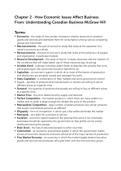
Chapter 2 - How Economic Issues Affect Business
From: Understanding Canadian Business McGraw Hill
Terms:
• Economics - the study of how society chooses to employ resources to produce
goods and services and distribute them for consumption among various competing
groups and individuals.
• Macroeconomics - the part of economic study that looks at the operation of a
nation’s economy as a whole.
• Microeconomics - the part of economic study that looks at the behaviour of people
and organization in particular markets.
• Resource Development - the study of how to increase resources and the creation of
the conditions that will make better use of those resources (eg, recycling)
• Invisible Hand - a phrase coined by Adam Smith to describe the process that turns
self-directed gain into social and economic benefit for all.
• Capitalism - an economic system in which all or most of the factors of production
and distribution are privately owned and operated for profit.
• State Capitalism - a combination of freer markets and some government control.
• Supply - quantity of products that manufacturers or owners are willing to sell at
different prices at a specific time
• Demand - the quantity of products that people are willing to buy at different prices
at a specific time.
• Market Price - the price determined by supply and demand
• Perfect Competition - the market situation in which there are many sellers in a
market and no seller is large enough the dictate the price of the product
• Monopolistic Competition - large number of sellers products very similar products
that buyers nevertheless perceive as different
• Oligopoly - form of competition in which just a few sellers dominate the market
• Monopoly - one seller for a product or service
• Socialism - economic system based on the premise that some if not most basic
businesses should be opened by the government so that profits can be evenly
distributed among the people.
• Brain Drain - the loss of educated people to other countries
• Communism - an economic and political system in which the government makes
almost all economic decisions and owns almost all of the major factors of production.
• Free Market Economy - an economy in which the market largely determines what
goods and services are produced, who gets them and how the economy grows.
, • Command Economy - an economy in which the government largely decides what
goods and services are produced, who gets them and how the economy will grow.
• Mixed Economies - economic systems in which some allocation of resources is made
by the market and some by the government.
• Gross Domestic Product (GDP) - the total value of goods and services produced in
a country in a given year.
• Unemployment Rate - the percentage of the labor force that actively seeks work but
is unable to find work at a given time.
Topics
How Economic Conditions Affect Business
- a major part of business success is due to an economic and social climate that allows
businesses to operate freely. Foreign investors like Canada because we have a stable
economic and political environment. Investing is risky enough without having to
worry about unpredictable governments, massive corruption, and weak laws.
Therefore any change in our economic or political system can have a major influence
on businesses.
- Global economic and global politics also have a major influence on businesses in
Canada.
What is Economics
- the study of how society chooses to employ resources to produce goods and
services and distribute them for consumption among various competing groups and
individuals (remember from chapter 1, they are called factors of production)
- Businesses may contribute to an economic system by inventing products that greatly
increase available resources, as some economists define economics as the allocation
of “scarce” resources. Therefore the greater quantity, the less scarce.
- 2 major branches of economics, micro and macro (definitions in list)
Secret to Creating a Wealthy Economy
- Thomas Malthus theory (1700s) is that the growing population is bad and there there
are too many people in the world, where he then gave the solution of radical birth
control and forced abortions.
- Macroeconomics believe that the large population, especially one that is educated,
is a valuable resource.
- Adam Smith Theories
From: Understanding Canadian Business McGraw Hill
Terms:
• Economics - the study of how society chooses to employ resources to produce
goods and services and distribute them for consumption among various competing
groups and individuals.
• Macroeconomics - the part of economic study that looks at the operation of a
nation’s economy as a whole.
• Microeconomics - the part of economic study that looks at the behaviour of people
and organization in particular markets.
• Resource Development - the study of how to increase resources and the creation of
the conditions that will make better use of those resources (eg, recycling)
• Invisible Hand - a phrase coined by Adam Smith to describe the process that turns
self-directed gain into social and economic benefit for all.
• Capitalism - an economic system in which all or most of the factors of production
and distribution are privately owned and operated for profit.
• State Capitalism - a combination of freer markets and some government control.
• Supply - quantity of products that manufacturers or owners are willing to sell at
different prices at a specific time
• Demand - the quantity of products that people are willing to buy at different prices
at a specific time.
• Market Price - the price determined by supply and demand
• Perfect Competition - the market situation in which there are many sellers in a
market and no seller is large enough the dictate the price of the product
• Monopolistic Competition - large number of sellers products very similar products
that buyers nevertheless perceive as different
• Oligopoly - form of competition in which just a few sellers dominate the market
• Monopoly - one seller for a product or service
• Socialism - economic system based on the premise that some if not most basic
businesses should be opened by the government so that profits can be evenly
distributed among the people.
• Brain Drain - the loss of educated people to other countries
• Communism - an economic and political system in which the government makes
almost all economic decisions and owns almost all of the major factors of production.
• Free Market Economy - an economy in which the market largely determines what
goods and services are produced, who gets them and how the economy grows.
, • Command Economy - an economy in which the government largely decides what
goods and services are produced, who gets them and how the economy will grow.
• Mixed Economies - economic systems in which some allocation of resources is made
by the market and some by the government.
• Gross Domestic Product (GDP) - the total value of goods and services produced in
a country in a given year.
• Unemployment Rate - the percentage of the labor force that actively seeks work but
is unable to find work at a given time.
Topics
How Economic Conditions Affect Business
- a major part of business success is due to an economic and social climate that allows
businesses to operate freely. Foreign investors like Canada because we have a stable
economic and political environment. Investing is risky enough without having to
worry about unpredictable governments, massive corruption, and weak laws.
Therefore any change in our economic or political system can have a major influence
on businesses.
- Global economic and global politics also have a major influence on businesses in
Canada.
What is Economics
- the study of how society chooses to employ resources to produce goods and
services and distribute them for consumption among various competing groups and
individuals (remember from chapter 1, they are called factors of production)
- Businesses may contribute to an economic system by inventing products that greatly
increase available resources, as some economists define economics as the allocation
of “scarce” resources. Therefore the greater quantity, the less scarce.
- 2 major branches of economics, micro and macro (definitions in list)
Secret to Creating a Wealthy Economy
- Thomas Malthus theory (1700s) is that the growing population is bad and there there
are too many people in the world, where he then gave the solution of radical birth
control and forced abortions.
- Macroeconomics believe that the large population, especially one that is educated,
is a valuable resource.
- Adam Smith Theories


