, Week 1 | measurement, scaling and norms
Literature
Furr chapters 1 – 3
Definition of psychometrics: The science concerned with evaluating the attributes of
psychological tests.
Difference experimental and differential psychology:
o Experimental psychology focuses on ‘the average person’, individual differences =
noise/error.
o Differential psychology mostly concerns itself with measuring the differences
between people, comparing measurements.
Measurement: the assignment of numerals to objects or events according to rules
Scaling: concerns the way numerical values are assigned to psychological attributes.
Sum of squares: ∑ ¿¿
Variance: s =∑ ¿ ¿ ¿ Square root of variance gives standard deviation.
2
Covariance: represents the degree of association between the variability in two distributions
of scores.
o c xy =
∑ ( x−x ) ( y− y )
N −1
Product-moment correlation: represents the association between two variables much more
clearly than covariance
c xy
o r xy =
sx s y
Measurement scales
o Nominal: identity (categories, mutually exclusive and exhaustive)
o Ordinal: plus an order
o Interval: plus quantity (measuring unit)
o Ratio: plus absolute zero
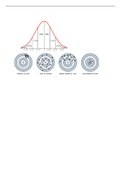
Z-score: number of SD from the mean
o Mean = 0
SD = 1
X−M x
o Zx=
SD x
o Add to paper: formula for SD
T-score: easier to understand, friendlier than Z-scores. Only positive outcomes.
o Mean = 50
SD = 10
o T x =10 × Z x +50
Percentile ranks Px : percentage of scores equal or lower than specific test score.
Interindividual differences: comparing different people.
Intraindividual differences: comparing within people.
,
Literature
Furr chapters 1 – 3
Definition of psychometrics: The science concerned with evaluating the attributes of
psychological tests.
Difference experimental and differential psychology:
o Experimental psychology focuses on ‘the average person’, individual differences =
noise/error.
o Differential psychology mostly concerns itself with measuring the differences
between people, comparing measurements.
Measurement: the assignment of numerals to objects or events according to rules
Scaling: concerns the way numerical values are assigned to psychological attributes.
Sum of squares: ∑ ¿¿
Variance: s =∑ ¿ ¿ ¿ Square root of variance gives standard deviation.
2
Covariance: represents the degree of association between the variability in two distributions
of scores.
o c xy =
∑ ( x−x ) ( y− y )
N −1
Product-moment correlation: represents the association between two variables much more
clearly than covariance
c xy
o r xy =
sx s y
Measurement scales
o Nominal: identity (categories, mutually exclusive and exhaustive)
o Ordinal: plus an order
o Interval: plus quantity (measuring unit)
o Ratio: plus absolute zero
Z-score: number of SD from the mean
o Mean = 0
SD = 1
X−M x
o Zx=
SD x
o Add to paper: formula for SD
T-score: easier to understand, friendlier than Z-scores. Only positive outcomes.
o Mean = 50
SD = 10
o T x =10 × Z x +50
Percentile ranks Px : percentage of scores equal or lower than specific test score.
Interindividual differences: comparing different people.
Intraindividual differences: comparing within people.
,