

RESTORATIVE JUSTICE: UNIT 7
Restorative justice (RJ):
Is a different lens through which to view crime & justice. According to this perspective crime
should be viewed as a violation of people and relationships, rather than just breaking law.
The focus should be on putting the wrong right, rather than imposing punishment.
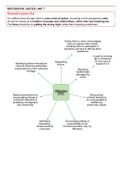
Giving them a voice, encouraging
them to express their needs,
enabling them to participate in
resolution process & offering them
assistance
In part by arriving
@ a consensus
Supporting on how best to
Identifying factors that lead to victims. respond to it.
crime & informing authorities
responsible for crime reduction Repairing
strategy. relationships
damaged by
crime:
Objectives
of RJ:
Reducing recidivism by Denouncing
encouraging change in criminal behaviour
individual offenders & as unacceptable &
facilitating reintegration reaffirming
into community community values
Identifying Encouraging taking of
restorative, responsibility by all
forward-looking concerned parties, esp. by
outcomes offenders
, Restorative justice and policy [Read this section on pages 116 and 117]
Why this interest in RJ?
The facts indicate below = need for a radical reconceptualization of justice, & that is the aim
of RJ.
(e.g. time it takes to respond to calls,
X wanting to record a case,
insensitive treatment, being offender
centred, X apprehending offender,
offender X being prosecuted).
It’s postulated that many ppl. Many victims X trust
realise that imprisonment is CJS
X necessarily answer, & that Victims often feel
retribution is X only need of excluded from process,
victims. even though they are ppl.
most affected by crime.
Interest
in RJ
Many feel that needs of those who Many argue that state owns the
have suffered, whether emotional / case & is only concerned about
material are X really a matter of what laws have been broken & that
concern. guilty person is appropriately
punished.
Access to justice &
fair treatment
Contact w/ CJS
(Want to be safe from perpetrator and
Safety his/her family & know how to prevent
repeat victimisation).
Needs of crime
Give & receive information
victims
(Practical assistance, emotional
Assistance & services support, counselling, services &
shelter).
To have a voice.
Validation & acknowledgement
Restitution & apology.
Answers to questions: Why me?
Restorative justice (RJ):
Is a different lens through which to view crime & justice. According to this perspective crime
should be viewed as a violation of people and relationships, rather than just breaking law.
The focus should be on putting the wrong right, rather than imposing punishment.
Giving them a voice, encouraging
them to express their needs,
enabling them to participate in
resolution process & offering them
assistance
In part by arriving
@ a consensus
Supporting on how best to
Identifying factors that lead to victims. respond to it.
crime & informing authorities
responsible for crime reduction Repairing
strategy. relationships
damaged by
crime:
Objectives
of RJ:
Reducing recidivism by Denouncing
encouraging change in criminal behaviour
individual offenders & as unacceptable &
facilitating reintegration reaffirming
into community community values
Identifying Encouraging taking of
restorative, responsibility by all
forward-looking concerned parties, esp. by
outcomes offenders
, Restorative justice and policy [Read this section on pages 116 and 117]
Why this interest in RJ?
The facts indicate below = need for a radical reconceptualization of justice, & that is the aim
of RJ.
(e.g. time it takes to respond to calls,
X wanting to record a case,
insensitive treatment, being offender
centred, X apprehending offender,
offender X being prosecuted).
It’s postulated that many ppl. Many victims X trust
realise that imprisonment is CJS
X necessarily answer, & that Victims often feel
retribution is X only need of excluded from process,
victims. even though they are ppl.
most affected by crime.
Interest
in RJ
Many feel that needs of those who Many argue that state owns the
have suffered, whether emotional / case & is only concerned about
material are X really a matter of what laws have been broken & that
concern. guilty person is appropriately
punished.
Access to justice &
fair treatment
Contact w/ CJS
(Want to be safe from perpetrator and
Safety his/her family & know how to prevent
repeat victimisation).
Needs of crime
Give & receive information
victims
(Practical assistance, emotional
Assistance & services support, counselling, services &
shelter).
To have a voice.
Validation & acknowledgement
Restitution & apology.
Answers to questions: Why me?



