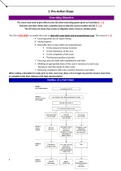
1: Pre-Action Steps
Overriding Objective
The court must seek to give effect to the OO when exercising power given to it by Rules (r 1.2)
Solicitors and their clients have a positive duty to help the court to further the OO (r 1.3).
The OO does not mean that a party to litigation owes a duty to another party.
The OO of CPR 1998 is to enable the court to deal with cases justly and at proportionate cost. This means (r 1.1):
Ensuring parties are on equal footing
Saving expense
Deal with cases in ways which are proportionate
To the amount of money involved
To the importance of the case
To the complexity of the issues
The financial position of parties
Ensuring cases are dealt with expeditiously and fairly
Allotting an appropriate share of the court’s resources to each case,
bearing in mind the needs of other cases
Enforcing compliance with rules, practice directions and orders
When setting a timetable for tasks prior to trial, court may allow a D w/o legal rep and low income more time
to complete tasks than claimant with legal representation.
Outline of a Civil Claim
1
, Pre-action Steps
STEP
1) Check any professional The solicitor acting in civil proceedings must have regard to the follow rules of
conduct points page 14 professional conduct:
Duty of confidentiality:
6.3 SRA Code of Conduct 2019 – keep affairs of current and former clients
confidential unless disclosure permitted by law or client consents
Conflict of interest:
6.2 SRA Code of Conduct 2019 – do not act if there is a risk of a conflict of
interest or if there is a conflict
Money laundering:
Proceeds of Crime Act 2002. Must ensure adequate procedures are in place to
check new client’s identity.
Who the client is and authorisation to act:
If receives instructions from someone other than client, or by only one client on
behalf of others, should not proceed without checking all clients agree with
instructions given.
Solicitor’s duty as an officer of the court:
- Duty not to mislead the court or your clients (1.4 of the Code)
- Must disclose all relevant legal authorities to the court, even if not
favourable to case.
- Help court achieve the overriding objective (r.1.3).
Solicitor’s core duties:
The SRA Code of Conduct 2019 is based on certain mandatory principles.
1. Act in a way that upholds the constitutional principle of RoL and proper
administration of justice
2. Act in a way that upholds public trust and confidence in the solicitors’
profession and in legal services provided by authorised persons
3. Independence
4. Honesty
5. Integrity
6. Equality, diversity & inclusion
7. Clients’ best interests
2) Identify the client’s - What does the client want?
objectives - What realistically can be achieved?
3) Identify and locate, if
necessary, all potential
parties
4) Check the financial - Will the defendant be able to pay any judgment and costs?
viability of the - What assets are available?
defendant
5) Check jurisdiction - Any relevant contractual clauses?
- Are one or more parties outside the jurisdiction?
6) Assess limitation - Any relevant contractual clause?
periods
Basic rules: Limitation Act 1980
2
, Types of claim Statutory limitation period
Contract 6 years (s5)
(excluding personal injury) as soon as breach of contract
occurs
Tort 6 years (s2)
(excluding personal injury and when the tort is committed
latent damage) when some damage occurs (for
negligence)
Latent damage (ONLY 6 years or 3 years from date of
NEGLIGENCE) knowledge (s14A)
In non-personal injury claim Long-stop limitation period of
based on negligence where the 15 years from date of alleged
damage is latent (NOT AWARE breach of duty (s14B)
OF IT) at the date when the
cause of action accrues
7) Discuss and agree Explore all options - See funding notes.
funding with the client
8) Collect and preserve - Where are relevant documents located?
evidence - Is pre-action disclosure required?
Prospective C might need to see docs held by the potential D who is
unwilling to show them voluntarily
Application for disclosure of docs prior to the start of proceedings is
permitted under s33 of the Senior Courts Act 1981 or s52 of the
County Courts Act 1984
- Is a preservation of evidence order required?
- What witnesses can proofs of evidence be taken from?
- Is an expert’s report needed?
- Are business’s accounts needed?
- Are photographs or a site visit needed?
Disclosure statement
An individual must sign: A party is under an obligation to disclose documents
that might adversely affect his own or support another party’s case.
Essential that parties comply fully and honestly with requirements of
disclosure (r 31.10(5)).
Has to sign statement:
o Setting out the extent of the search that has been made to locate the
documents;
o Certifying he understands the duty to disclose documents;
o Certifying to the best of his knowledge, he has carried out that duty.
Contempt of court
o Proceedings may be brought under this against a person who makes
or causes to be made a false disclosure statement without honest
belief in its truth.
Solicitor’s duties
o Practice Direction 31A states if the disclosing party has a legal
representative acting for him, the legal representative must endeavor
to ensure that the person making the disclosure statement
understands the duty of disclosure.
Duty to advise his client as to the requirements.
Confirm advice in writing
Continuing disclosure obligation
o Continues until the proceedings are concluded.
3
, 11) Carry out the necessary
legal research
12) Do a case analysis i) Identified all potential causes of action
ii) For each element, identified all factual issues
iii) What is the likelihood of success?
iv) What further evidence is needed?
Who is the client?
Who is the opponent?
What is the cause of action?
13) Write a letter of advice
to the client
summarizing analysis
and advising on options
14) Explore possible See ADR notes.
methods of ADR
15) Comply with any See pre-action protocol notes.
approved pre-action
protocol requirements
or the Practice Direction
16) Keep client informed
17) Should the client make a Treated as ‘without prejudice except as to costs’
Part 36 offer? Can be made before or during proceedings (r 36.7(1))
(settlement offer) If offer rejected and party does not end up with a better deal, may suffer
severe financial penalties
N.B. party can make offer to settle in whatever way they choose
Alternative Methods of Dispute Resolution – page 55
N.B. Check if there is a contractual ADR.
Arbitration
Adjudication operating outside normal court process, by which a 3rd party reaches a decision which is binding.
Quicker, less formal, in private, more practical, confidential.
However, certain remedies – like injunctions – not available
Negotiation
Should consider with the client whether it is possible to negotiate a settlement with the opponent.
Voluntary and non-binding
No independent third party
Should be commenced as soon as possible.
o If attempts exhausted, should be kept under review and make appropriate attempts to resolve
the matter without issuing proceedings.
Alternative Dispute Resolution
Means of resolving dispute by using an independent third party to help the parties reach a solution.
Different to litigation because:
4
Overriding Objective
The court must seek to give effect to the OO when exercising power given to it by Rules (r 1.2)
Solicitors and their clients have a positive duty to help the court to further the OO (r 1.3).
The OO does not mean that a party to litigation owes a duty to another party.
The OO of CPR 1998 is to enable the court to deal with cases justly and at proportionate cost. This means (r 1.1):
Ensuring parties are on equal footing
Saving expense
Deal with cases in ways which are proportionate
To the amount of money involved
To the importance of the case
To the complexity of the issues
The financial position of parties
Ensuring cases are dealt with expeditiously and fairly
Allotting an appropriate share of the court’s resources to each case,
bearing in mind the needs of other cases
Enforcing compliance with rules, practice directions and orders
When setting a timetable for tasks prior to trial, court may allow a D w/o legal rep and low income more time
to complete tasks than claimant with legal representation.
Outline of a Civil Claim
1
, Pre-action Steps
STEP
1) Check any professional The solicitor acting in civil proceedings must have regard to the follow rules of
conduct points page 14 professional conduct:
Duty of confidentiality:
6.3 SRA Code of Conduct 2019 – keep affairs of current and former clients
confidential unless disclosure permitted by law or client consents
Conflict of interest:
6.2 SRA Code of Conduct 2019 – do not act if there is a risk of a conflict of
interest or if there is a conflict
Money laundering:
Proceeds of Crime Act 2002. Must ensure adequate procedures are in place to
check new client’s identity.
Who the client is and authorisation to act:
If receives instructions from someone other than client, or by only one client on
behalf of others, should not proceed without checking all clients agree with
instructions given.
Solicitor’s duty as an officer of the court:
- Duty not to mislead the court or your clients (1.4 of the Code)
- Must disclose all relevant legal authorities to the court, even if not
favourable to case.
- Help court achieve the overriding objective (r.1.3).
Solicitor’s core duties:
The SRA Code of Conduct 2019 is based on certain mandatory principles.
1. Act in a way that upholds the constitutional principle of RoL and proper
administration of justice
2. Act in a way that upholds public trust and confidence in the solicitors’
profession and in legal services provided by authorised persons
3. Independence
4. Honesty
5. Integrity
6. Equality, diversity & inclusion
7. Clients’ best interests
2) Identify the client’s - What does the client want?
objectives - What realistically can be achieved?
3) Identify and locate, if
necessary, all potential
parties
4) Check the financial - Will the defendant be able to pay any judgment and costs?
viability of the - What assets are available?
defendant
5) Check jurisdiction - Any relevant contractual clauses?
- Are one or more parties outside the jurisdiction?
6) Assess limitation - Any relevant contractual clause?
periods
Basic rules: Limitation Act 1980
2
, Types of claim Statutory limitation period
Contract 6 years (s5)
(excluding personal injury) as soon as breach of contract
occurs
Tort 6 years (s2)
(excluding personal injury and when the tort is committed
latent damage) when some damage occurs (for
negligence)
Latent damage (ONLY 6 years or 3 years from date of
NEGLIGENCE) knowledge (s14A)
In non-personal injury claim Long-stop limitation period of
based on negligence where the 15 years from date of alleged
damage is latent (NOT AWARE breach of duty (s14B)
OF IT) at the date when the
cause of action accrues
7) Discuss and agree Explore all options - See funding notes.
funding with the client
8) Collect and preserve - Where are relevant documents located?
evidence - Is pre-action disclosure required?
Prospective C might need to see docs held by the potential D who is
unwilling to show them voluntarily
Application for disclosure of docs prior to the start of proceedings is
permitted under s33 of the Senior Courts Act 1981 or s52 of the
County Courts Act 1984
- Is a preservation of evidence order required?
- What witnesses can proofs of evidence be taken from?
- Is an expert’s report needed?
- Are business’s accounts needed?
- Are photographs or a site visit needed?
Disclosure statement
An individual must sign: A party is under an obligation to disclose documents
that might adversely affect his own or support another party’s case.
Essential that parties comply fully and honestly with requirements of
disclosure (r 31.10(5)).
Has to sign statement:
o Setting out the extent of the search that has been made to locate the
documents;
o Certifying he understands the duty to disclose documents;
o Certifying to the best of his knowledge, he has carried out that duty.
Contempt of court
o Proceedings may be brought under this against a person who makes
or causes to be made a false disclosure statement without honest
belief in its truth.
Solicitor’s duties
o Practice Direction 31A states if the disclosing party has a legal
representative acting for him, the legal representative must endeavor
to ensure that the person making the disclosure statement
understands the duty of disclosure.
Duty to advise his client as to the requirements.
Confirm advice in writing
Continuing disclosure obligation
o Continues until the proceedings are concluded.
3
, 11) Carry out the necessary
legal research
12) Do a case analysis i) Identified all potential causes of action
ii) For each element, identified all factual issues
iii) What is the likelihood of success?
iv) What further evidence is needed?
Who is the client?
Who is the opponent?
What is the cause of action?
13) Write a letter of advice
to the client
summarizing analysis
and advising on options
14) Explore possible See ADR notes.
methods of ADR
15) Comply with any See pre-action protocol notes.
approved pre-action
protocol requirements
or the Practice Direction
16) Keep client informed
17) Should the client make a Treated as ‘without prejudice except as to costs’
Part 36 offer? Can be made before or during proceedings (r 36.7(1))
(settlement offer) If offer rejected and party does not end up with a better deal, may suffer
severe financial penalties
N.B. party can make offer to settle in whatever way they choose
Alternative Methods of Dispute Resolution – page 55
N.B. Check if there is a contractual ADR.
Arbitration
Adjudication operating outside normal court process, by which a 3rd party reaches a decision which is binding.
Quicker, less formal, in private, more practical, confidential.
However, certain remedies – like injunctions – not available
Negotiation
Should consider with the client whether it is possible to negotiate a settlement with the opponent.
Voluntary and non-binding
No independent third party
Should be commenced as soon as possible.
o If attempts exhausted, should be kept under review and make appropriate attempts to resolve
the matter without issuing proceedings.
Alternative Dispute Resolution
Means of resolving dispute by using an independent third party to help the parties reach a solution.
Different to litigation because:
4