Understand types, structures, reactions, uses and properties of isomers.
P4:
Isomerism can be categorised into structural isomerism and stereoisomerism.
Structural isomerism describes isomers in form of molecules which have the same molecular
formula, but the arrangement of atoms is different. Isomers can have different chemical and physical
properties.
3 types of structural isomerism:
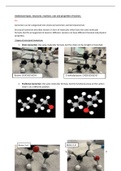
1. Chain isomerism: the same molecular formula, but the chain can be straight or branched.
Butane: CH3CH2CH2CH3 2-methylpropane: CH3CH2CH3CH3
2. Positional isomerism: the same molecular formula, but the functional group on the carbon
chain is on a different position.
Butan-1-ol Butan-2-ol
3. F
u
, nctional group isomerism: the same molecular formula, but the functional group is different
on the carbon chain.
Stereoisomerism: isomers which have the same structural formula but the 3D arrangement of
atoms in space is different. There are 2 types of stereoisomers: optical and geometric.
- Optical: these compounds can rotate in polarised light thus changes direction. they
consist of 2 enantiomers in which one rotates in a clockwise direction and is represented
as + R while the other rotates in the opposite direction which is named as -S.
Organic optical enantiomers are non-superimposable and in mirror images of each other. Optical
isomers are known as asymmetric and therefore having four different groups attached to the central
carbon. The carbon atom in the middle is known as a chiral carbon.
Structural formula: CH₃CHCH₂CH₃
Optically active substances are made of
2 enantiomers which mix in equal
amounts to make a racemic mixture,
and which has no effect on polarised
light. An example of a racemic mixture
is lactic acid. This is because the
nucleophile can attack on either side.
Polarisation is known as a process in which light in form of transverse waves, travels. For example, in
a light bulb, the light produced transmits unpolarized light meaning that the waves are at different
angles but 90 from the source. A polarized light can be produced if the unpolarized light travel
through a polarizing filter where plane-polarized light is produced hence the wave travels in one
direction only. It can be stopped when another polarizing filter is inserted and has a different angle.
To test if a solution is optically active a polarimeter is used. Firstly, the unpolarized light is passed
through a polaroid where one single wave at the same angle gets transmitted through a cuvette
containing the solution which is in the front of the polaroid. Through the cuvette the light can come
out at a different angle/rotated to which can be continuously transmitted along if another polaroid is
set at the same angle…...
P4:
Isomerism can be categorised into structural isomerism and stereoisomerism.
Structural isomerism describes isomers in form of molecules which have the same molecular
formula, but the arrangement of atoms is different. Isomers can have different chemical and physical
properties.
3 types of structural isomerism:
1. Chain isomerism: the same molecular formula, but the chain can be straight or branched.
Butane: CH3CH2CH2CH3 2-methylpropane: CH3CH2CH3CH3
2. Positional isomerism: the same molecular formula, but the functional group on the carbon
chain is on a different position.
Butan-1-ol Butan-2-ol
3. F
u
, nctional group isomerism: the same molecular formula, but the functional group is different
on the carbon chain.
Stereoisomerism: isomers which have the same structural formula but the 3D arrangement of
atoms in space is different. There are 2 types of stereoisomers: optical and geometric.
- Optical: these compounds can rotate in polarised light thus changes direction. they
consist of 2 enantiomers in which one rotates in a clockwise direction and is represented
as + R while the other rotates in the opposite direction which is named as -S.
Organic optical enantiomers are non-superimposable and in mirror images of each other. Optical
isomers are known as asymmetric and therefore having four different groups attached to the central
carbon. The carbon atom in the middle is known as a chiral carbon.
Structural formula: CH₃CHCH₂CH₃
Optically active substances are made of
2 enantiomers which mix in equal
amounts to make a racemic mixture,
and which has no effect on polarised
light. An example of a racemic mixture
is lactic acid. This is because the
nucleophile can attack on either side.
Polarisation is known as a process in which light in form of transverse waves, travels. For example, in
a light bulb, the light produced transmits unpolarized light meaning that the waves are at different
angles but 90 from the source. A polarized light can be produced if the unpolarized light travel
through a polarizing filter where plane-polarized light is produced hence the wave travels in one
direction only. It can be stopped when another polarizing filter is inserted and has a different angle.
To test if a solution is optically active a polarimeter is used. Firstly, the unpolarized light is passed
through a polaroid where one single wave at the same angle gets transmitted through a cuvette
containing the solution which is in the front of the polaroid. Through the cuvette the light can come
out at a different angle/rotated to which can be continuously transmitted along if another polaroid is
set at the same angle…...