Structures, reactions, uses, and properties of benzene:
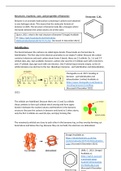
Benzene is an aromatic hydrocarbon containing 6 carbons each attached
to one hydrogen atom. This means that the molecular formula of
benzene is C6H6. The structure of benzene looks like a hexagon where
the bonds between the carbon atoms are all the same.
Quora, 2021. what is the real structure of benzene? [image] Available
at: https://qph.fs.quoracdn.net/main-qimg-
dbbf2a3c6de6fa03a1b8c9077577e766 [Accessed 11 December 2021].
Hybridisation:
The bonds between the carbons are called sigma bonds. These bonds are formed due to
hybridisation. The first step is the electron promotion to an empty P orbital. Because the carbon
contains 6 electrons and each carbon atom forms 4 bonds, there are 2 S orbitals (1s, 2 s) and 3 P
orbitals (2px, 2py, 2pz) available, however, carbon only uses the 2 S orbitals each with 2 electrons
and 2 P orbitals (2px,2py) each with one electron. One P orbital (2pz) remains empty, so the 2S
orbital donates one electron to the 2pz. (Bonding in benzene - sp2 hybridisation and delocalisation,
Chemguide.co.uk. 2021. bonding in
benzene - sp2 hybridisation and
delocalisation. [online] Available at:
https://www.chemguide.co.uk/basicorg
/bonding/benzene2.html#top
[Accessed 6 December 2021].
2021)
The orbitals are hybridised. Because there are 1 S and 3 p orbitals
these combine to form sp3 orbitals which overlap and form sigma
bonds in between the (carbon) atoms and therefore in the benzene
structure. Because the carbons in benzene only bond to 3 other atoms,
only the first 3 orbitals are used (2s,2px, and 2py) forming this:
The remained p orbitals are close to each other in the benzene ring, so they overlap forming a pi
bond above and below the ring. Because they are not held, the electrons are delocalised.
[image] Available at:
https://alevelchemistry.co.uk/wp-
content/uploads/2019/04/Delocalization_
2.jpg [Accessed 6 December 2021].
Uhlik, C., 2021. [image]
Available at:
https://qph.fs.quoracd
n.net/main-qimg-
0a4618744f32c62a04a
25c9600fa48a4-pjlq
[Accessed 6 December
Benzene is an aromatic hydrocarbon containing 6 carbons each attached
to one hydrogen atom. This means that the molecular formula of
benzene is C6H6. The structure of benzene looks like a hexagon where
the bonds between the carbon atoms are all the same.
Quora, 2021. what is the real structure of benzene? [image] Available
at: https://qph.fs.quoracdn.net/main-qimg-
dbbf2a3c6de6fa03a1b8c9077577e766 [Accessed 11 December 2021].
Hybridisation:
The bonds between the carbons are called sigma bonds. These bonds are formed due to
hybridisation. The first step is the electron promotion to an empty P orbital. Because the carbon
contains 6 electrons and each carbon atom forms 4 bonds, there are 2 S orbitals (1s, 2 s) and 3 P
orbitals (2px, 2py, 2pz) available, however, carbon only uses the 2 S orbitals each with 2 electrons
and 2 P orbitals (2px,2py) each with one electron. One P orbital (2pz) remains empty, so the 2S
orbital donates one electron to the 2pz. (Bonding in benzene - sp2 hybridisation and delocalisation,
Chemguide.co.uk. 2021. bonding in
benzene - sp2 hybridisation and
delocalisation. [online] Available at:
https://www.chemguide.co.uk/basicorg
/bonding/benzene2.html#top
[Accessed 6 December 2021].
2021)
The orbitals are hybridised. Because there are 1 S and 3 p orbitals
these combine to form sp3 orbitals which overlap and form sigma
bonds in between the (carbon) atoms and therefore in the benzene
structure. Because the carbons in benzene only bond to 3 other atoms,
only the first 3 orbitals are used (2s,2px, and 2py) forming this:
The remained p orbitals are close to each other in the benzene ring, so they overlap forming a pi
bond above and below the ring. Because they are not held, the electrons are delocalised.
[image] Available at:
https://alevelchemistry.co.uk/wp-
content/uploads/2019/04/Delocalization_
2.jpg [Accessed 6 December 2021].
Uhlik, C., 2021. [image]
Available at:
https://qph.fs.quoracd
n.net/main-qimg-
0a4618744f32c62a04a
25c9600fa48a4-pjlq
[Accessed 6 December