

If I knew the light source was smaller, then the bicycle would be closer than it appears.
111111111111111111111111111111111111111111111111111111111111111111111111111
11111111111
Name:
Student Exploration: Big Bang Theory – Hubble’s
Law
Directions: Follow the instructions to go through the simulation. Respond to the questions and prompts in the orange boxes.
Vocabulary: absolute brightness, absorption spectrum, apparent brightness, Big Bang
theory, blueshift, Cepheid variable, Doppler shift, Hubble constant, Hubble’s law,
luminosity, megaparsec, period, redshift, spectrograph
Prior Knowledge Questions (Do these BEFORE using the Gizmo.)
Standing by the side of a lonely highway at night, you see two motorcycle headlights, one in each direction. The headlight on your left appears brighter than the one on your right.
1.If the headlights are equally bright, which motorcycle is closer?
Explain:
2.Suppose the dim-looking headlight on the right is actually a small light on the front of a bicycle. What can you conclude about the distance of the motorcycle and bicycle?
Gizmo Warm-up
In 1912, an astronomer named Henrietta Swan Leavitt studied a class of stars called Cepheid variables. These stars change from bright to dim to bright again. Her discoveries led to a method of measuring distances to other galaxies and eventually helped to support the Big Bang theory of the origin of the universe.
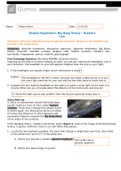
In the Big Bang Theory – Hubble’s Law Gizmo, select Region A. Look at the image of the Andromeda
Galaxy, a galaxy relatively close to our own Milky Way galaxy.
1.Locate the two Cepheid variables, the stars that change in brightness over time. Star A-091
is the yellow star, and A-171 is the white star.
A.Which star reaches a greater apparent brightness?
B.Which star takes longer to pulse?
Star A-091 has a greater apparent brightness.The headlight on the left is closer, because the closer a light source is to you, the more light particles hit your eye and the less they have to travel and to be dispersed.Hibba Hasan Date:11-16-20 2.Because both stars are in the same galaxy, they are about the same distance from Earth. Based on what you see, how is the brightness of the star related to how quickly it pulses?
111111111111111111111111111111111111111111111111111111111111111111111111111
11111111111
Name:
Student Exploration: Big Bang Theory – Hubble’s
Law
Directions: Follow the instructions to go through the simulation. Respond to the questions and prompts in the orange boxes.
Vocabulary: absolute brightness, absorption spectrum, apparent brightness, Big Bang
theory, blueshift, Cepheid variable, Doppler shift, Hubble constant, Hubble’s law,
luminosity, megaparsec, period, redshift, spectrograph
Prior Knowledge Questions (Do these BEFORE using the Gizmo.)
Standing by the side of a lonely highway at night, you see two motorcycle headlights, one in each direction. The headlight on your left appears brighter than the one on your right.
1.If the headlights are equally bright, which motorcycle is closer?
Explain:
2.Suppose the dim-looking headlight on the right is actually a small light on the front of a bicycle. What can you conclude about the distance of the motorcycle and bicycle?
Gizmo Warm-up
In 1912, an astronomer named Henrietta Swan Leavitt studied a class of stars called Cepheid variables. These stars change from bright to dim to bright again. Her discoveries led to a method of measuring distances to other galaxies and eventually helped to support the Big Bang theory of the origin of the universe.
In the Big Bang Theory – Hubble’s Law Gizmo, select Region A. Look at the image of the Andromeda
Galaxy, a galaxy relatively close to our own Milky Way galaxy.
1.Locate the two Cepheid variables, the stars that change in brightness over time. Star A-091
is the yellow star, and A-171 is the white star.
A.Which star reaches a greater apparent brightness?
B.Which star takes longer to pulse?
Star A-091 has a greater apparent brightness.The headlight on the left is closer, because the closer a light source is to you, the more light particles hit your eye and the less they have to travel and to be dispersed.Hibba Hasan Date:11-16-20 2.Because both stars are in the same galaxy, they are about the same distance from Earth. Based on what you see, how is the brightness of the star related to how quickly it pulses?


