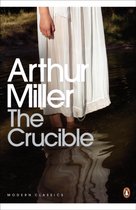
SECTION 2: The Crucible
Themes- (Religion) (Truth, Lies & Deceit) (Hysteria & Fear) (Individuality & Collective Power)
(Reputation & Integrity)
Significant Quotes & Techniques
1. My name is good in the village! I will not have it said my name is soiled! Goody Proctor is a
gossiping liar!- Abigail 1 Irony
Abigail is concerned about her reputation and her "name;" this is no doubt what motivates her, at least
initially, to put the blame for the dancing in the woods on Tituba. If her name is "soiled," Abigail could
face harsh consequences in the Salem theocracy where women are already low on the totem pole – if it's
discovered that she, an unmarried orphan woman, slept with a married man, she would face huge
consequences (although what these consequences would be aren't specified in the play).
2. “I want to open myself, I want the light of God; I want the sweet love of Jesus! I danced for the
Devil; I saw him, I wrote in his book; I go back to Jesus; I kiss His hand. I saw Sarah Good with
the Devil! I saw Goody Osburn with the Devil! I saw Bridget Bishop with the Devil!” - Abigail, 1,
Parallel Sentence Structure
- Abigail Williams “confesses” to being a witch. This outburst exemplifies the hypocrisy present in
Salem as well as the ridiculousness of the witch trials & that she is clearly terrified of Salem’s
strict oppressive religious law.
- After the confession of Tituba to witchcraft, Abigail spent the first act worrying desperately
about the possibility of being disgraced for having cast charms with her friends in the forest.
Tituba’s confession, however, offers an example of a way out of her own problems, and Abigail
takes it. She “confesses” to consorting with the Devil, which, according to the theology of Salem,
means that she is redeemed and free from guilt. Then, as the next step in absolving herself of
sin, she accuses others of being witches, thus shifting the burden of shame from her shoulders
to those she names. Seeing Abigail’s success, the other girls follow suit, and with this pattern of
hysterical, self-serving accusations, the witch trials get underway. It ends with accusing others
of witchcraft, the false confessions favour the dishonest and are motivated by jealousy and spite.
3. “And mark this. Let either of you breathe a word, or the edge of a word, about the other things,
and I will come to you in the black of some terrible night, and I will bring a pointy reckoning
that will shudder you. And you know I can do it; I saw Indians smash my dear parents’ heads on
the pillow next to mine and I have seen some reddish work done at night, and I can make you
wish you had never seen the sun go down!”- Abigail, 1 foreboding
- At the beginning of the play, the power that Abigail holds is relatively minimal. We get a glimpse
of Abigail Williams' ruthless nature & instability. This threat gives a glimpse of Abigail's harsh
nature that if anyone discloses the secret of her witchcraft, she will not hesitate to kill them in
the dark of the night foreboding that she could lead to some cataclysmic events later in the play.
Themes- (Religion) (Truth, Lies & Deceit) (Hysteria & Fear) (Individuality & Collective Power)
(Reputation & Integrity)
Significant Quotes & Techniques
1. My name is good in the village! I will not have it said my name is soiled! Goody Proctor is a
gossiping liar!- Abigail 1 Irony
Abigail is concerned about her reputation and her "name;" this is no doubt what motivates her, at least
initially, to put the blame for the dancing in the woods on Tituba. If her name is "soiled," Abigail could
face harsh consequences in the Salem theocracy where women are already low on the totem pole – if it's
discovered that she, an unmarried orphan woman, slept with a married man, she would face huge
consequences (although what these consequences would be aren't specified in the play).
2. “I want to open myself, I want the light of God; I want the sweet love of Jesus! I danced for the
Devil; I saw him, I wrote in his book; I go back to Jesus; I kiss His hand. I saw Sarah Good with
the Devil! I saw Goody Osburn with the Devil! I saw Bridget Bishop with the Devil!” - Abigail, 1,
Parallel Sentence Structure
- Abigail Williams “confesses” to being a witch. This outburst exemplifies the hypocrisy present in
Salem as well as the ridiculousness of the witch trials & that she is clearly terrified of Salem’s
strict oppressive religious law.
- After the confession of Tituba to witchcraft, Abigail spent the first act worrying desperately
about the possibility of being disgraced for having cast charms with her friends in the forest.
Tituba’s confession, however, offers an example of a way out of her own problems, and Abigail
takes it. She “confesses” to consorting with the Devil, which, according to the theology of Salem,
means that she is redeemed and free from guilt. Then, as the next step in absolving herself of
sin, she accuses others of being witches, thus shifting the burden of shame from her shoulders
to those she names. Seeing Abigail’s success, the other girls follow suit, and with this pattern of
hysterical, self-serving accusations, the witch trials get underway. It ends with accusing others
of witchcraft, the false confessions favour the dishonest and are motivated by jealousy and spite.
3. “And mark this. Let either of you breathe a word, or the edge of a word, about the other things,
and I will come to you in the black of some terrible night, and I will bring a pointy reckoning
that will shudder you. And you know I can do it; I saw Indians smash my dear parents’ heads on
the pillow next to mine and I have seen some reddish work done at night, and I can make you
wish you had never seen the sun go down!”- Abigail, 1 foreboding
- At the beginning of the play, the power that Abigail holds is relatively minimal. We get a glimpse
of Abigail Williams' ruthless nature & instability. This threat gives a glimpse of Abigail's harsh
nature that if anyone discloses the secret of her witchcraft, she will not hesitate to kill them in
the dark of the night foreboding that she could lead to some cataclysmic events later in the play.