LSAT Practice exam
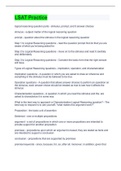
logical reasoning question parts stimulus, prompt, and 5 answer choices stimulus subject matter of the logical reasoning question prompt question about the stimulus in the logical reasoning question Step 1 to Logical Reasoning questions read the question prompt first do that you are aware of what you're being asked for Step 2 to Logical Reasoning questions move on to the stimulus and read it carefully and deliberately Step 3 to Logical Reasoning questions Consider the basic form that the right answer will have. Types of Logical Reasoning questions implication, operation, and characterization Implication questions A question in which you are asked to draw an inference and everything in the stimulus must be believed to be true Operation questions A question that allows answer choices to perform an operation on the stimulus, each answer choice should be treated as true to see how it affects the stimulus Characterization questions A question in which you read the stimulus and the. are asked to characterize it in some way What is the best way to approach a Characterization Logical Reasoning question? The best way to respond is to ask yourself, "what makes this argument work?" Proposition the basic unit of assertion Sentence one or multiple propositions argument a set of propositions in which one or more propositions are intended to provide support for another proposition premises propositions upon which an argument is based, they are stated as facts and are intended to support a conclusion conclusion propositions that are supported by premises premise keywords since, because, for, as, after all, moreover, in addition, given that conclusion keywords therefore, thus, hence, so, as a result, consequently, it follows that, it is clear that assumptions claims that are not explicitly stated but that must be true in order for the conclusion to be inferred from the premises steps to breaking down arguments 1. locate the conclusion 2. find the premises 3. identify any assumptions logical not concerned with the truth but with implications, inferences, and validity Greek symbol for entailment 3 dots in a triangle formation valid argument conclusion is properly inferred from the premises invalid argument conclusion cannot be properly inferred from the premises absolute statements assert the existence of some fact conditional statements assert the existence of a hypothetical relationship between conditions elements of a conditional statement sufficient condition and necessary condition; goes from sufficient to necessary sufficient condition satisfied condition is enough to guarantee that a necessary condition will follow necessary condition required for a sufficient condition to be satisfied valid affirmation the most basic inferences that can be drawn from a conditional statement, if a sufficient condition is satisfied then that is always enough to conclude that the necessary condition follows contrapositive flipping a conditional statement and negating it. switch and negate. switch and negate. switch and negate. switch and negate. denying a necessary conclusion is always enough to conclude that a sufficient condition will not follow. contrapositive inferences the contrapositive is always a valid inference fallacy of the inverse negating both conditions without switching them will result in an invalid inference Invalid inference denying a sufficient condition does not necessarily imply that a necessary condition cannot obtain, the inverse is always an invalid inference Sufficiency key words if, when, whenever, all, any, each, every Necessity key words then, only, only if, only when, needs, requires, must If and only if statements it is both sufficient and necessary, either both occur or neither unless, Until, Without, Except statements that could be easily replaced with "if not" no (none) statements this type of statement posits that there is no overlap between two conditions, no A's are B's implies that all A's are not B's transitive property when a conditional statement's necessary condition is identical to the sufficient condition of another conditional statement, always a valid inference How many processes are there in the logic games? 2 ordering taking a variable set and lining them up grouping instead of lining them up, you have to make
Written for
- Institution
- LSAT
- Module
- LSAT
Document information
- Uploaded on
- November 7, 2022
- Number of pages
- 12
- Written in
- 2022/2023
- Type
- Exam (elaborations)
- Contains
- Questions & answers
Subjects
- prompt
- and 5 answer choices
-
logical reasoning question parts stimulus
-
stimulus subject matter of the logical reasoning question
-
prompt question about the stimulus in the logical reasoning question
-
s

Also available in package deal