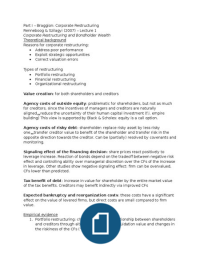
Part I – Braggion: Corporate Restructuring
Renneboog & Szilagyi (2007) – Lecture 1
Corporate Restructuring and Bondholder Wealth
Theoretical background
Reasons for corporate restructuring:
Address poor performance
Exploit strategic opportunities
Correct valuation errors
Types of restructuring
Portfolio restructuring
Financial restructuring
Organizational restructuring
Value creation: for both shareholders and creditors
Agency costs of outside equity: problematic for shareholders, but not as much
for creditors, since the incentives of managers and creditors are naturally
alignedreduce the uncertainty of their human capital investment (f.i. empire
building) This view is supported by Black & Scholes: equity is a call option.
Agency costs of risky debt: shareholder: replace risky asset by less risky
onetransfer creditor value to benefit of the shareholder and transfer risk in the
opposite direction towards the creditor. Can be (partially) resolved by covenants and
monitoring.
Signaling effect of the financing decision: share prices react positively to
leverage increase. Reaction of bonds depend on the tradeoff between negative risk
effect and controlling ability over managerial discretion over the CFs of the increase
in leverage. Other studies show negative signaling effect: firm can be overvalued,
CFs lower than predicted.
Tax benefit of debt: increase in value for shareholder by the entire market value
of the tax benefits. Creditors may benefit indirectly via improved CFs
Expected bankruptcy and reorganization costs: these costs have a significant
effect on the value of levered firms, but direct costs are small compared to firm
value.
Empirical evidence
1. Portfolio restructuring: change contracting relationship between shareholders
and creditors through altering collateral and liquidation value and changes in
the riskiness of the CFs (“co-insurance effect”).
, a. Expansion: M&A – creditor does not gain (sometimes even lose; i.e.
negative excess returns); negligible effect of co-insurance. Excess
returns for creditors only possible via junk-grade investments.
b. Reduction: refocusing (equity carve-outs, spin-offs, sell-offs) –
economic gains and reduction in agency costs. Signaling effect (only
carve-outs and sell-offs as they generate cash): may indicate
overvaluation of the subsidiary and undervaluation of the parent.
Important for creditors is the allocation of debt between the parent and
the subsidiary (w.r.t. risk as well). In general, parent bondholders are
found to be harmed more through a change in leverage (generally
higher leveraged to exploit growth of subsidiary better) and change of
the underlying collateral. However, no reduction in co-insurance.
Overall, no clear findings on effects ((economically) insignificant or
somehow contradictory).
2. Financial restructuring: altering the firm’s capital structure. Direct effect on
creditorchange in leverage=change credit risk. Three effects of financial
restructuring: 1) wealth redistribution effect, 2) expected bankruptcy cost
effect, and 3) corporate tax effect.
a. New debt issues: scarce and inconclusive evidence
b. Seasoned equity offerings: negative reaction of both shareholders and
creditors. Negative signaling effect for bondholders, but positive effect
due to wealth transfer from shareholder to bondholder.
c. Exchange offers and recapitalizations: negative bondholder response
when equity-for-debt. When debt-for-equity, bondholders might gain
via better performance expectations, but in general associated with
wealth transfer towards shareholders (due to increased leverage).
d. Public-to-private transactions: LBOs, MBOs, etc. Often associated with
downgrades, hence, creditor losses.
e. Leveraged recapitalizations: Increase in leverage to pay extra
dividends or repurchase shares to prevent hostile takeover creditor
losses
f. Dividend payouts and share repurchases: combination of positive
signaling of paying dividends combined with increased leverage (i.e.
wealth transfer). Overall, negative excess returns for creditors for both
dividend payouts and share repurchases.
g. Executive stock option plans: realign managerial interests with
shareholder interests (hence, away from creditor interests as these are
naturally aligned with the managers’)
Martynova & Renneboog – Lecture 3
The Performance of the European Market for Corporate Control: Evidence from the
5th Takeover Wave
I
ntroduction
Renneboog & Szilagyi (2007) – Lecture 1
Corporate Restructuring and Bondholder Wealth
Theoretical background
Reasons for corporate restructuring:
Address poor performance
Exploit strategic opportunities
Correct valuation errors
Types of restructuring
Portfolio restructuring
Financial restructuring
Organizational restructuring
Value creation: for both shareholders and creditors
Agency costs of outside equity: problematic for shareholders, but not as much
for creditors, since the incentives of managers and creditors are naturally
alignedreduce the uncertainty of their human capital investment (f.i. empire
building) This view is supported by Black & Scholes: equity is a call option.
Agency costs of risky debt: shareholder: replace risky asset by less risky
onetransfer creditor value to benefit of the shareholder and transfer risk in the
opposite direction towards the creditor. Can be (partially) resolved by covenants and
monitoring.
Signaling effect of the financing decision: share prices react positively to
leverage increase. Reaction of bonds depend on the tradeoff between negative risk
effect and controlling ability over managerial discretion over the CFs of the increase
in leverage. Other studies show negative signaling effect: firm can be overvalued,
CFs lower than predicted.
Tax benefit of debt: increase in value for shareholder by the entire market value
of the tax benefits. Creditors may benefit indirectly via improved CFs
Expected bankruptcy and reorganization costs: these costs have a significant
effect on the value of levered firms, but direct costs are small compared to firm
value.
Empirical evidence
1. Portfolio restructuring: change contracting relationship between shareholders
and creditors through altering collateral and liquidation value and changes in
the riskiness of the CFs (“co-insurance effect”).
, a. Expansion: M&A – creditor does not gain (sometimes even lose; i.e.
negative excess returns); negligible effect of co-insurance. Excess
returns for creditors only possible via junk-grade investments.
b. Reduction: refocusing (equity carve-outs, spin-offs, sell-offs) –
economic gains and reduction in agency costs. Signaling effect (only
carve-outs and sell-offs as they generate cash): may indicate
overvaluation of the subsidiary and undervaluation of the parent.
Important for creditors is the allocation of debt between the parent and
the subsidiary (w.r.t. risk as well). In general, parent bondholders are
found to be harmed more through a change in leverage (generally
higher leveraged to exploit growth of subsidiary better) and change of
the underlying collateral. However, no reduction in co-insurance.
Overall, no clear findings on effects ((economically) insignificant or
somehow contradictory).
2. Financial restructuring: altering the firm’s capital structure. Direct effect on
creditorchange in leverage=change credit risk. Three effects of financial
restructuring: 1) wealth redistribution effect, 2) expected bankruptcy cost
effect, and 3) corporate tax effect.
a. New debt issues: scarce and inconclusive evidence
b. Seasoned equity offerings: negative reaction of both shareholders and
creditors. Negative signaling effect for bondholders, but positive effect
due to wealth transfer from shareholder to bondholder.
c. Exchange offers and recapitalizations: negative bondholder response
when equity-for-debt. When debt-for-equity, bondholders might gain
via better performance expectations, but in general associated with
wealth transfer towards shareholders (due to increased leverage).
d. Public-to-private transactions: LBOs, MBOs, etc. Often associated with
downgrades, hence, creditor losses.
e. Leveraged recapitalizations: Increase in leverage to pay extra
dividends or repurchase shares to prevent hostile takeover creditor
losses
f. Dividend payouts and share repurchases: combination of positive
signaling of paying dividends combined with increased leverage (i.e.
wealth transfer). Overall, negative excess returns for creditors for both
dividend payouts and share repurchases.
g. Executive stock option plans: realign managerial interests with
shareholder interests (hence, away from creditor interests as these are
naturally aligned with the managers’)
Martynova & Renneboog – Lecture 3
The Performance of the European Market for Corporate Control: Evidence from the
5th Takeover Wave
I
ntroduction