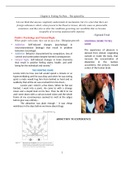
Chapter 5. Hey, What's in This Stuff, Anyway
"Alcohol and not the dog is man's best friend"
- W.C. Fields "To alcohol: the cause of and solution to all of life's problem
- Homer Simson
Moderate alcohol consumption may have beneficial effects on health. These include decreased
risk for heart disease and mortality due to heart disease, reduced risk of ischemic smoke (in
which the arteries to the brain become narrowed or blocked, resulting in reduced blood flow),
and decreased risk of diabetes. In most western countries where chronic diseases such as
coronary heart disease, cancer, stroke, and diabetes are the primary causes of death, extensive
epidemiological studies consistently show that alcohol reduces mortality, especially among
middle-aged and older men and women. This association is likely due to the protective effects of
moderate alcohol consumption on CHD, diabetes, and ischemic stroke.
Most people drink to feel better, to be more sociable and less sedate!
Inheriting alcoholism
the national Council on alcoholism, Alcoholics
• Intentional fermentation (alcohol) has been
Anonymous, and the American Medical around for thousands of years (rice wine was
Association described alcoholism as: consumed in China for at least 9000 years).
• Throughout time alcohol has been attributed
to positive and negative factors
Alcoholism is regarded as a chronic and • In the past alcohol abuse was viewed as
moral depravity and weakness
potentially fatal disease that pays little respect to
• Today alcohol abuse is viewed as a chronic
strengths or weaknesses of character. and potentially fatal disease
The disease concept holds addicts have inherited maladaptive biochemical responses to certain
chemicals. For example, Faulty genes can lead to the production of faulty enzymes that disturb
the normal metabolism of substances; other faulty genes can change expressions of
neurotransmitter receptors which will alter a person's sensitivity to drugs. Both types of genetic
differences can result in a pathological response to the drug, making a person vulnerable to
addiction once they start using the substance.
1
, Identical twins who share the same genes are about twice as likely as fraternal twins who
share an average of 50% of their genes to resemble each other in terms of the presentence of
alcoholism.
• 50-60% of the risk of To understand the theory of inherited alcoholism, consider the
alcoholism is genetically pathway in the liver. (See textbox). It is primarily acetaldehyde
determined for both men and
that is responsible for the adverse effects associated with too
women -
– metabolic enzymes much alcohol: nausea, vomiting, dizziness, and flushing of the
– neurotransmitter skin. Disulfiram (Antabuse') is sometimes prescribed to treat
receptors
– Genetics plays a part alcoholism. It works by inhibiting ALDH, delaying the body's
in risk and protective acetaldehyde metabolism into acetic acid. As a result,
factors
acetaldehyde will build up in the person's system if they drink
well on disulfiram. The result is a physical illness intended to discourage the person from
consuming alcohol again in the future.
Metabolism of alcohol.
In the first step,
alcohol (ethanol) is converted to
acetaldehyde using the enzyme alcohol
dehydrogenase (ADH) and co-enzyme,
nicotinamide adenine dinucleotide
(NAD+).
In the second step,
acetaldehyde is changed to acetate and
finally to carbon dioxide and water.
The conversion of acetaldehyde to acetate
requires aldehyde dehydrogenase (ALDH),
as well as (NAD+).
Si
n ce
enzymes (in this case, ADH and ALDH) are involved in the
2
"Alcohol and not the dog is man's best friend"
- W.C. Fields "To alcohol: the cause of and solution to all of life's problem
- Homer Simson
Moderate alcohol consumption may have beneficial effects on health. These include decreased
risk for heart disease and mortality due to heart disease, reduced risk of ischemic smoke (in
which the arteries to the brain become narrowed or blocked, resulting in reduced blood flow),
and decreased risk of diabetes. In most western countries where chronic diseases such as
coronary heart disease, cancer, stroke, and diabetes are the primary causes of death, extensive
epidemiological studies consistently show that alcohol reduces mortality, especially among
middle-aged and older men and women. This association is likely due to the protective effects of
moderate alcohol consumption on CHD, diabetes, and ischemic stroke.
Most people drink to feel better, to be more sociable and less sedate!
Inheriting alcoholism
the national Council on alcoholism, Alcoholics
• Intentional fermentation (alcohol) has been
Anonymous, and the American Medical around for thousands of years (rice wine was
Association described alcoholism as: consumed in China for at least 9000 years).
• Throughout time alcohol has been attributed
to positive and negative factors
Alcoholism is regarded as a chronic and • In the past alcohol abuse was viewed as
moral depravity and weakness
potentially fatal disease that pays little respect to
• Today alcohol abuse is viewed as a chronic
strengths or weaknesses of character. and potentially fatal disease
The disease concept holds addicts have inherited maladaptive biochemical responses to certain
chemicals. For example, Faulty genes can lead to the production of faulty enzymes that disturb
the normal metabolism of substances; other faulty genes can change expressions of
neurotransmitter receptors which will alter a person's sensitivity to drugs. Both types of genetic
differences can result in a pathological response to the drug, making a person vulnerable to
addiction once they start using the substance.
1
, Identical twins who share the same genes are about twice as likely as fraternal twins who
share an average of 50% of their genes to resemble each other in terms of the presentence of
alcoholism.
• 50-60% of the risk of To understand the theory of inherited alcoholism, consider the
alcoholism is genetically pathway in the liver. (See textbox). It is primarily acetaldehyde
determined for both men and
that is responsible for the adverse effects associated with too
women -
– metabolic enzymes much alcohol: nausea, vomiting, dizziness, and flushing of the
– neurotransmitter skin. Disulfiram (Antabuse') is sometimes prescribed to treat
receptors
– Genetics plays a part alcoholism. It works by inhibiting ALDH, delaying the body's
in risk and protective acetaldehyde metabolism into acetic acid. As a result,
factors
acetaldehyde will build up in the person's system if they drink
well on disulfiram. The result is a physical illness intended to discourage the person from
consuming alcohol again in the future.
Metabolism of alcohol.
In the first step,
alcohol (ethanol) is converted to
acetaldehyde using the enzyme alcohol
dehydrogenase (ADH) and co-enzyme,
nicotinamide adenine dinucleotide
(NAD+).
In the second step,
acetaldehyde is changed to acetate and
finally to carbon dioxide and water.
The conversion of acetaldehyde to acetate
requires aldehyde dehydrogenase (ALDH),
as well as (NAD+).
Si
n ce
enzymes (in this case, ADH and ALDH) are involved in the
2