

Neurocognition Hoorcolleges
Lecture 1: The brain and cognition over the life span
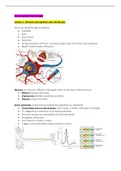
Parts you should be able to identify:
• Cell body
• Axon
• Axon hillock
• Dendrites
• Synapse/synaptic cleft (pre- and postsynaptic side and vesicles and receptors)
• Myelin sheath (nodes of Ranvier)
Neurons can look very different, distinguish them on the base of their function:
• Afferent (sensory) terminals
• Interneurons (stellate, pyramidal, purkinje)
• Efferent (motor) terminals
Action potentials: no full chemical details but look them up. Important:
• Thresholded and non-decremental. Once it goes, it doesn’t decrease in strength.
• It’s triggered by summation of excitatory potentials.
• Driven by varying ion permeability of a cell membrane
• Propagates along axon
• Can travel for a meter or more
• Triggers neurotransmitter release at axon terminal
,Synapse: Action potential leads to neurotransmitter release into synaptic cleft.
• Some neurons can release more than 1 type of neurotransmitter, depending on type
of stimulation (e.g., low vs. high-frequency stimulation)
- Acetylcholine
- Dopamine
- Norepinephrine
- Serotonin
- Glutamate
- Gamma-aminobutyric acid (GABA)
• Receptor cells in the postsynaptic membrane can adapt to under- or over-use.
• The distribution of synapses connecting to a cell influences its excitability.
Glia cells: Different shapes and functions:
• Astrocytes (Blood-brain barrier, structural support)
• Oligodendrocytes (myelin for CNS neurons)
• Microglial cells (fight infections, waste disposal)
• Ependymal cells (ventricular surface epithelium, create CSF)
• Schwann cells (myelin for PNS)
,Cortical cell layers:
• Different types of neurons are often organized in layers
• Sensory (input), interneurons (relay) and motor (output) neurons are grouped
• Layers are different in different cortical areas, depending on primary function
Each layer has a specific function: 6 layers: often interconnected, with subdivisions.
• Input layers from:
- Thalamus
- Cortex
- Brainstem
• Output layers from:
- Thalamus
- Cortex
- Brainstem and spinal cord
White matter tracts: Bundles of myelinated axons:
• Connecting neurons throughout the central and peripheral nervous system
- Association fibers connecting areas within a hemisphere
- Commissural fibers crossing to the other hemisphere, to the same (homotopic) or
a different place (heterotopic)
- Projection fibers connect outward to subcortical regions, cerebellum or the spinal
cord.
Major components of the CNS:
• Forebrain, incl. hemispheres, corpus callosum and subcortical deep structure
(telencephalon)
• Diencephalon, incl. thalamic structures
• Midbrain (mesencephalon), top of brain stem, incl. sensory and motor relay nuclei
• Hindbrain (metencephalon), incl. pons and cerebellum, medulla oblongata
• Spinal cord
, Hindbrain and midbrain:
Hindbrain:
• Medulla oblongata: Contributes to vital reflexes, damage is often fatal
• Pons: Crossing over many fibers in the motor and sensory pathways for contralateral
motor control
• Cerebellum: Automated movement, balance, timing and time perception,
sensorimotor coupling, attention shifting, other cognitive functions
• Origin of cranial nerves V-XII
Midbrain/mesencephalon:
• Superior/inferior colliculi: Contribute to sensory processing
• Substantia nigra: Contribute to movement initiation
• Origin of cranial nerves II-IV.
Diencephalon:
• Thalamus: Relay station (many subnuclei)
• Hypothalamus
• Pituitary gland
Lecture 1: The brain and cognition over the life span
Parts you should be able to identify:
• Cell body
• Axon
• Axon hillock
• Dendrites
• Synapse/synaptic cleft (pre- and postsynaptic side and vesicles and receptors)
• Myelin sheath (nodes of Ranvier)
Neurons can look very different, distinguish them on the base of their function:
• Afferent (sensory) terminals
• Interneurons (stellate, pyramidal, purkinje)
• Efferent (motor) terminals
Action potentials: no full chemical details but look them up. Important:
• Thresholded and non-decremental. Once it goes, it doesn’t decrease in strength.
• It’s triggered by summation of excitatory potentials.
• Driven by varying ion permeability of a cell membrane
• Propagates along axon
• Can travel for a meter or more
• Triggers neurotransmitter release at axon terminal
,Synapse: Action potential leads to neurotransmitter release into synaptic cleft.
• Some neurons can release more than 1 type of neurotransmitter, depending on type
of stimulation (e.g., low vs. high-frequency stimulation)
- Acetylcholine
- Dopamine
- Norepinephrine
- Serotonin
- Glutamate
- Gamma-aminobutyric acid (GABA)
• Receptor cells in the postsynaptic membrane can adapt to under- or over-use.
• The distribution of synapses connecting to a cell influences its excitability.
Glia cells: Different shapes and functions:
• Astrocytes (Blood-brain barrier, structural support)
• Oligodendrocytes (myelin for CNS neurons)
• Microglial cells (fight infections, waste disposal)
• Ependymal cells (ventricular surface epithelium, create CSF)
• Schwann cells (myelin for PNS)
,Cortical cell layers:
• Different types of neurons are often organized in layers
• Sensory (input), interneurons (relay) and motor (output) neurons are grouped
• Layers are different in different cortical areas, depending on primary function
Each layer has a specific function: 6 layers: often interconnected, with subdivisions.
• Input layers from:
- Thalamus
- Cortex
- Brainstem
• Output layers from:
- Thalamus
- Cortex
- Brainstem and spinal cord
White matter tracts: Bundles of myelinated axons:
• Connecting neurons throughout the central and peripheral nervous system
- Association fibers connecting areas within a hemisphere
- Commissural fibers crossing to the other hemisphere, to the same (homotopic) or
a different place (heterotopic)
- Projection fibers connect outward to subcortical regions, cerebellum or the spinal
cord.
Major components of the CNS:
• Forebrain, incl. hemispheres, corpus callosum and subcortical deep structure
(telencephalon)
• Diencephalon, incl. thalamic structures
• Midbrain (mesencephalon), top of brain stem, incl. sensory and motor relay nuclei
• Hindbrain (metencephalon), incl. pons and cerebellum, medulla oblongata
• Spinal cord
, Hindbrain and midbrain:
Hindbrain:
• Medulla oblongata: Contributes to vital reflexes, damage is often fatal
• Pons: Crossing over many fibers in the motor and sensory pathways for contralateral
motor control
• Cerebellum: Automated movement, balance, timing and time perception,
sensorimotor coupling, attention shifting, other cognitive functions
• Origin of cranial nerves V-XII
Midbrain/mesencephalon:
• Superior/inferior colliculi: Contribute to sensory processing
• Substantia nigra: Contribute to movement initiation
• Origin of cranial nerves II-IV.
Diencephalon:
• Thalamus: Relay station (many subnuclei)
• Hypothalamus
• Pituitary gland


