Chapter 1
Introduction to Management
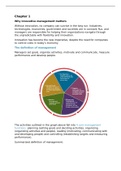
Management: organizes goals in an e ective and e cient way of planning, organizing, leading and
controlling.
E ectiveness: degree on achieving a goal
E ciency: use of minimal resources to produce desired output
The four management roles
Planning: managerial planning de nes where the organization wants to be in the future and how to get there
Organizing: following the planning and re ecting how to accomplish the plan
Leading: the use of in uence to motivate employees to achieve goals
Controlling: monitoring employees and determine if organization is moving towards goal and correcting
Management skills
- conceptual: ability to see organization as a whole and relationships among its parts.
- Human: able to work with people and be able to motivate, facilitate, lead, coordinate, communicate
- Technical: understand the performing tasks, mastery methods, techniques and equipment involved.
Chapter 2
The evolution of management thinking
Management and organization
Social forces: aspects of society that guides relationships among other people like, needs, standards of
behavior
Political forces: relate to in uence go political and legal institutions on people and organizations (contract
rights).
Economic forces: a ects availability and distribution of society’s recourses.
Classical perspective (during 19th / 20th century)
- rise of large complex factory system “industrial revolution”
- Problems regarding managerial structure, organizing operations, training, employees and labor
dissatisfaction.
- Need for new approaches to coordinate and control.
Scienti c management: empathizes scienti cally determined jobs and management as the way of e ciency
and labor productivity.
F. Taylor said: employees should be put to one speci c task where their skills can be used best to improve
e ciency and labor productivity
Bureaucratic organization: to avoid employees being loyal to an individual rather than a organization. This
leads to listening to the desires of an individual instead of the desires of a company.
Humanistic perspective
Importance of understanding human behaviors, needs and attitudes. There are three primary sub elds,
Human relations movements, human resource and behavioral sciences.
Human relations movement: movement based on the idea that truly e ective control comes from within the
worker and not from strict, authoritarian control. Hawthorne studies: personnel functions better when not
being observed.
Recent historial trends:
System thinking: ability to see both distinct elements of a system or situation and the complex and
changing interaction among those elements
Total quality management: focussing on managing in total organization to deliver better quality to customers
ffi
ff fi ff fl fl fi flff fi fi ffi ff ffi fi
, Chapter 3
The organization and corporate culture.
External environment
Everything outside the organization that a ects the organization. Could be, competitors, resources,
technology and economics.
General environment: mostly a ects organizations indirectly. Could be Economics, legal-politics,
international and natural
The task environment: is closer to the organization itself and has day-to-day transitions with the
organization and directly in uences its basic operations and performances.
Organization-environment relationships
Organizations rely on what happens externally.
Environment uncertainly: managers do not have enough information about those factors to predict what will
happen.
Adopting to the environment: violently customers or earthquakes.
Chapter 7
Managerial planning and goal setting.
Goal setting and planning overview
Desired circumstance for the organization
Levels of goals and plans
1. Mission: de ning a formal mission
2. Strategic: established by senior manager so they can look If its suitable
3. Tactics: established by middle manager that focuses on major actions
4. Operational: identifying speci c procedures by Lower managers
Goals setting in organizations
Something that is decided by a group of people
Organization mission: at the top, the organization primary reason for existence. Stands for their values and
mission. With no mission it’s hard to get the company anywhere.
Goals and plans:
Strategic goals: statement describing where the organization wants to be in the future.
Strategic plans: de nes the steps they want to take to get to the desired results
Tactical goals: the results that departments within the organization try to take action (middle management)
Tactical plans: designed to execute the strategic plans
Operating goals: practice and measurable goals and results expected from departments, work groups and
individuals.
Operational plans: department manager tools for daily and weekly operations and describes how goals will
be achieved.
Operational planning
It has to be speci c and measurable, de ned by time period, key result areas, challenging but realistic and
linked to rewards
Bene ts of planning
Source of motivation and commitment, guide to action, guide resource allocation and set a standard
performance.
Limitations of goals
Create false sense of certainty, rigidity in a turbulent environment and get in the way of initiation and
creativity.
fi fi fifi fl fi ff fi ff
Introduction to Management
Management: organizes goals in an e ective and e cient way of planning, organizing, leading and
controlling.
E ectiveness: degree on achieving a goal
E ciency: use of minimal resources to produce desired output
The four management roles
Planning: managerial planning de nes where the organization wants to be in the future and how to get there
Organizing: following the planning and re ecting how to accomplish the plan
Leading: the use of in uence to motivate employees to achieve goals
Controlling: monitoring employees and determine if organization is moving towards goal and correcting
Management skills
- conceptual: ability to see organization as a whole and relationships among its parts.
- Human: able to work with people and be able to motivate, facilitate, lead, coordinate, communicate
- Technical: understand the performing tasks, mastery methods, techniques and equipment involved.
Chapter 2
The evolution of management thinking
Management and organization
Social forces: aspects of society that guides relationships among other people like, needs, standards of
behavior
Political forces: relate to in uence go political and legal institutions on people and organizations (contract
rights).
Economic forces: a ects availability and distribution of society’s recourses.
Classical perspective (during 19th / 20th century)
- rise of large complex factory system “industrial revolution”
- Problems regarding managerial structure, organizing operations, training, employees and labor
dissatisfaction.
- Need for new approaches to coordinate and control.
Scienti c management: empathizes scienti cally determined jobs and management as the way of e ciency
and labor productivity.
F. Taylor said: employees should be put to one speci c task where their skills can be used best to improve
e ciency and labor productivity
Bureaucratic organization: to avoid employees being loyal to an individual rather than a organization. This
leads to listening to the desires of an individual instead of the desires of a company.
Humanistic perspective
Importance of understanding human behaviors, needs and attitudes. There are three primary sub elds,
Human relations movements, human resource and behavioral sciences.
Human relations movement: movement based on the idea that truly e ective control comes from within the
worker and not from strict, authoritarian control. Hawthorne studies: personnel functions better when not
being observed.
Recent historial trends:
System thinking: ability to see both distinct elements of a system or situation and the complex and
changing interaction among those elements
Total quality management: focussing on managing in total organization to deliver better quality to customers
ffi
ff fi ff fl fl fi flff fi fi ffi ff ffi fi
, Chapter 3
The organization and corporate culture.
External environment
Everything outside the organization that a ects the organization. Could be, competitors, resources,
technology and economics.
General environment: mostly a ects organizations indirectly. Could be Economics, legal-politics,
international and natural
The task environment: is closer to the organization itself and has day-to-day transitions with the
organization and directly in uences its basic operations and performances.
Organization-environment relationships
Organizations rely on what happens externally.
Environment uncertainly: managers do not have enough information about those factors to predict what will
happen.
Adopting to the environment: violently customers or earthquakes.
Chapter 7
Managerial planning and goal setting.
Goal setting and planning overview
Desired circumstance for the organization
Levels of goals and plans
1. Mission: de ning a formal mission
2. Strategic: established by senior manager so they can look If its suitable
3. Tactics: established by middle manager that focuses on major actions
4. Operational: identifying speci c procedures by Lower managers
Goals setting in organizations
Something that is decided by a group of people
Organization mission: at the top, the organization primary reason for existence. Stands for their values and
mission. With no mission it’s hard to get the company anywhere.
Goals and plans:
Strategic goals: statement describing where the organization wants to be in the future.
Strategic plans: de nes the steps they want to take to get to the desired results
Tactical goals: the results that departments within the organization try to take action (middle management)
Tactical plans: designed to execute the strategic plans
Operating goals: practice and measurable goals and results expected from departments, work groups and
individuals.
Operational plans: department manager tools for daily and weekly operations and describes how goals will
be achieved.
Operational planning
It has to be speci c and measurable, de ned by time period, key result areas, challenging but realistic and
linked to rewards
Bene ts of planning
Source of motivation and commitment, guide to action, guide resource allocation and set a standard
performance.
Limitations of goals
Create false sense of certainty, rigidity in a turbulent environment and get in the way of initiation and
creativity.
fi fi fifi fl fi ff fi ff