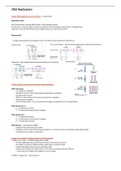
DNA Replication
Explain DNA Replication and its function → bidirectional
Replication types
Semi-conservative: parental DNA strand in each daughter helices
Conservative: 2 parental DNA strands stay together and the daughter duplex DNA is completely new
Dispersive: the parental DNA becomes fragmented and co-exists with the new
Experimental
→ using density gradient centrifugation with E.coli DNA containing 14N and 15N mixture
Conservative Semi-conservative - hybrid with density between parental and ordinary
Dispersive - intermediate density because strands are all mixed up Actual result:
List the proteins and enzymes involved in DNA replication
DNA Polymerase
- use ssDNA as a template
- add dNTPs to free 3'-OH of base-paired nucleotide to synthesise
complementary strand
- dNTPs are form Watson-Crick base pairing with the template
- Synthesis occurs rapidly
- proof reading activity: correct nucleotide has higher binding affinity to moving DNA pol
DNA polymerase III
- 5' - 3' polymerase activity
- 3' - 5' exonuclease activity (proof-reading)
DNA polymerase I
- 5' - 3' polymerase activity
- 3' - 5' exonuclease activity (proof-reading)
- 5' - 3' exonuclease activity
DNA Helicase - unwinding the dsDNA
- hydrolyse ATP when bound to ssDNA
- hydrolysis of ATP cause conformational change in to a cyclical manner and propel rapidly along ssDNA
- recognised at the origins of replication
Explain the problems for DNA synthesis and the solutions
1. DNA is very 'sticky' - ssDNA binding proteins (SSB)
- helix destabilising proteins and stop formation of secondary structures
- bind tightly to exposed ssDNA and help stabilising the unwound state
- interact with other proteins at the replication forks
- Cooperative binding: each SSB prefers to bind next to previously bound molecule
→ form long row of SSBs that straightens out the ssDNA
2. DNA is wrapped up - topoisomerase
Explain DNA Replication and its function → bidirectional
Replication types
Semi-conservative: parental DNA strand in each daughter helices
Conservative: 2 parental DNA strands stay together and the daughter duplex DNA is completely new
Dispersive: the parental DNA becomes fragmented and co-exists with the new
Experimental
→ using density gradient centrifugation with E.coli DNA containing 14N and 15N mixture
Conservative Semi-conservative - hybrid with density between parental and ordinary
Dispersive - intermediate density because strands are all mixed up Actual result:
List the proteins and enzymes involved in DNA replication
DNA Polymerase
- use ssDNA as a template
- add dNTPs to free 3'-OH of base-paired nucleotide to synthesise
complementary strand
- dNTPs are form Watson-Crick base pairing with the template
- Synthesis occurs rapidly
- proof reading activity: correct nucleotide has higher binding affinity to moving DNA pol
DNA polymerase III
- 5' - 3' polymerase activity
- 3' - 5' exonuclease activity (proof-reading)
DNA polymerase I
- 5' - 3' polymerase activity
- 3' - 5' exonuclease activity (proof-reading)
- 5' - 3' exonuclease activity
DNA Helicase - unwinding the dsDNA
- hydrolyse ATP when bound to ssDNA
- hydrolysis of ATP cause conformational change in to a cyclical manner and propel rapidly along ssDNA
- recognised at the origins of replication
Explain the problems for DNA synthesis and the solutions
1. DNA is very 'sticky' - ssDNA binding proteins (SSB)
- helix destabilising proteins and stop formation of secondary structures
- bind tightly to exposed ssDNA and help stabilising the unwound state
- interact with other proteins at the replication forks
- Cooperative binding: each SSB prefers to bind next to previously bound molecule
→ form long row of SSBs that straightens out the ssDNA
2. DNA is wrapped up - topoisomerase