STRUCTURE: -
-
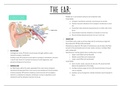
Middle ear is connected to pharynx by Eustachian tube.
FUNCTIONS:
Pinna
Tympanic membrane transmits sound waves to ossicles
Ossicles transmit vibrations from tympanic membrane to inner
ear
Eustachian tube maintains equal pressure on either side of ear
Auditory nerve drum.
Oval window transmits vibrations of ossicles to inner ear.
Round window absorbs pressure set up in inner ear.
INNER EAR
- Fluid-filled cavity made up of bony labyrinth & membranous labyrinth.
- Bony labyrinth → filled with perilymph
- Membranous labyrinth → made of membranous sacs & tubes that float
around in the perilymph (semi-circular canals; sacculus; cochlea); filled
OUTER EAR with endolymph
- Cartilaginous pinna → directs sound waves through auditory canal - Membranous cochlea (within bony cochlea) has 3 canals:
towards tympanic membrane) o Upper canal (filled with perilymph)
- Auditory canal → conducts sound waves to tympanic membrane; cerumen o Middle canal (filled with endolymph)
/ wax & hairs found in it prevent entrance of small organisms; wax o Lower canal (filled with perilymph)
prevents drying out of ear drum. - FUNCTIONS:
Semi-circular canals, sacculus & utriculus → concerned with
MIDDLE EAR balance & equilibrium of the body.
- Air-filled cavity within the skull, separated from outer ear by tympanic Cochlea contains organ of Corti → converts stimulus of sound
membrane & separated from inner ear by oval window and round window. into an impulse.
- 3 bones (ossicles) → hammer (malleus); anvil (incus) & stirrup (stapes). Auditory nerve arising from cochlea transmits sound impulse to
- Hammer is attached to tympanic membrane; stirrup is attached to oval brain.
window & anvil lies between hammer & stirrup.
-
Middle ear is connected to pharynx by Eustachian tube.
FUNCTIONS:
Pinna
Tympanic membrane transmits sound waves to ossicles
Ossicles transmit vibrations from tympanic membrane to inner
ear
Eustachian tube maintains equal pressure on either side of ear
Auditory nerve drum.
Oval window transmits vibrations of ossicles to inner ear.
Round window absorbs pressure set up in inner ear.
INNER EAR
- Fluid-filled cavity made up of bony labyrinth & membranous labyrinth.
- Bony labyrinth → filled with perilymph
- Membranous labyrinth → made of membranous sacs & tubes that float
around in the perilymph (semi-circular canals; sacculus; cochlea); filled
OUTER EAR with endolymph
- Cartilaginous pinna → directs sound waves through auditory canal - Membranous cochlea (within bony cochlea) has 3 canals:
towards tympanic membrane) o Upper canal (filled with perilymph)
- Auditory canal → conducts sound waves to tympanic membrane; cerumen o Middle canal (filled with endolymph)
/ wax & hairs found in it prevent entrance of small organisms; wax o Lower canal (filled with perilymph)
prevents drying out of ear drum. - FUNCTIONS:
Semi-circular canals, sacculus & utriculus → concerned with
MIDDLE EAR balance & equilibrium of the body.
- Air-filled cavity within the skull, separated from outer ear by tympanic Cochlea contains organ of Corti → converts stimulus of sound
membrane & separated from inner ear by oval window and round window. into an impulse.
- 3 bones (ossicles) → hammer (malleus); anvil (incus) & stirrup (stapes). Auditory nerve arising from cochlea transmits sound impulse to
- Hammer is attached to tympanic membrane; stirrup is attached to oval brain.
window & anvil lies between hammer & stirrup.