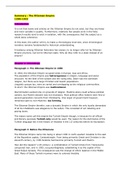
Summary : The Ottoman Empire
1299-1922
Introduction
It is not that books and articles on the Ottoman Empire do not exist, but they are fewer
and more variable in quality. Furthermore, relatively few people work in the field,
research results tend to exist in isolation, with the consequence that the subject as a
whole lacks coherence.
In this book, the author will try to make a chronologica loverview, since chronological
narrative remains fundamental to historical understanding.
A tendency among Ottoman historians has arosen, to no longer refer tot he Ottoman
Empire anymore, but tot he Ottoman state. Why do they refer to a state instead of an
empire?
Chapter 1: Chronology
Paragraph 1: The Ottoman Empire in 1650
In 1650, the Ottoman Empire occupied lands in Europe, Asia and Africa.
The population of the Empire was hetrerogenous in religion, language and social
structure. As the faith of the sultans and the ruling elite, Islam was the dominant
religion, but there were large Christian and Jewish populations.
Linguistic groups too, were as varied and overlapping as the religious communities.
In short: the Ottoman Empire was multinational.
Discrimination existed only on grounds of religion. Muslims alone could achieve political
careers, but Muslim descent was not necessary. Most political office holders were first or
second generation converts from Christianity. One organ of government however,
remained open to non-Muslims: tax farming.
The Ottoman Empire therefor, was a dynastic Empire in which the only loyalty demanded
of all its inhabitants was allegiance to the sultan. This consisted of not rebelling and
paying taxes.
The reason some call this empire the Turkish Empire though, is because for all official
and literary purposes Turkish only would be used. The reason for the dominance of the
Turkish language lies in the history of Anatolia in the 2,5 centuries before its foundation.
Paragraph 2: Before the Ottomans
The Ottoman Empire came into being in about 1300 in north-western Anatolia to the east
of the Byzantine capital, Constantinople. From being primarily Greek and Christian in the
eleventh century, by 1300 Anatolia had become primarily Turkish and Muslim.
How did this happen? 11th century: a confederation of Turkish tribes from Transoxania
conquered Iran, and in 1055, occupied Baghdad, establishing it as the capital of the
Great Seljuk dynasty. The consequence was the change of ethnic balance in the Middle
East. Many of these Turkish incomers were to colonise Anatolia.
1299-1922
Introduction
It is not that books and articles on the Ottoman Empire do not exist, but they are fewer
and more variable in quality. Furthermore, relatively few people work in the field,
research results tend to exist in isolation, with the consequence that the subject as a
whole lacks coherence.
In this book, the author will try to make a chronologica loverview, since chronological
narrative remains fundamental to historical understanding.
A tendency among Ottoman historians has arosen, to no longer refer tot he Ottoman
Empire anymore, but tot he Ottoman state. Why do they refer to a state instead of an
empire?
Chapter 1: Chronology
Paragraph 1: The Ottoman Empire in 1650
In 1650, the Ottoman Empire occupied lands in Europe, Asia and Africa.
The population of the Empire was hetrerogenous in religion, language and social
structure. As the faith of the sultans and the ruling elite, Islam was the dominant
religion, but there were large Christian and Jewish populations.
Linguistic groups too, were as varied and overlapping as the religious communities.
In short: the Ottoman Empire was multinational.
Discrimination existed only on grounds of religion. Muslims alone could achieve political
careers, but Muslim descent was not necessary. Most political office holders were first or
second generation converts from Christianity. One organ of government however,
remained open to non-Muslims: tax farming.
The Ottoman Empire therefor, was a dynastic Empire in which the only loyalty demanded
of all its inhabitants was allegiance to the sultan. This consisted of not rebelling and
paying taxes.
The reason some call this empire the Turkish Empire though, is because for all official
and literary purposes Turkish only would be used. The reason for the dominance of the
Turkish language lies in the history of Anatolia in the 2,5 centuries before its foundation.
Paragraph 2: Before the Ottomans
The Ottoman Empire came into being in about 1300 in north-western Anatolia to the east
of the Byzantine capital, Constantinople. From being primarily Greek and Christian in the
eleventh century, by 1300 Anatolia had become primarily Turkish and Muslim.
How did this happen? 11th century: a confederation of Turkish tribes from Transoxania
conquered Iran, and in 1055, occupied Baghdad, establishing it as the capital of the
Great Seljuk dynasty. The consequence was the change of ethnic balance in the Middle
East. Many of these Turkish incomers were to colonise Anatolia.