CHAPTER 4 – MACROECONOMIC POLICY IN AN OPEN ECONOMY
- 4.1 INTRODUCTION
o Effect of devaluation is dependent upon the economic policies
o This chapter → how exchange rate changes and macroeconomic policies
impact open economy
- 4.2 THE PROBLEM OF INTERNAL AND EXTERNAL BALANCE
o 1950s and 1960s → two primary objectives → full employment and stable
price level
o But expanding output in an open economy → impact on balance of payments
▪ Expanding both output and employment → greater expenditure on
imports → deterioration of CA
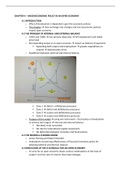
o Equilibrium between external and internal balance
▪ Zone 1 → deficit + inflationary pressures
▪ Zone 2 → deficit and deflationary pressures
▪ Zone 3 → surplus and deflationary pressures
▪ Zone 4 → surplus and inflationary pressures
o Purpose of this model → using one instrument – fiscal policy or devaluation
to achieve two targets → internal and external balance
▪ Not likely to be successful
▪ No role for international capital movements
▪ No distinction between monetary and fiscal policies
- 4.3 THE MUNDELL-FLEMING MODEL
o James Fleming and Robert Mundell
o Implications concerning effectiveness of fiscal and monetary policy for
attaining external and internal balance
- 4.4 DERIVATION OF THE IS SCHEDULE FOR AN OPEN ECONOMY
o IS curve for an open economy shows various combinations of the level of
output Y and the rate of interest that make leakages
, o The identity → Yd = C + I + G + X – M
▪ Yd → disposable national income
▪ I → domestic investment
▪ C → domestic consumption
▪ G → government expenditure
▪ X → export expenditure
▪ M → import expenditure
o Equality between leakages and injections
▪ S+M=I+G+X
▪ S = Sa + sY
• Autonomous savings plus savings which are positive function of
income (s – marginal propensity to save)
▪ M = Ma + mY
• Autonomous imports + imports which are positive function of
increases in income (m – marginal propensity to import)
▪ Higher levels of income generate higher leakages requiring a fall in the
interest rate to generate increased investment → maintain equality
between leakages and investments
- 4.5 DERIVATION OF THE LM SCHEDULE FOR AN OPEN ECONOMY
o LM schedule shows various combinations of the level of income and rate of
interest for which money market is in equilibrium
▪ Money demand = money supply
▪ Money is demanded for two reasons
• Transactions purposes
• Speculative purposes
- 4.1 INTRODUCTION
o Effect of devaluation is dependent upon the economic policies
o This chapter → how exchange rate changes and macroeconomic policies
impact open economy
- 4.2 THE PROBLEM OF INTERNAL AND EXTERNAL BALANCE
o 1950s and 1960s → two primary objectives → full employment and stable
price level
o But expanding output in an open economy → impact on balance of payments
▪ Expanding both output and employment → greater expenditure on
imports → deterioration of CA
o Equilibrium between external and internal balance
▪ Zone 1 → deficit + inflationary pressures
▪ Zone 2 → deficit and deflationary pressures
▪ Zone 3 → surplus and deflationary pressures
▪ Zone 4 → surplus and inflationary pressures
o Purpose of this model → using one instrument – fiscal policy or devaluation
to achieve two targets → internal and external balance
▪ Not likely to be successful
▪ No role for international capital movements
▪ No distinction between monetary and fiscal policies
- 4.3 THE MUNDELL-FLEMING MODEL
o James Fleming and Robert Mundell
o Implications concerning effectiveness of fiscal and monetary policy for
attaining external and internal balance
- 4.4 DERIVATION OF THE IS SCHEDULE FOR AN OPEN ECONOMY
o IS curve for an open economy shows various combinations of the level of
output Y and the rate of interest that make leakages
, o The identity → Yd = C + I + G + X – M
▪ Yd → disposable national income
▪ I → domestic investment
▪ C → domestic consumption
▪ G → government expenditure
▪ X → export expenditure
▪ M → import expenditure
o Equality between leakages and injections
▪ S+M=I+G+X
▪ S = Sa + sY
• Autonomous savings plus savings which are positive function of
income (s – marginal propensity to save)
▪ M = Ma + mY
• Autonomous imports + imports which are positive function of
increases in income (m – marginal propensity to import)
▪ Higher levels of income generate higher leakages requiring a fall in the
interest rate to generate increased investment → maintain equality
between leakages and investments
- 4.5 DERIVATION OF THE LM SCHEDULE FOR AN OPEN ECONOMY
o LM schedule shows various combinations of the level of income and rate of
interest for which money market is in equilibrium
▪ Money demand = money supply
▪ Money is demanded for two reasons
• Transactions purposes
• Speculative purposes