Lecture 1: the trait approach
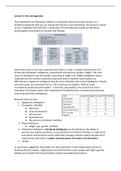
This framework (Von Rosenstiel, 2003) is a component that recurs every lecture. It is
therefore important that you can situate the lectures in the framework. This lecture is based
on the “individual characteristics” component. This (introductory) week we talk about
psychological traits based on research and findings.
Some traits seem to be more impactful than others. A trait is a stable characteristic of a
person (psychological: intelligence, extraversion) and physical: gender, height). The main
ones are intelligence and personality. According to Judge et al. (2004) Intelligence seems
important but less so than commonly assumed (small to medium sized relations to
effectiveness). Apparent intelligence may be more important than actual intelligence. People
who look smart, are assumed to be so. This is how we can explain: “Why so many
incompetent people become leaders”. In this line, personality is the second trait that is
important. Personality seems more important for leadership than commonly assumed and
more important than intelligence.
Relevant traits are thus:
1. (Apparent) intelligence
2. Personality (OCEAN)
a. Openness
b. Conscientiousness
c. Extraversion
d. Agreeableness
e. Neuroticsm (emotional stabililty)
3. Physical features
a. Height, age, gender, earlobes
4. Emotional intelligence: emotional intelligence can be defined as the ability to
perceive and express emotions, to use emotions to facilitate thinking, to understand
and reason with emotions and to effectively manage emotions within oneself and in
relationships with others. Leaders must be aware of context, self and others.
5. Gender
In conclusion, suggestion that leaders are born and there is little organizations can do to
develop effective leaders. Organizations should therefore select people with high cognitive
abilities and a leader that fits personality profile into leadership positions.
,Lecture 1: articles – book: chapter 1 + 2
Chapter 1: what is leadership?
Evaluation of leadership:
1900-1929 1930s 1940s 1950s 1960s 1970s 1980s 21st century
• Control and • Influence • Individual • Group with • Behaviour • Reciprocal • Dominance • Complex
centraliziati rather than directing shared that process in a , influence, concept
on of domination group goals with influences organizatio traits and
power leader that people nal context transforma
improves tion
effectivene
ss
Leadership definition: leadership is a process whereby an individual influences a group of individuals
to achieve a common goal.
Important notes!
• By defining leadership as a process means that it is not a trait or a characteristic. It is a process
that resides between leader and follower.
• Influence is inherent to leadership.
• Leadership occurs in groups who want to accomplish common goals.
• Because of common goals, there exist a mutual purpose. Stressing mutuality lessens the
possibility that leaders might act toward followers in ways that are forced or unethical.
• Leadership = leaders + followers. Leaders are necessary for an initiation of a relationship,
creates the communication, carries the relationship. Leaders have a responsibility toward
followers and are not better or above than followers.
The trait viewpoint conceptualizes leadership as a property or set of properties possessed in varying
degrees by different people. The viewpoint suggest that certain individuals have special innate or
inborn characteristics or qualities that make them leaders. Some of these characters or qualities are
physical (e.g., height), personality (e.g., extraversion) and other characteristics (e.g., fluency). The
counterpart of this concept is the process viewpoint. The process viewpoint suggest that leadership is
a phenomenon that resides in the context of the interactions between leaders and followers and
makes leadership available to everyone.
Assigned Versus Emergent Leadership
Assigned leaders are people that are leaders because of their formal position in an organization (e.g.,
military officer). Others are leaders because they way other group members respond to them (e.g.,
‘group leaders’ in a school project). The individual acquires emergent leadership through other
people in the organization who support and accept that individual’s behavior.
Power and leadership
Power is the potential to influence. Power has five
common and important bases: referent, expert,
legitimate, reward and coercive. See table:
,Leadership and Management
Leadership and management have three things in common: group, influence and goal-directed.
Nevertheless, they are not the same. To manage means to accomplish activities and master routines,
whereas to lead means to influence others and create visions for change. The difference between the
two is:
Managers Leaders
• Reactive • Emotional and active involvement
• Low emotional involvement • Directed towards new
• Seeking order and stability goals/change
Chapter 2: Trait approach
R evokes different meanings/traits. Some of the traits are central to this list include intelligence, self-
confidence, determination, integrity, and sociability.
Concept Examples
Intelligence: leaders tend to have higher Steve Jobs had a unique view on the future: visionary
intelligence than non-leaders: strong products like the iPhone and iPad have revolutionized
verbal ability, perceptual ability, and the PC and other electronic devices.
reasoning. But if the leaders IQ is very
different from that of the followers, it can
have counterproductive impact on
leadership.
Self-confidence is the ability to be certain Steve Jobs never doubted his products would change
about one’s competencies and skills. It the world, and, despite resistance, he did things the
includes a sense of self-esteem and self- way he thought best.
assurance and the belief to make a
difference
Determination is the desire to get the job Lance Armstrong is a seven-time Tour de France
done and includes characteristics such as winner and cancer survivor. Due to him being sick, he
initiative, persistence, dominance and founded a organization that helps other patients.
drive. Being determined includes showing
dominance at times and in situations
Integrity is the quality of honesty and People are demanding more honesty of their public
trustworthiness. Leaders with integrity officials:
inspire confidence in others because they - TVOH schandaal
can be trusted to do what they say they - Toeslagen affaire
are going to do
Sociability is a leader’s inclination to seek Michael Hughes, a University president who is ‘in the
out pleasant social relationships. middle’ of his students by eating lunch with them,
talking to them in the hallway and so forth.
, Lecture 2: the dark side of leadership
“Power tends to corrupt, and absolute power corrupts absolutely. Great men are almost
always bad men.”
Traits versus situations
Galinsky (2008) introduces power as a asymmetric control over valuable resources and
outcomes within a specific situation and set of social relations. This implies that power
involves both control and independence from others in obtaining important information.
You can see power in two ways: being uninfluenced or influenced by others. This affects life
itself and therefore people with power roam in a very different psychological space than
those without power Powerful people are less dependent on others for information and
therefore do not experience certain influence streams or threats. Powerful people
underestimate these treats or influences, while unpowerful people overestimate the power
of their bosses. Powerful people often fail in consider less powerful people’s point of view.
They stay focused on their goals even in the face of obstacles or distracting goal-irrelevant
information. All these studies suggest that the situation loses its suffocating hold over the
thoughts and behavior of the powerful. In short, power reduce the press of the situation.
But then the question arises: How do you influence the powerful?
The powerful perceive more choice than the situation may warrant and falsely attribute
their actions to their own volition (=power of using one’s will), one secret to influencing
powerful people is to avoid the overt appearance of persuasion. To the extent that people
belief the idea – and thus advocate for that idea. Saying is believing.
Power and corruption
This study implies that power is not inherently corrupting. Instead, power simply reduces the
strength of the situation.
☹
- Powerful people can only be focused on desires and being unaware of constraints on
those desires can lead to malfeasant behaviors as sexual harassment
- Power can also lead to ignore the important perspectives and opinions of others.
😊
- Powerful people see choice in the environment and by reducing attention to barriers
that constrain options, power can provide the capacity to achieve several things not
ordinarily possible
- No group thinking or group pressure: own creativity, freedom, and choice.
Thought reform – brainwashing
“DeCelles et al. (2012): power can indeed corrupt but it depends on 2 variables.”
1) Moral identity is a self-conception organized about a set of moral traits (e.g., caring,,
compassionate, fair, friendly, generous, helpful, hardworking, honest, and kind)
2) Moral awareness is recognizing that a situation contains moral content and can be
considered from a moral point of view. People with high moral identities will have
This framework (Von Rosenstiel, 2003) is a component that recurs every lecture. It is
therefore important that you can situate the lectures in the framework. This lecture is based
on the “individual characteristics” component. This (introductory) week we talk about
psychological traits based on research and findings.
Some traits seem to be more impactful than others. A trait is a stable characteristic of a
person (psychological: intelligence, extraversion) and physical: gender, height). The main
ones are intelligence and personality. According to Judge et al. (2004) Intelligence seems
important but less so than commonly assumed (small to medium sized relations to
effectiveness). Apparent intelligence may be more important than actual intelligence. People
who look smart, are assumed to be so. This is how we can explain: “Why so many
incompetent people become leaders”. In this line, personality is the second trait that is
important. Personality seems more important for leadership than commonly assumed and
more important than intelligence.
Relevant traits are thus:
1. (Apparent) intelligence
2. Personality (OCEAN)
a. Openness
b. Conscientiousness
c. Extraversion
d. Agreeableness
e. Neuroticsm (emotional stabililty)
3. Physical features
a. Height, age, gender, earlobes
4. Emotional intelligence: emotional intelligence can be defined as the ability to
perceive and express emotions, to use emotions to facilitate thinking, to understand
and reason with emotions and to effectively manage emotions within oneself and in
relationships with others. Leaders must be aware of context, self and others.
5. Gender
In conclusion, suggestion that leaders are born and there is little organizations can do to
develop effective leaders. Organizations should therefore select people with high cognitive
abilities and a leader that fits personality profile into leadership positions.
,Lecture 1: articles – book: chapter 1 + 2
Chapter 1: what is leadership?
Evaluation of leadership:
1900-1929 1930s 1940s 1950s 1960s 1970s 1980s 21st century
• Control and • Influence • Individual • Group with • Behaviour • Reciprocal • Dominance • Complex
centraliziati rather than directing shared that process in a , influence, concept
on of domination group goals with influences organizatio traits and
power leader that people nal context transforma
improves tion
effectivene
ss
Leadership definition: leadership is a process whereby an individual influences a group of individuals
to achieve a common goal.
Important notes!
• By defining leadership as a process means that it is not a trait or a characteristic. It is a process
that resides between leader and follower.
• Influence is inherent to leadership.
• Leadership occurs in groups who want to accomplish common goals.
• Because of common goals, there exist a mutual purpose. Stressing mutuality lessens the
possibility that leaders might act toward followers in ways that are forced or unethical.
• Leadership = leaders + followers. Leaders are necessary for an initiation of a relationship,
creates the communication, carries the relationship. Leaders have a responsibility toward
followers and are not better or above than followers.
The trait viewpoint conceptualizes leadership as a property or set of properties possessed in varying
degrees by different people. The viewpoint suggest that certain individuals have special innate or
inborn characteristics or qualities that make them leaders. Some of these characters or qualities are
physical (e.g., height), personality (e.g., extraversion) and other characteristics (e.g., fluency). The
counterpart of this concept is the process viewpoint. The process viewpoint suggest that leadership is
a phenomenon that resides in the context of the interactions between leaders and followers and
makes leadership available to everyone.
Assigned Versus Emergent Leadership
Assigned leaders are people that are leaders because of their formal position in an organization (e.g.,
military officer). Others are leaders because they way other group members respond to them (e.g.,
‘group leaders’ in a school project). The individual acquires emergent leadership through other
people in the organization who support and accept that individual’s behavior.
Power and leadership
Power is the potential to influence. Power has five
common and important bases: referent, expert,
legitimate, reward and coercive. See table:
,Leadership and Management
Leadership and management have three things in common: group, influence and goal-directed.
Nevertheless, they are not the same. To manage means to accomplish activities and master routines,
whereas to lead means to influence others and create visions for change. The difference between the
two is:
Managers Leaders
• Reactive • Emotional and active involvement
• Low emotional involvement • Directed towards new
• Seeking order and stability goals/change
Chapter 2: Trait approach
R evokes different meanings/traits. Some of the traits are central to this list include intelligence, self-
confidence, determination, integrity, and sociability.
Concept Examples
Intelligence: leaders tend to have higher Steve Jobs had a unique view on the future: visionary
intelligence than non-leaders: strong products like the iPhone and iPad have revolutionized
verbal ability, perceptual ability, and the PC and other electronic devices.
reasoning. But if the leaders IQ is very
different from that of the followers, it can
have counterproductive impact on
leadership.
Self-confidence is the ability to be certain Steve Jobs never doubted his products would change
about one’s competencies and skills. It the world, and, despite resistance, he did things the
includes a sense of self-esteem and self- way he thought best.
assurance and the belief to make a
difference
Determination is the desire to get the job Lance Armstrong is a seven-time Tour de France
done and includes characteristics such as winner and cancer survivor. Due to him being sick, he
initiative, persistence, dominance and founded a organization that helps other patients.
drive. Being determined includes showing
dominance at times and in situations
Integrity is the quality of honesty and People are demanding more honesty of their public
trustworthiness. Leaders with integrity officials:
inspire confidence in others because they - TVOH schandaal
can be trusted to do what they say they - Toeslagen affaire
are going to do
Sociability is a leader’s inclination to seek Michael Hughes, a University president who is ‘in the
out pleasant social relationships. middle’ of his students by eating lunch with them,
talking to them in the hallway and so forth.
, Lecture 2: the dark side of leadership
“Power tends to corrupt, and absolute power corrupts absolutely. Great men are almost
always bad men.”
Traits versus situations
Galinsky (2008) introduces power as a asymmetric control over valuable resources and
outcomes within a specific situation and set of social relations. This implies that power
involves both control and independence from others in obtaining important information.
You can see power in two ways: being uninfluenced or influenced by others. This affects life
itself and therefore people with power roam in a very different psychological space than
those without power Powerful people are less dependent on others for information and
therefore do not experience certain influence streams or threats. Powerful people
underestimate these treats or influences, while unpowerful people overestimate the power
of their bosses. Powerful people often fail in consider less powerful people’s point of view.
They stay focused on their goals even in the face of obstacles or distracting goal-irrelevant
information. All these studies suggest that the situation loses its suffocating hold over the
thoughts and behavior of the powerful. In short, power reduce the press of the situation.
But then the question arises: How do you influence the powerful?
The powerful perceive more choice than the situation may warrant and falsely attribute
their actions to their own volition (=power of using one’s will), one secret to influencing
powerful people is to avoid the overt appearance of persuasion. To the extent that people
belief the idea – and thus advocate for that idea. Saying is believing.
Power and corruption
This study implies that power is not inherently corrupting. Instead, power simply reduces the
strength of the situation.
☹
- Powerful people can only be focused on desires and being unaware of constraints on
those desires can lead to malfeasant behaviors as sexual harassment
- Power can also lead to ignore the important perspectives and opinions of others.
😊
- Powerful people see choice in the environment and by reducing attention to barriers
that constrain options, power can provide the capacity to achieve several things not
ordinarily possible
- No group thinking or group pressure: own creativity, freedom, and choice.
Thought reform – brainwashing
“DeCelles et al. (2012): power can indeed corrupt but it depends on 2 variables.”
1) Moral identity is a self-conception organized about a set of moral traits (e.g., caring,,
compassionate, fair, friendly, generous, helpful, hardworking, honest, and kind)
2) Moral awareness is recognizing that a situation contains moral content and can be
considered from a moral point of view. People with high moral identities will have