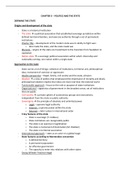
CHAPTER 3 – POLITICS AND THE STATE
DEFINING THE STATE
Origins and development of the state
- State is a historical institution
- The state → a political association that established sovereign jurisdiction within
defined territorial borders, and exercise authority through a set of permanent
institutions
- Charles Tilly – development of the modern state was its ability to fight wars
o War made the state, and the state made war
- Marxists – origins of the state are traced back to the transition from feudalism to
capitalism
- Nation-state → a sovereign political association within which citizenship and
nationality overlap, one nation within a single state
Approaches to the state
- State can be a lot of things: collection of institutions, territorial unit, philosophical
idea, instrument of coercion or oppression
- Idealist perspective – Hegel, family, civil society and the state, altruism
- Idealism → a view of politics that emphasized the importance of morality and ideals,
philosophical idealism implies thar ideas are more real than the material world
- Functionalist approach – focus on the role or purpose of state institutions
- Organizational – apparatus of government in the broadest sense, set of institutions
that are public
- Civil society → a private sphere of autonomous groups and associations,
independent from the state or public authority
- Sovereignty → the principle of absolute and unlimited power
o Legal – supreme legal authority
o Internal – supreme power within the state
o External – state’s place in international order
- 5 key features of the state
o State is sovereign (T. Hobbes)
o State institutions are recognisably public
o The state is an exercise in legitimation
o The state is instrument of domination (M. Webber)
o The state is territorial association
- International approach – state as an actor on a global stage
- State features according to Montevideo convention
o A defined territory
o A permanent population
o An effective government
o The capacity to enter into relations with other states
- Georg Wilhelm Friedrich Hegel
, o German philosopher, founder of modern idealism
o Consciousness and material objects are unified
o Phenomenology of spirit
DEBATING THE STATE
Rival theories of the state
- State is essentially contested
The pluralist state
- Liberal lineage, state as a umpire or referee in society
- Popular in Anglo-American
- Pluralism → a belief in diversity or multiplicity, or the belief that power in modern
societies is widely and evenly distributed
- Hobbes and Locke
- Political obligation → the duty of the citizen towards the state, the basis of the
state’s right to rule
- T. Hobbes – English philosopher, first comprehensive theory of nature and human
behaviour since Aristotle
- State of nature → society devoid of political authority and of formal (legal) checks on
the individual, usually employed as a theoretical device
- Divine right → the doctrine that earthly rulers are chosen by God and thus wield
unchallengeable authority, a defence of monarchical absolutism
- Neutrality of the state
- Hobbes → stability and order could be secured only through unlimited state
- Locke → limited state, defence of natural (god given) rights – life, liberty and
property
- Anarchy → without rule, other word for instability and chaos
- State is neutral
- Schwarzmantel – state is a servant of society, not its master
o Two key assumptions
▪ State is subordinate to government
▪ Democratic process is meaningful and effective
- Social-contract theory → voluntary agreement amongst individuals through which an
organized society (state) is brought to existence
- Modern pluralism → critical view of the state
o R. Dahl, C. Lindblom, J. K. Galbraith
o Modern states are less responsible to pluralism
o Business enjoys privileged position
- Neo pluralism → style of social theorizing that remains faithful to pluralist values
while recognising the need to revise or update classical pluralism
The capitalist state
- Marxist notion, alternative to pluralism
DEFINING THE STATE
Origins and development of the state
- State is a historical institution
- The state → a political association that established sovereign jurisdiction within
defined territorial borders, and exercise authority through a set of permanent
institutions
- Charles Tilly – development of the modern state was its ability to fight wars
o War made the state, and the state made war
- Marxists – origins of the state are traced back to the transition from feudalism to
capitalism
- Nation-state → a sovereign political association within which citizenship and
nationality overlap, one nation within a single state
Approaches to the state
- State can be a lot of things: collection of institutions, territorial unit, philosophical
idea, instrument of coercion or oppression
- Idealist perspective – Hegel, family, civil society and the state, altruism
- Idealism → a view of politics that emphasized the importance of morality and ideals,
philosophical idealism implies thar ideas are more real than the material world
- Functionalist approach – focus on the role or purpose of state institutions
- Organizational – apparatus of government in the broadest sense, set of institutions
that are public
- Civil society → a private sphere of autonomous groups and associations,
independent from the state or public authority
- Sovereignty → the principle of absolute and unlimited power
o Legal – supreme legal authority
o Internal – supreme power within the state
o External – state’s place in international order
- 5 key features of the state
o State is sovereign (T. Hobbes)
o State institutions are recognisably public
o The state is an exercise in legitimation
o The state is instrument of domination (M. Webber)
o The state is territorial association
- International approach – state as an actor on a global stage
- State features according to Montevideo convention
o A defined territory
o A permanent population
o An effective government
o The capacity to enter into relations with other states
- Georg Wilhelm Friedrich Hegel
, o German philosopher, founder of modern idealism
o Consciousness and material objects are unified
o Phenomenology of spirit
DEBATING THE STATE
Rival theories of the state
- State is essentially contested
The pluralist state
- Liberal lineage, state as a umpire or referee in society
- Popular in Anglo-American
- Pluralism → a belief in diversity or multiplicity, or the belief that power in modern
societies is widely and evenly distributed
- Hobbes and Locke
- Political obligation → the duty of the citizen towards the state, the basis of the
state’s right to rule
- T. Hobbes – English philosopher, first comprehensive theory of nature and human
behaviour since Aristotle
- State of nature → society devoid of political authority and of formal (legal) checks on
the individual, usually employed as a theoretical device
- Divine right → the doctrine that earthly rulers are chosen by God and thus wield
unchallengeable authority, a defence of monarchical absolutism
- Neutrality of the state
- Hobbes → stability and order could be secured only through unlimited state
- Locke → limited state, defence of natural (god given) rights – life, liberty and
property
- Anarchy → without rule, other word for instability and chaos
- State is neutral
- Schwarzmantel – state is a servant of society, not its master
o Two key assumptions
▪ State is subordinate to government
▪ Democratic process is meaningful and effective
- Social-contract theory → voluntary agreement amongst individuals through which an
organized society (state) is brought to existence
- Modern pluralism → critical view of the state
o R. Dahl, C. Lindblom, J. K. Galbraith
o Modern states are less responsible to pluralism
o Business enjoys privileged position
- Neo pluralism → style of social theorizing that remains faithful to pluralist values
while recognising the need to revise or update classical pluralism
The capitalist state
- Marxist notion, alternative to pluralism