
Lecture 2
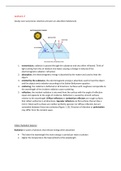
(stukje over wat precies relection,emission en absorbion betekenen)
1. transmission, radiation is passed through the substance and very often refracted. Think of
light coming from the air medium into water causing a change in velocity of the
electromagnetic radiation: refraction.
2. absorption, the electromagnetic energy is absorbed by the matter and used to heat the
object.
3. emitted by the substance, the electromagnetic energy is absorbed, used to heat the object
and the object emits radiation according to the Stefan-Boltzmann equation.
4. scattering, the radiation is deflected in all directions. Surfaces with roughness comparable to
the wavelength of the incident radiation cause scattering.
5. reflection, the incident radiation is returned from the surface with the angle of reflection
equal and opposite to the angle of incidence. Reflection is caused by smooth surfaces
relative to the wavelength. Diffuse reflectors or Lambertian reflectors are rough surfaces
that reflect uniformly in all directions. Specular reflectors are flat surfaces that act like a
mirror. Most earth surfaces are neither perfectly specular nor diffuse reflectors but act
somewhat between these two extremes (figure 1.12). Direction of vibration or polarization
may differ from the incident wave.
Video: Radiation balance
Radiation is waves of photons that release energy when absorbed.
• The lower the wavelength the more energy is carried per wave or photon
• Higher the temperature the lower(/shorter) the wavelength
,Planck function
All objects above 0 kelvin release radiation
Energy emitted is (E= εT^4) in W/m^2
ε Is emissivity, blackbody ε = 1 Is Stefan-Bolzman cste , = 5.67*10^-8
• Area under the planck curve is the total energy emitted
Radian theory
Sun has very high temperature
Emits high energy radiation with short wavelength
➢ Shortwave radiation (uv, visible)
Land surface lower temperature
Emits low energy radiation with long wavelength
➢ Long wave radiation (infrared = near room temperature)
Short wave radiation
Shortwave radiation from the Sun penetrates through space to outer edge of atmosphere. Until this
point no disturbance.
solar constant
Shortwave radiation can reach the ground as: Once solar radiation begins to penetrate through the
atmosphere this amount begins to decrease due to
,absorption (~20%)
reflection (e.g. by clouds, the more clouds, the less shortwave radiation reaches the ground)
Shortwave radiation can reach the ground as:
Direct radiation diffuse radiation
Diffuse radiation(a beam of radiation is broken down into many weaker rays redirected in other
directions by gases in the atmosphere)
It can be
Absorbed
Reflected > depend on albedo
Albedo = measure of amount of shortwave radiation that is reflected
Albedo snow: 0.87
Albedo fresh asphalt: 0.04
Longwave radiation
Stefan Boltzmann equation
Earth’s surface emits longwave radiation
Infrared radiation
Gases of the atmosphere are relatively good absorbers of longwave radiation
➢ Absorb the energy emitted by the Earth’s surface
80% of excess radiative energy used to evaporate water rather than raising the surface temperature
Water vapor condenses in atmosphere which is causing the atmosphere to heat up (ocean, lake or
plants) vaporizing water
➢ Latent heat transfer = 80% of excess radiative energy used for rising warm air and sinking
cold air, parcels of warm air rising to the atmosphere , evapotranspiration.
➢ sensible heat transfer = 20% is related to changes in temperature of a gas or object with no
change in phase
Latent heat flux= Energy is supplied by the Earth surface to turn water from the liquid into the
gaseous phase and is released when this same water vapor condensates again when clouds are
formed.
radiation in different in at the poles and the equator.
, Video: Greenhous effect
There is more energy getting in then getting out = the greenhouse effect
Depends on temperature difference from the atmosphere and surface
And this depends on the greenhouse gasses.
Radiative forcing (RF); is difference between incoming solar radiation and outcoming
difference between
- incoming solar radiation
- outgoing LW radiation
- Incoming LW radiation from stratosphere at the tropopause!
Instantaneous radiative forcing :
Without temperature of the stratosphere
(adjusted) radiative forcing:
Including temperature adjustment of the stratosphere
➢ Makes the RF smaller (because smaller LW flux from stratosphere to troposphere)
Video: atmospheric circulation
Because of forces
- Pressure difference
- Earth rotation
(stukje over wat precies relection,emission en absorbion betekenen)
1. transmission, radiation is passed through the substance and very often refracted. Think of
light coming from the air medium into water causing a change in velocity of the
electromagnetic radiation: refraction.
2. absorption, the electromagnetic energy is absorbed by the matter and used to heat the
object.
3. emitted by the substance, the electromagnetic energy is absorbed, used to heat the object
and the object emits radiation according to the Stefan-Boltzmann equation.
4. scattering, the radiation is deflected in all directions. Surfaces with roughness comparable to
the wavelength of the incident radiation cause scattering.
5. reflection, the incident radiation is returned from the surface with the angle of reflection
equal and opposite to the angle of incidence. Reflection is caused by smooth surfaces
relative to the wavelength. Diffuse reflectors or Lambertian reflectors are rough surfaces
that reflect uniformly in all directions. Specular reflectors are flat surfaces that act like a
mirror. Most earth surfaces are neither perfectly specular nor diffuse reflectors but act
somewhat between these two extremes (figure 1.12). Direction of vibration or polarization
may differ from the incident wave.
Video: Radiation balance
Radiation is waves of photons that release energy when absorbed.
• The lower the wavelength the more energy is carried per wave or photon
• Higher the temperature the lower(/shorter) the wavelength
,Planck function
All objects above 0 kelvin release radiation
Energy emitted is (E= εT^4) in W/m^2
ε Is emissivity, blackbody ε = 1 Is Stefan-Bolzman cste , = 5.67*10^-8
• Area under the planck curve is the total energy emitted
Radian theory
Sun has very high temperature
Emits high energy radiation with short wavelength
➢ Shortwave radiation (uv, visible)
Land surface lower temperature
Emits low energy radiation with long wavelength
➢ Long wave radiation (infrared = near room temperature)
Short wave radiation
Shortwave radiation from the Sun penetrates through space to outer edge of atmosphere. Until this
point no disturbance.
solar constant
Shortwave radiation can reach the ground as: Once solar radiation begins to penetrate through the
atmosphere this amount begins to decrease due to
,absorption (~20%)
reflection (e.g. by clouds, the more clouds, the less shortwave radiation reaches the ground)
Shortwave radiation can reach the ground as:
Direct radiation diffuse radiation
Diffuse radiation(a beam of radiation is broken down into many weaker rays redirected in other
directions by gases in the atmosphere)
It can be
Absorbed
Reflected > depend on albedo
Albedo = measure of amount of shortwave radiation that is reflected
Albedo snow: 0.87
Albedo fresh asphalt: 0.04
Longwave radiation
Stefan Boltzmann equation
Earth’s surface emits longwave radiation
Infrared radiation
Gases of the atmosphere are relatively good absorbers of longwave radiation
➢ Absorb the energy emitted by the Earth’s surface
80% of excess radiative energy used to evaporate water rather than raising the surface temperature
Water vapor condenses in atmosphere which is causing the atmosphere to heat up (ocean, lake or
plants) vaporizing water
➢ Latent heat transfer = 80% of excess radiative energy used for rising warm air and sinking
cold air, parcels of warm air rising to the atmosphere , evapotranspiration.
➢ sensible heat transfer = 20% is related to changes in temperature of a gas or object with no
change in phase
Latent heat flux= Energy is supplied by the Earth surface to turn water from the liquid into the
gaseous phase and is released when this same water vapor condensates again when clouds are
formed.
radiation in different in at the poles and the equator.
, Video: Greenhous effect
There is more energy getting in then getting out = the greenhouse effect
Depends on temperature difference from the atmosphere and surface
And this depends on the greenhouse gasses.
Radiative forcing (RF); is difference between incoming solar radiation and outcoming
difference between
- incoming solar radiation
- outgoing LW radiation
- Incoming LW radiation from stratosphere at the tropopause!
Instantaneous radiative forcing :
Without temperature of the stratosphere
(adjusted) radiative forcing:
Including temperature adjustment of the stratosphere
➢ Makes the RF smaller (because smaller LW flux from stratosphere to troposphere)
Video: atmospheric circulation
Because of forces
- Pressure difference
- Earth rotation


