
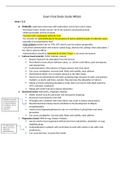
Final Study Guide NR565
Exam Final Study Guide NR565 Week 7 & 8 Antacids: weak bases that react with hydrochloric acid to form salt & water. -Neutralize Gastric Acidity (causes ^pH of the stomach and duodenal bulb) -Inhibit proteolytic activity of pepsin -Increase lower esophageal sphincter tone -ALL antacids are contraindicated in the presence of severe abdominal pain of unknown cause, especially if accompanied by fever -HIGH SODIUM content: pts w/ HTN. CHF need to use low sodium preparation -Concurrent administration with enteric-coated drugs, destroys the coating= alters absorption, ^ the risk for adverse effects -Administrations should be separated by at least 2 hours to decrease interactions 1. Calcium based antacids: TUMS, Caltrate, Calcarb Require Vitamin D for absorption from the GI tract Prescribed to treat calcium deficient states, i.e. chronic renal failure, post-menopause, and osteoporosis Contraindicated in the presence of hypercalcemia and renal calculi Can cause constipation- increase bulk, fluids and mobility, stool softener Administered 30min- 1hr on empty stomach or 3hr after meals Should not be administered with food containing large amounts of oxalic acid (spinach, rhubarb), or phytic acid (bran, cereals), they decrease the absorption of calcium Taking w/ foods containing phosphorus (milk, dairy) can lead to milk-alkali syndrome (N/V, confusion, headache). Taking with acidic fruit juice improve absorpt
Document information
- Uploaded on
- October 13, 2022
- Number of pages
- 23
- Written in
- 2022/2023
- Type
- Exam (elaborations)
- Contains
- Unknown


