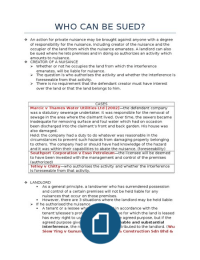
WHO CAN BE SUED?
An action for private nuisance may be brought against anyone with a degree
of responsibility for the nuisance, including creator of the nuisance and the
occupier of the land from which the nuisance emanates. A landlord can also
be sued where he lets premises and in doing so authorizes an activity which
amounts to nuisance.
CREATOR OF A NUISANCE
Whether or not he occupies the land from which the interference
emanates, will be liable for nuisance.
The question is who authorises the activity and whether the interference is
foreseeable from that activity.
There is no requirement that the defendant creator must have interest
over the land or that the land belongs to him.
CASES
Marcic v Thames Water Utilities Ltd [2002]—the defendant company
was a statutory sewerage undertaker. It was responsible for the removal of
sewage in the area where the claimant lived. Over time, the sewers became
inadequate for removing surface and foul water which had on occasion
been discharged into the claimant’s front and back garden. His house was
also damaged.
Held: the company had a duty to do whatever was reasonable in the
circumstances to prevent such hazards from damaging property belonging
to others. The company had or should have had knowledge of the hazard
and it was within their capabilities to abate the nuisance. (foreseeability)
Southport Corporation v Esso Petroleum—the licensee will be deemed
to have been invested with the management and control of the premises
(authorized)
Tetley v Chitty—who authorises the activity and whether the interference
is foreseeable from that activity.
LANDLORD
As a general principle, a landowner who has surrendered possession
and control of a certain premises will not be held liable for any
nuisances that occur on those premises.
However, there are 3 situations where the landlord may be held liable:
If he authorised the nuisance
A tenant or a lessee who uses the land in accordance with the
tenant’s/lessee’s profession or the purpose for which the land is leased
has every right to use the premises for the agreed purpose, but If the
agreed purpose gives rise to an unreasonable and substantial
interference, the nuisance will also be attributed to the landlord. (Wu
Siew Ying v Gunung Tunggal Quarry & Construction Sdn Bhd &
An action for private nuisance may be brought against anyone with a degree
of responsibility for the nuisance, including creator of the nuisance and the
occupier of the land from which the nuisance emanates. A landlord can also
be sued where he lets premises and in doing so authorizes an activity which
amounts to nuisance.
CREATOR OF A NUISANCE
Whether or not he occupies the land from which the interference
emanates, will be liable for nuisance.
The question is who authorises the activity and whether the interference is
foreseeable from that activity.
There is no requirement that the defendant creator must have interest
over the land or that the land belongs to him.
CASES
Marcic v Thames Water Utilities Ltd [2002]—the defendant company
was a statutory sewerage undertaker. It was responsible for the removal of
sewage in the area where the claimant lived. Over time, the sewers became
inadequate for removing surface and foul water which had on occasion
been discharged into the claimant’s front and back garden. His house was
also damaged.
Held: the company had a duty to do whatever was reasonable in the
circumstances to prevent such hazards from damaging property belonging
to others. The company had or should have had knowledge of the hazard
and it was within their capabilities to abate the nuisance. (foreseeability)
Southport Corporation v Esso Petroleum—the licensee will be deemed
to have been invested with the management and control of the premises
(authorized)
Tetley v Chitty—who authorises the activity and whether the interference
is foreseeable from that activity.
LANDLORD
As a general principle, a landowner who has surrendered possession
and control of a certain premises will not be held liable for any
nuisances that occur on those premises.
However, there are 3 situations where the landlord may be held liable:
If he authorised the nuisance
A tenant or a lessee who uses the land in accordance with the
tenant’s/lessee’s profession or the purpose for which the land is leased
has every right to use the premises for the agreed purpose, but If the
agreed purpose gives rise to an unreasonable and substantial
interference, the nuisance will also be attributed to the landlord. (Wu
Siew Ying v Gunung Tunggal Quarry & Construction Sdn Bhd &