
Taste lecture (1)
● Five basic tastes:
○ Sweet.
○ Salt.
○ Umami.
○ Sour.
○ Bitter.
● The chemistry between salt and sweet is not well understood.
● A certain company turns taste sensations into food ingredients: there is a range of
complete flavor solutions that provides a tingling sensation or a salivating sensation.
● It is also possible to combine flavors with encapsulation strategies.
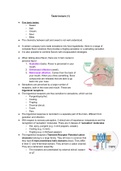
● When talking about flavor, there are 3 main routes to
perceive flavor:
1. Gustation (taste). Flavor is perceived in your
mouth.
2. Orthonasal olfaction (smell).
3. Retronasal olfaction. Comes from the back of
your mouth. When you chew something, flavor
compounds are released that are able to go
back into your nose.
● Sensations are perceived by a large number of
receptors, both in the nose and mouth. These are
trigeminal receptors.
● The trigeminal receptors are thus sensitive to sensations, which can be:
○ Pungent/spicy/hot.
○ Cooling.
○ Tingling.
○ Thermal stimuli.
○ Touch.
○ Pain.
● The trigeminal response is recorded in a separate part of the brain, different from
gustation and olfaction.
● With respect to sensory perception, 2 stimuli are of importance: temperature and the
recognition of ‘sensation’ molecules. There are 3 classes of ‘sensation’ molecules:
○ Hot, spicy, pungent (e.g. in chili peppers, wasabi).
○ Cooling (e.g. in mint).
○ Tingling (e.g. in Sichuan pepper).
● The trigeminal receptors (Transient Receptor Potential cation
channels) belong to a large family. They all have in common that
they have 6 trans-membrane helix domains (blue). They differ
in their C- and N-terminal domain. They all form a cation channel.
They are a tetrameric assembly.
○ The receptors are potentiated by external stimuli: tastant
or ΔT.
, ● The trigeminal receptors are quite different from the basic taste receptors.
○ Taste receptors have 7 trans-membrane helices. They act as monomers and
do not form a channel. They are G-protein coupled receptors (GPCR).
● The TRPV1 receptor will recognize e.g. capsaicin (chili pepper).
● The TRPA1 receptor will recognize e.g. glucosinolates (mustard).
● The TRPM8 receptor will recognize e.g. menthol (mint).
● Mechanism of action:
○ There is first activation of the receptor by a stimulus (tastant or ΔT). The
channel will open and there is an influx of Ca2+ and Na+ inside the cell.
There will be depolarization of the neuronal fibers. Subsequently, electrical
stimuli will be transduced to the brain via the trigeminal nerve. You then
perceive the sensation.
● Each TRP responds to a specific temperature range.
○ TRP’s sensitivity to temperature is related to conformational changes in the
tetrameric TRP assembly, leading to widening (increased activity) or
narrowing of the channel (decreased activity).
● If you have a warm dish, you will have an overwhelming taste of spiciness. However,
if you let the dish cool down, the spiciness will be reduced (still spicy, but not that
strong).
● EC50 can be used to conveniently compare the binding affinity of ligands.
- EC50: half maximal effective concentration.
● It should be noted that mammals are sensitive to capsaicin, whereas birds are not.
● Capsaicin is the main compound
responsible for spiciness in chili peppers.
Capsaicin is characterized by its
homovanillyl group (aromatic ring with
OH-group and O-methyl group).
○ The TRPV1 receptor will recognize
the homovanillyl group.
● When it comes to cooling compounds, there are a lot of different structures that can
all be recognized by the TRPM8 receptor. The different structures will activate the
receptor to a different degree.
● TRPA1-activating compounds have in common that they are able to react with
cysteine.
● Five basic tastes:
○ Sweet.
○ Salt.
○ Umami.
○ Sour.
○ Bitter.
● The chemistry between salt and sweet is not well understood.
● A certain company turns taste sensations into food ingredients: there is a range of
complete flavor solutions that provides a tingling sensation or a salivating sensation.
● It is also possible to combine flavors with encapsulation strategies.
● When talking about flavor, there are 3 main routes to
perceive flavor:
1. Gustation (taste). Flavor is perceived in your
mouth.
2. Orthonasal olfaction (smell).
3. Retronasal olfaction. Comes from the back of
your mouth. When you chew something, flavor
compounds are released that are able to go
back into your nose.
● Sensations are perceived by a large number of
receptors, both in the nose and mouth. These are
trigeminal receptors.
● The trigeminal receptors are thus sensitive to sensations, which can be:
○ Pungent/spicy/hot.
○ Cooling.
○ Tingling.
○ Thermal stimuli.
○ Touch.
○ Pain.
● The trigeminal response is recorded in a separate part of the brain, different from
gustation and olfaction.
● With respect to sensory perception, 2 stimuli are of importance: temperature and the
recognition of ‘sensation’ molecules. There are 3 classes of ‘sensation’ molecules:
○ Hot, spicy, pungent (e.g. in chili peppers, wasabi).
○ Cooling (e.g. in mint).
○ Tingling (e.g. in Sichuan pepper).
● The trigeminal receptors (Transient Receptor Potential cation
channels) belong to a large family. They all have in common that
they have 6 trans-membrane helix domains (blue). They differ
in their C- and N-terminal domain. They all form a cation channel.
They are a tetrameric assembly.
○ The receptors are potentiated by external stimuli: tastant
or ΔT.
, ● The trigeminal receptors are quite different from the basic taste receptors.
○ Taste receptors have 7 trans-membrane helices. They act as monomers and
do not form a channel. They are G-protein coupled receptors (GPCR).
● The TRPV1 receptor will recognize e.g. capsaicin (chili pepper).
● The TRPA1 receptor will recognize e.g. glucosinolates (mustard).
● The TRPM8 receptor will recognize e.g. menthol (mint).
● Mechanism of action:
○ There is first activation of the receptor by a stimulus (tastant or ΔT). The
channel will open and there is an influx of Ca2+ and Na+ inside the cell.
There will be depolarization of the neuronal fibers. Subsequently, electrical
stimuli will be transduced to the brain via the trigeminal nerve. You then
perceive the sensation.
● Each TRP responds to a specific temperature range.
○ TRP’s sensitivity to temperature is related to conformational changes in the
tetrameric TRP assembly, leading to widening (increased activity) or
narrowing of the channel (decreased activity).
● If you have a warm dish, you will have an overwhelming taste of spiciness. However,
if you let the dish cool down, the spiciness will be reduced (still spicy, but not that
strong).
● EC50 can be used to conveniently compare the binding affinity of ligands.
- EC50: half maximal effective concentration.
● It should be noted that mammals are sensitive to capsaicin, whereas birds are not.
● Capsaicin is the main compound
responsible for spiciness in chili peppers.
Capsaicin is characterized by its
homovanillyl group (aromatic ring with
OH-group and O-methyl group).
○ The TRPV1 receptor will recognize
the homovanillyl group.
● When it comes to cooling compounds, there are a lot of different structures that can
all be recognized by the TRPM8 receptor. The different structures will activate the
receptor to a different degree.
● TRPA1-activating compounds have in common that they are able to react with
cysteine.


