Cell theory
Example question: outline the cell theory [2]
Exceptions to cell theory
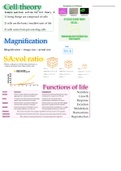
1) living things are composed of cells
IF C ELLS C O ME FROM
2) cells are the basic/smallest unit of life - CE iis!!
<
r
H
3) cells come from pre-existing cells (end #
, 2
THENWHERE DlDTHEFIRSTCELL
140ii.EFRio'M?!
Magnification .
M lA :
Magnification = image size ÷ actual size at
M -
-
SA:vol ratio
When a cell grows, SA:Vol ratio decreases as
volume increases faster than surface area
sides = 3
¥ sides = 2 sides = 1
Yummyfeel anyYET
so wound) surface area = 3 x 3 x 6 = 54 surface area = 2 x 2 x 6 = 24 surface area = 1 x 1 x 6 = 6
j
250 volume = 3 x 3 x 3 = 27 volume = 2 x 2 x 2 = 8 volume = 1 x 1 x 1 = 1
§
-
200
SA:Vol = 2 SA:Vol = 2 SA:Vol = 6
{l 50
II t OO
§ 5O
-
Functions of life
.
l 2 3 4 5 G 7
Nutrition
Growth
Response
Excretion
Metabolism
Homeostasis
Reproduction
,Example question: explain the importance of surface area to volume ratio as
a factor limiting cell size [7]
as volume of a cell increases, the ratio of its surface area to volume decreases;
food/oxygen enters through the surface of cells;
wastes leave through the surface of cells;
the rate of substance crossing the membrane depends on surface area;
more metabolic activity in a larger cell means more food and oxygen required;
large volume means longer diffusion time;
(large volume) means more wastes produced;
excess heat generated will not be lost efficiently (with low surface area to
volume ratio);
eventually surface area can no longer serve the requirements of the cell;
this critical ratio stimulates mitosis;
(thus) the size of the cell is reduced and kept within size limits;
Example question: state the function of life in Paramecium that is carried
out by: cilia [1]
movement/locomotion OR feeding/nutrition
Example question: state the function of life in Paramecium that is carried
out by: contractile vacuole [1]
homeostasis OR maintain osmotic balance/expels << excess>> water/ maintains
<<cell>> water content
Emergent properties
Emergent properties arise from the
interaction of the component parts
of a complex structure.
Multicellular organisms have
properties that emerge from the
interaction of their cellular
components.
, Differentiation All cells have the same set of genes (identical
genome)
However, a different sequence of genes is
expressed in different cells, which results in
a cell undergoing differentiation and
becoming specialised.
Example question: explain how multicellular organisms develop specialised
tissues [2]
only some genes are expressed in each cell type/tissue;
tissues therefore develop differently/become differentiated;
example of differentiated cell and the function of tissues
Example question: explain how a meristematic cell develops into a mesophyll
cell in a leaf [7]
Process [max 6]
cells stop dividing;
enlarge / elongate;
water enters;
by osmosis / down water potential gradient;
vacuoles form;
cellulose, stretches / increases area of cell walls;
synthesise new materials / named
differentiate;
cell becomes specialised;
ref to gene switch on / off;
ref to PGR / named PGR PGR: plant growth regulator
=
Structure [max 3]
cytoplasm round edge / large central vacuole;
palisade columnar;
spongy irregular;
chloroplasts form
Example question: outline the cell theory [2]
Exceptions to cell theory
1) living things are composed of cells
IF C ELLS C O ME FROM
2) cells are the basic/smallest unit of life - CE iis!!
<
r
H
3) cells come from pre-existing cells (end #
, 2
THENWHERE DlDTHEFIRSTCELL
140ii.EFRio'M?!
Magnification .
M lA :
Magnification = image size ÷ actual size at
M -
-
SA:vol ratio
When a cell grows, SA:Vol ratio decreases as
volume increases faster than surface area
sides = 3
¥ sides = 2 sides = 1
Yummyfeel anyYET
so wound) surface area = 3 x 3 x 6 = 54 surface area = 2 x 2 x 6 = 24 surface area = 1 x 1 x 6 = 6
j
250 volume = 3 x 3 x 3 = 27 volume = 2 x 2 x 2 = 8 volume = 1 x 1 x 1 = 1
§
-
200
SA:Vol = 2 SA:Vol = 2 SA:Vol = 6
{l 50
II t OO
§ 5O
-
Functions of life
.
l 2 3 4 5 G 7
Nutrition
Growth
Response
Excretion
Metabolism
Homeostasis
Reproduction
,Example question: explain the importance of surface area to volume ratio as
a factor limiting cell size [7]
as volume of a cell increases, the ratio of its surface area to volume decreases;
food/oxygen enters through the surface of cells;
wastes leave through the surface of cells;
the rate of substance crossing the membrane depends on surface area;
more metabolic activity in a larger cell means more food and oxygen required;
large volume means longer diffusion time;
(large volume) means more wastes produced;
excess heat generated will not be lost efficiently (with low surface area to
volume ratio);
eventually surface area can no longer serve the requirements of the cell;
this critical ratio stimulates mitosis;
(thus) the size of the cell is reduced and kept within size limits;
Example question: state the function of life in Paramecium that is carried
out by: cilia [1]
movement/locomotion OR feeding/nutrition
Example question: state the function of life in Paramecium that is carried
out by: contractile vacuole [1]
homeostasis OR maintain osmotic balance/expels << excess>> water/ maintains
<<cell>> water content
Emergent properties
Emergent properties arise from the
interaction of the component parts
of a complex structure.
Multicellular organisms have
properties that emerge from the
interaction of their cellular
components.
, Differentiation All cells have the same set of genes (identical
genome)
However, a different sequence of genes is
expressed in different cells, which results in
a cell undergoing differentiation and
becoming specialised.
Example question: explain how multicellular organisms develop specialised
tissues [2]
only some genes are expressed in each cell type/tissue;
tissues therefore develop differently/become differentiated;
example of differentiated cell and the function of tissues
Example question: explain how a meristematic cell develops into a mesophyll
cell in a leaf [7]
Process [max 6]
cells stop dividing;
enlarge / elongate;
water enters;
by osmosis / down water potential gradient;
vacuoles form;
cellulose, stretches / increases area of cell walls;
synthesise new materials / named
differentiate;
cell becomes specialised;
ref to gene switch on / off;
ref to PGR / named PGR PGR: plant growth regulator
=
Structure [max 3]
cytoplasm round edge / large central vacuole;
palisade columnar;
spongy irregular;
chloroplasts form