

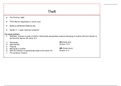
Theft
● The Theft act 1968
● TEW offence-magistrates or crown court
● Made by parliament-Statutory law
● Section 7- 7 years maximum sentence
The seven sections:
1. Definition- A person is guilty of theft is: Dishonestly appropriates property belonging to another with the intention to
permanently deprive the owner of it
2. Dishonesty AR (Guilty act)-
3. Appropriates Section 3,4,5
4. Property
5. Belonging to another MR (Guilty mind)-
6. With the intention to permanently deprive the owner of it Section 2+ 6
7. The sentence (7years)
, S2. Dishonestly (MR)
R v Ghosh (1982)
● Charged the NHS for a surgery he did not do
● This case came up with two questions:
1.Would the ordinary, honest person consider it dishonest?-Objective part of the test
2.Did D consider it to be dishonest?-Subjective
● The Jury have to ask themselves these questions
Ivey v Genting Casinos (2017)- (Poker player, didn't consider edge-sorting cheating)
● This case has cast doubt on the second part of test
● D was a poker player and he won 7.1 million in a casino in 2012
● The casino claimed he was not entitled the money as he cheated as he used a technique called ‘edge-sorting’
● Ivey stated he did not consider ‘edge-sorting’ to be cheating- the subjective limb of Ghosh could not be fulfilled
● The second question of the ghosh test was applied and the ordinary man would consider this cheating
● The Theft act 1968
● TEW offence-magistrates or crown court
● Made by parliament-Statutory law
● Section 7- 7 years maximum sentence
The seven sections:
1. Definition- A person is guilty of theft is: Dishonestly appropriates property belonging to another with the intention to
permanently deprive the owner of it
2. Dishonesty AR (Guilty act)-
3. Appropriates Section 3,4,5
4. Property
5. Belonging to another MR (Guilty mind)-
6. With the intention to permanently deprive the owner of it Section 2+ 6
7. The sentence (7years)
, S2. Dishonestly (MR)
R v Ghosh (1982)
● Charged the NHS for a surgery he did not do
● This case came up with two questions:
1.Would the ordinary, honest person consider it dishonest?-Objective part of the test
2.Did D consider it to be dishonest?-Subjective
● The Jury have to ask themselves these questions
Ivey v Genting Casinos (2017)- (Poker player, didn't consider edge-sorting cheating)
● This case has cast doubt on the second part of test
● D was a poker player and he won 7.1 million in a casino in 2012
● The casino claimed he was not entitled the money as he cheated as he used a technique called ‘edge-sorting’
● Ivey stated he did not consider ‘edge-sorting’ to be cheating- the subjective limb of Ghosh could not be fulfilled
● The second question of the ghosh test was applied and the ordinary man would consider this cheating


