

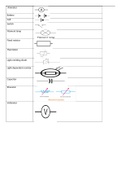
Ammeter
Battery
Cell
Switch
Filament lamp
Fixed resistor
Thermistor
Light emitting diode
Light dependent resistor
Capacitor
Rheostat
Voltmeter
, Current (amperes) Is the rate of flow of charge around the
electrical circuits.
Potential difference (volt) Potential difference is amount of energy
which is transferred between two parts of
the circuit.
Electrical charge (coulomb) Charge is is the amount of rate of flow of
charge
Resistance (ohm) This is a force which lower the current. A
high resistance means low current. A low
resistance means a high current.
Conductance (Siemen) Is how electric current can flow easily
thorough
Electrical power (watt) This is the rate at which electrical energy is
transferred into the circuit.
Capacitance (farad and subunits) This is component which stores and collects
energy in the form of electrical charge.
They are energy storing devices which are
in different shapes, and they have two
plates which are material that conducts and
the thing between the two plates are
ceramic, glass and they are many other
materials.
Current in term of rate of flow of mobile Current is the rate of flow of electrons
charge carrier.
Electromotive force (EMF) as a measure of Electromotive force is the same as potential
ratio of energy supplied per unit of course difference when there is zero flow of
current. This is how much energy which is
given by the battery to every single
coulomb which is passing through.
Conductance and resistance in relation to Conductor such as copper it is a metal
density of the mobile charge carriers. which has delocalized electron so it has a
high mobile charge carriers
Potential difference and resistance - Electric circuits - AQA - BBC
https://www.bbc.co.uk › bitesize › guides › revision
Section 2 - Electrical formulae and relationships
Draw diagrams of theoretical circuits and use the following electrical formulae to accurately calculate a
range of electrical quantities. As part of your working, explain the following equations and how you have
applied them:
Electrical formulae and relationships
Kirchhoff’s first law is that the currents entering the junction within the circuit equals to the current leaving the
junction.
,e.g= I1 + I2 = I3 + I4
Kirchhoff’s second law-
This states that where there is in a circuit a closed loop this means total potential difference around this circuit
equal to zero. This relates to the voltage which lower across the component in the circuit.
An example of this is the electromotive force= potential difference +1 + potential difference 2 + potential
difference 3 = 0
S-cool
Kirchoff's First and Second Laws | S-cool, the revision website
Kirchoff first law – the current entering the junction equal to the current leaving the junction
Ohms law-
, This is a law that says the current is directly proportional to the voltage but inversely proportional to the
resistance which shows the correlation between the current, voltage and resistance.
Example
The equation is voltage= current * resistance
So E= i*R
Rearrange the equation
R=E/I
36/4=12 ohms
So, the resistance is 12 ohms.
The resistance is 12 ohms because you divide 36/12=4
Due to the voltage over the current there will be
Power-
Power is the amount of work done in a fixed time
The equation is power = voltage * current. or power= I squared * R
Or power= energy/ time
Example
A washing machine is used for 60 minutes and a sum of 10000000 joules of energy is transferred. Calculate the
power of the washing machine.
60 minutes convert to second= 60*60=360
1 million/360= 2777.77777778
2777.8
Charge= is a property of body which encounters a force in an electromagnetic field area.
The equation for charge= current* time and q=i*t
Charge is measured in coulombs.
Current is measured in amperes.
Time is measured in seconds.
A current of 12a flows. How long does it take for 1440 c to pass a point in the circuit?
1400/12=120s
Conductance this measures how simple it is for an electric current to pass though for example a metal but it
can be anything. This is also the opposite of resistance.
The equation for this is g=1/r=1/v
What is the conductance on a circuit on 120 volts and a current of 500 amps?
Resistance= v/i
Battery
Cell
Switch
Filament lamp
Fixed resistor
Thermistor
Light emitting diode
Light dependent resistor
Capacitor
Rheostat
Voltmeter
, Current (amperes) Is the rate of flow of charge around the
electrical circuits.
Potential difference (volt) Potential difference is amount of energy
which is transferred between two parts of
the circuit.
Electrical charge (coulomb) Charge is is the amount of rate of flow of
charge
Resistance (ohm) This is a force which lower the current. A
high resistance means low current. A low
resistance means a high current.
Conductance (Siemen) Is how electric current can flow easily
thorough
Electrical power (watt) This is the rate at which electrical energy is
transferred into the circuit.
Capacitance (farad and subunits) This is component which stores and collects
energy in the form of electrical charge.
They are energy storing devices which are
in different shapes, and they have two
plates which are material that conducts and
the thing between the two plates are
ceramic, glass and they are many other
materials.
Current in term of rate of flow of mobile Current is the rate of flow of electrons
charge carrier.
Electromotive force (EMF) as a measure of Electromotive force is the same as potential
ratio of energy supplied per unit of course difference when there is zero flow of
current. This is how much energy which is
given by the battery to every single
coulomb which is passing through.
Conductance and resistance in relation to Conductor such as copper it is a metal
density of the mobile charge carriers. which has delocalized electron so it has a
high mobile charge carriers
Potential difference and resistance - Electric circuits - AQA - BBC
https://www.bbc.co.uk › bitesize › guides › revision
Section 2 - Electrical formulae and relationships
Draw diagrams of theoretical circuits and use the following electrical formulae to accurately calculate a
range of electrical quantities. As part of your working, explain the following equations and how you have
applied them:
Electrical formulae and relationships
Kirchhoff’s first law is that the currents entering the junction within the circuit equals to the current leaving the
junction.
,e.g= I1 + I2 = I3 + I4
Kirchhoff’s second law-
This states that where there is in a circuit a closed loop this means total potential difference around this circuit
equal to zero. This relates to the voltage which lower across the component in the circuit.
An example of this is the electromotive force= potential difference +1 + potential difference 2 + potential
difference 3 = 0
S-cool
Kirchoff's First and Second Laws | S-cool, the revision website
Kirchoff first law – the current entering the junction equal to the current leaving the junction
Ohms law-
, This is a law that says the current is directly proportional to the voltage but inversely proportional to the
resistance which shows the correlation between the current, voltage and resistance.
Example
The equation is voltage= current * resistance
So E= i*R
Rearrange the equation
R=E/I
36/4=12 ohms
So, the resistance is 12 ohms.
The resistance is 12 ohms because you divide 36/12=4
Due to the voltage over the current there will be
Power-
Power is the amount of work done in a fixed time
The equation is power = voltage * current. or power= I squared * R
Or power= energy/ time
Example
A washing machine is used for 60 minutes and a sum of 10000000 joules of energy is transferred. Calculate the
power of the washing machine.
60 minutes convert to second= 60*60=360
1 million/360= 2777.77777778
2777.8
Charge= is a property of body which encounters a force in an electromagnetic field area.
The equation for charge= current* time and q=i*t
Charge is measured in coulombs.
Current is measured in amperes.
Time is measured in seconds.
A current of 12a flows. How long does it take for 1440 c to pass a point in the circuit?
1400/12=120s
Conductance this measures how simple it is for an electric current to pass though for example a metal but it
can be anything. This is also the opposite of resistance.
The equation for this is g=1/r=1/v
What is the conductance on a circuit on 120 volts and a current of 500 amps?
Resistance= v/i


