Test Submission: Quiz - Module 5
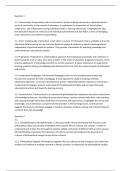
PUBH-8035D-1/HLTH-8035E-1/PUBH-8035-1/PUBH-8035H-1-Epidemiology: Decoding the Sci2022 Summer Qtr 06/01- 08/23-PT27 Quizzes Review Test Submission: Quiz - Module 5 Review Test Submission: Quiz - Module 5 Selection bias is most likely to occur in which type of study? Selected Answer: d. Both retrospective cohort and case-control studies Question 2 Interviewer/recording bias can occur in Selected Answer: d. Any type of epidemiologic study Question 3 1.7 out of 1.7 points 1.7 out of 1.7 points If a subjects’ willingness to participate is related to both their exposure status and disease status, the resulting bias is known as Selected Answer: c. Self-selection bias Question 4 Non-differential misclassification tends to bias study results in which direction? Selected Answer: a. Towards the null Question 5 Loss to follow-up bias is an important concern in which type of epidemiologic study? Selected Answer: d. Both cohort and experimental studies 1.6 out of 1.6 points 1.7 out of 1.7 points Question 6 Which of the following is a method for controlling confounding in the analysis phase only of a study? Selected Answer: b. Stratification Question 7 An analytic method that simultaneously adjusts for several variables (confounders) is called: Selected Answer: a. Multivariate modeling Question 8 For a variable to be a confounder, it must be: Selected Answer: c. Both of the above Question 9 1.7 out of 1.7 points 1.7 out of 1.7 points 1.6 out of 1.6 points 1.7 out of 1.7 points A study design method to control confounding involving the selection of study subjects so that potential confounders are distributed identically is called: Selected Answer: c. Matching Question 10 Residual confounding can result from: Selected Answer: d. All of the above 1.7 out of 1.7 points Question 11 1.6 out of 1.6 points When chance, bias, and confounding have been ruled out as alternative explanations for an association, we may conclude that the association is causal. Selected Answer: False Question 12 1.7 out of 1.7 points When the magnitude of the association between an exposure and disease is changed or modified by a third variable, this is known as: Selected Answer: c. Effect modification Question 13 1.6 out of 1.6 points Effect modification is an arbitrary statistical phenomenon that should be controlled for and minimized in an analysis. Selected Answer: False Question 14 1.6 out of 1.6 points In effect modification, it is possible to have a relative risk associated with both factors that is larger than the product of the relative risk associated with each factor alone. Selected Answer: True Question 15 Effect modification is evaluated in stratified analyses through: Selected Answer: d. All of the above 1.7 out of 1.7 points Tuesday, July 28, 2020 8:38:25 PM EDT ← OK
Written for
- Institution
-
Chamberlain College Of Nursng
- Course
-
/ NR507
Document information
- Uploaded on
- October 6, 2022
- Number of pages
- 6
- Written in
- 2022/2023
- Type
- Exam (elaborations)
- Contains
- Questions & answers
Subjects
-
pubh 8035d 1hlth 8035e 1pubh 8035 1pubh 8035h 1 epidemiology decoding the sci2022 summer qtr 0601 0823 pt27 quizzes review test submission quiz module 5 review test submission quiz mod