lOMoARcPSD|17103908
lOMoARcPSD|17103908
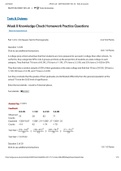
PATHO
PRACTICE
Quiz Week 5
Which of the following is considered to be the most dangerous arrhythmia?
Ventricular fibrillation
Confirmation of the diagnosis of a myocardial infarction would include:
specific changes in the ECG AND elevation of cardiac isoenzymes in serum. (1 & 3)
Which of the following statements regarding aneurysms is true?
Manifestations of aneurysms result from compression of adjacent structures.
The most common factor predisposing to the development of varicose veins is:
increased venous pressure.
In the period immediately following a myocardial infarction, the manifestations of pallor and
diaphoresis, rapid pulse, and anxiety result from:
onset of circulatory shock.
Septic shock differs from hypovolemic shock in that it is frequently manifested by:
fever and flushed face.
More extensive permanent damage is likely when a myocardial infarction is caused by:
an embolus.
A very rapid heart rate reduces cardiac output because:
ventricular filling is reduced.
Which of the following compensations that develop in patients with congestive heart failure
eventually increase the workload of the heart?
Faster heart rate and cardiomegaly, Peripheral vasoconstriction, AND increased secretion of
renin (1,2, & 3)
Which statement applies to paroxysmal nocturnal dyspnea?
It is caused by increased blood in the lungs when lying in a supine position.
In patients with congestive heart failure, ACE inhibitor drugs are useful because they:
reduce renin and aldosterone secretion.
Varicose ulcers may develop and be slow to heal because:
, lOMoARcPSD|17103908
edema reduces arterial blood supply to the area.
Excessive fluid in the pericardial space causes:
reduced venous return.
lOMoARcPSD|17103908
PATHO
PRACTICE
Quiz Week 5
Which of the following is considered to be the most dangerous arrhythmia?
Ventricular fibrillation
Confirmation of the diagnosis of a myocardial infarction would include:
specific changes in the ECG AND elevation of cardiac isoenzymes in serum. (1 & 3)
Which of the following statements regarding aneurysms is true?
Manifestations of aneurysms result from compression of adjacent structures.
The most common factor predisposing to the development of varicose veins is:
increased venous pressure.
In the period immediately following a myocardial infarction, the manifestations of pallor and
diaphoresis, rapid pulse, and anxiety result from:
onset of circulatory shock.
Septic shock differs from hypovolemic shock in that it is frequently manifested by:
fever and flushed face.
More extensive permanent damage is likely when a myocardial infarction is caused by:
an embolus.
A very rapid heart rate reduces cardiac output because:
ventricular filling is reduced.
Which of the following compensations that develop in patients with congestive heart failure
eventually increase the workload of the heart?
Faster heart rate and cardiomegaly, Peripheral vasoconstriction, AND increased secretion of
renin (1,2, & 3)
Which statement applies to paroxysmal nocturnal dyspnea?
It is caused by increased blood in the lungs when lying in a supine position.
In patients with congestive heart failure, ACE inhibitor drugs are useful because they:
reduce renin and aldosterone secretion.
Varicose ulcers may develop and be slow to heal because:
, lOMoARcPSD|17103908
edema reduces arterial blood supply to the area.
Excessive fluid in the pericardial space causes:
reduced venous return.