Wnt proteins operate during development of all animals, but also in the adults. Wnt-driven epithelial
self-renewal in the intestine.
80% of sporadic colon cancers have a mutation in APC. Loss of second allele leads to polyp formation
(lots of them). Germline mutation in APC + somatic mutation in the other allele → polyps. Sporadic
colon cancer has a low frequency since you’ll need a somatic allele loss to occur twice.
Lecture 9 Pocket Proteins
The retinoblastoma protein pRB plays an essential role in the G1/S checkpoint.
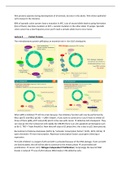
When pRB is inhibited → still G1 arrest because the inhibitory function will now be performed by
RBL1 (p107) and RBL2 (p130) --> pRB’s helpers. If you want to continue to S you’ll have to inhibit all
three of them (pRB, p107 and p130) which is the case with cancer → defective G1S checkpoint. They
can now go into the S phase but will rapidly die UNLESS there is an anti-apoptotic protein/gene such
as Bcl-2. TKO = Triple KnockOut. Now they will stop at G2 phase (4n). this is due to p21 (next picture).
Recruitment of Histone Acetylases (HATs) by “activator transcription factors” (E2F1, E2F2, E2F3a) →
open chromatin → more transcription. Repressor transcription factors cause gene silencing or
repression.
P21 (cdk inhibitor) is a target of p53 and p53 is activated because of the DNA damage. If p21 and p53
are lost/mutated, the cell will be able to continue to the mitotic phase → uncontrolled cell
proliferation → cancer cell (= Mitogen Independent Proliferation). Surprisingly the level of DNA
breaks is reduced → Loss of p53 reduces DNA breaks in Rb-defective cells.
self-renewal in the intestine.
80% of sporadic colon cancers have a mutation in APC. Loss of second allele leads to polyp formation
(lots of them). Germline mutation in APC + somatic mutation in the other allele → polyps. Sporadic
colon cancer has a low frequency since you’ll need a somatic allele loss to occur twice.
Lecture 9 Pocket Proteins
The retinoblastoma protein pRB plays an essential role in the G1/S checkpoint.
When pRB is inhibited → still G1 arrest because the inhibitory function will now be performed by
RBL1 (p107) and RBL2 (p130) --> pRB’s helpers. If you want to continue to S you’ll have to inhibit all
three of them (pRB, p107 and p130) which is the case with cancer → defective G1S checkpoint. They
can now go into the S phase but will rapidly die UNLESS there is an anti-apoptotic protein/gene such
as Bcl-2. TKO = Triple KnockOut. Now they will stop at G2 phase (4n). this is due to p21 (next picture).
Recruitment of Histone Acetylases (HATs) by “activator transcription factors” (E2F1, E2F2, E2F3a) →
open chromatin → more transcription. Repressor transcription factors cause gene silencing or
repression.
P21 (cdk inhibitor) is a target of p53 and p53 is activated because of the DNA damage. If p21 and p53
are lost/mutated, the cell will be able to continue to the mitotic phase → uncontrolled cell
proliferation → cancer cell (= Mitogen Independent Proliferation). Surprisingly the level of DNA
breaks is reduced → Loss of p53 reduces DNA breaks in Rb-defective cells.