Tumors with mutant TP53: majority are missense mutations in the DNA binding domain:
▪ Disruption of DNA binding
▪ Improper protein folding
▪ Impaired or acquired interaction with other proteins
Mutant TP53 can have a loss of function but also a gain of function! Mutant TP53 may be
considered an oncogene. Tumors with mut-p53 may be targeted via promoting mut-p53 degradation,
preventing specific interactions or restoring wt-p53 function.
Cyclotherapy = protecting normal cells by p53-induced cell cycle arrest.
P53 is a transcription factor, targeting genes that regulate the response to multiple sources of stress,
to block proliferation of pre-malignant and malignant cells.
Lecture 7 TGF-beta Signalling, Tumor Invasion and Angiogenesis
Luuk Hawinkels
TGF-b = Transforming Growth Factor beta. Plays a role in tissue homeostasis. You need to know the
effects of TGF-b on epithelial cancer cells, cancer-associated fibroblasts, endothelial cells and
angiogenesis. It is a very large family of cytokines (~33 different proteins) → dimeric proteins that are
highly homogenous. All cells secrete TGF-B and have TGF-B receptors. Majority in latent complex
(inactive form) bound to extracellular matrix.
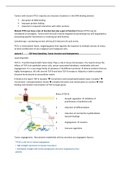
It binds to the type II TGF-b receptor ➔ recruitment and transphosphorylation type-I receptor ➔
recruitment + phosphorylation Smads ➔ complex formation and translocation to nucleus ➔ DNA
binding and initiation transcription of TGF-b target genes.
Roles of TGF-B:
1. Growth regulation → Inhibition of
proliferation of epithelial cells
2. Induction of differentiation
3. Induction of contractile myofibroblasts
(wound healing)
4. Angiogenesis → invasion.
5. Immune regulation
Tumor angiogenesis: Recruitment endothelial cells by secretion pro-angiogenic factors.
▪ Disruption of DNA binding
▪ Improper protein folding
▪ Impaired or acquired interaction with other proteins
Mutant TP53 can have a loss of function but also a gain of function! Mutant TP53 may be
considered an oncogene. Tumors with mut-p53 may be targeted via promoting mut-p53 degradation,
preventing specific interactions or restoring wt-p53 function.
Cyclotherapy = protecting normal cells by p53-induced cell cycle arrest.
P53 is a transcription factor, targeting genes that regulate the response to multiple sources of stress,
to block proliferation of pre-malignant and malignant cells.
Lecture 7 TGF-beta Signalling, Tumor Invasion and Angiogenesis
Luuk Hawinkels
TGF-b = Transforming Growth Factor beta. Plays a role in tissue homeostasis. You need to know the
effects of TGF-b on epithelial cancer cells, cancer-associated fibroblasts, endothelial cells and
angiogenesis. It is a very large family of cytokines (~33 different proteins) → dimeric proteins that are
highly homogenous. All cells secrete TGF-B and have TGF-B receptors. Majority in latent complex
(inactive form) bound to extracellular matrix.
It binds to the type II TGF-b receptor ➔ recruitment and transphosphorylation type-I receptor ➔
recruitment + phosphorylation Smads ➔ complex formation and translocation to nucleus ➔ DNA
binding and initiation transcription of TGF-b target genes.
Roles of TGF-B:
1. Growth regulation → Inhibition of
proliferation of epithelial cells
2. Induction of differentiation
3. Induction of contractile myofibroblasts
(wound healing)
4. Angiogenesis → invasion.
5. Immune regulation
Tumor angiogenesis: Recruitment endothelial cells by secretion pro-angiogenic factors.