TOPIC 5: ENZYMES
5.1 HOW ENZYMES WORK
→Catalyst: A substance that increases the rate of a chemical reaction and is not changed by the reaction.
→Enzymes: Proteins that function as biological catalysts.
Enzymes:
→Are catalysts that speed up the rate of a chemical reaction without being changed or used up in the reaction
→Are proteins
→Are biological catalysts (biological because they are made in living cells), for example: catalase.
→Enzymes are necessary to all living organisms as they maintain reaction speeds of all metabolic reactions (all the
reactions that keep an organism alive) at a rate that can sustain life.
→For example, if we did not produce digestive enzymes (like amylase and protease), it would take around 2 – 3
weeks to digest one meal; with enzymes, it takes around 4 hours
Naming enzymes
-Enzymes are named depending on the metabolic reaction they are going to catalyse, for example:
-GENERAL:
→break down of carbohydrates – carbohydrase enzyme
→break down proteins – protease enzyme
-SPECIFIC:
→carbohydrase that breaks down starch – amylase enzyme
→carbohydrase that breaks down sucrose – sucrase
How do they work
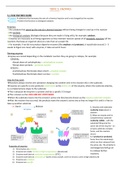
→Reactions always involve one substance changing into another and in this reaction this is the substrate.
→Enzymes are specific to one particular substrate(s) as the active site of the enzyme, where the substrate attaches,
is a complementary shape to the substrate
→This is because the enzyme is a protein and has a specific 3-D shape
→This is known as the LOCK AND KEY HYPOTHESIS
→When the substrate moves into the enzyme’s active site they become known as the enzyme-substrate complex
→After the reaction has occurred, the products leave the enzyme’s active site as they no longer fit it and it is free to
take up another substrate
i.e. Starch Maltose 1. Enzymes and substrates
Amylase randomly move about in
solution
2. When an enzyme and its
complementary substrate
randomly collide – with the
substrate fitting into the
active site of the enzyme – an
enzyme-substrate complex
forms, and the reaction
occurs.
3. A product (or products)
forms from the substrate(s)
which are then released from
the active site. The enzyme is
Properties of enzymes
1) All enzymes are proteins
unchanged and will go on
2) Enzymes are made inactive at high temperatures (denatured) to catalyse further
3) Enzymes work best at particular temperatures (37ºC) reactions.
4) Enzymes work best at particular pH (some at low acid pH, some at neutral, some at high alkaline pH)
5) Enzymes are catalysts
6) Enzymes are specific
5.1 HOW ENZYMES WORK
→Catalyst: A substance that increases the rate of a chemical reaction and is not changed by the reaction.
→Enzymes: Proteins that function as biological catalysts.
Enzymes:
→Are catalysts that speed up the rate of a chemical reaction without being changed or used up in the reaction
→Are proteins
→Are biological catalysts (biological because they are made in living cells), for example: catalase.
→Enzymes are necessary to all living organisms as they maintain reaction speeds of all metabolic reactions (all the
reactions that keep an organism alive) at a rate that can sustain life.
→For example, if we did not produce digestive enzymes (like amylase and protease), it would take around 2 – 3
weeks to digest one meal; with enzymes, it takes around 4 hours
Naming enzymes
-Enzymes are named depending on the metabolic reaction they are going to catalyse, for example:
-GENERAL:
→break down of carbohydrates – carbohydrase enzyme
→break down proteins – protease enzyme
-SPECIFIC:
→carbohydrase that breaks down starch – amylase enzyme
→carbohydrase that breaks down sucrose – sucrase
How do they work
→Reactions always involve one substance changing into another and in this reaction this is the substrate.
→Enzymes are specific to one particular substrate(s) as the active site of the enzyme, where the substrate attaches,
is a complementary shape to the substrate
→This is because the enzyme is a protein and has a specific 3-D shape
→This is known as the LOCK AND KEY HYPOTHESIS
→When the substrate moves into the enzyme’s active site they become known as the enzyme-substrate complex
→After the reaction has occurred, the products leave the enzyme’s active site as they no longer fit it and it is free to
take up another substrate
i.e. Starch Maltose 1. Enzymes and substrates
Amylase randomly move about in
solution
2. When an enzyme and its
complementary substrate
randomly collide – with the
substrate fitting into the
active site of the enzyme – an
enzyme-substrate complex
forms, and the reaction
occurs.
3. A product (or products)
forms from the substrate(s)
which are then released from
the active site. The enzyme is
Properties of enzymes
1) All enzymes are proteins
unchanged and will go on
2) Enzymes are made inactive at high temperatures (denatured) to catalyse further
3) Enzymes work best at particular temperatures (37ºC) reactions.
4) Enzymes work best at particular pH (some at low acid pH, some at neutral, some at high alkaline pH)
5) Enzymes are catalysts
6) Enzymes are specific