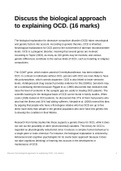
Discuss the biological approach
to explaining OCD. (16 marks)
The biological explanation for obsessive compulsive disorder (OCD) takes neurological
and genetic factors into account. According to genetic theories, OCD is inherited.
Neurological explanations for OCD point to the involvement of aberrant neurotransmitter
levels. OCD is a polygenic disorder, meaning that several genes are involved.
According to Taylor (2003), as many as 230 genes may be involved, and various
genetic differences contribute to the various kinds of OCD, such as hoarding or religious
compulsions.
The COMT gene, which makes catechol-O-methyltransferase, has been related to
OCD. In contrast to individuals without OCD, persons with OCD are more likely to have
this polymorphism, which controls dopamine. OCD is also linked to lower serotonin
levels. Antidepressant drug research provides evidence for this (SSRIs). Serotonin may
be a contributing element because Piggott et al. (1990) discovered that medicines that
raise the level of serotonin in the synaptic gap are useful in treating OCD patients. The
scientific backing for the biological basis of OCD can be found in family studies. When
Lewis (1936) looked at OCD patients, he discovered that 37% of them had parents who
also had the illness and 21% had sibling sufferers. Nestadt et al. (2000) extend this idea
by arguing that people who have a first-degree relative who has OCD are up to five
times more likely than people in the general population who don't have this genetic link
to develop the condition in their lifetime.
Research from family studies like these supports a genetic theory for OCD, while it does
not rule out the possibility of other (environmental) variables. This theory for OCD is
regarded as physiologically reductionist since it reduces a complex human behaviour to
a single gene or brain chemical. For instance, the biological explanation is criticised by
behavioural and cognitive psychologists for its overly basic approach because it does
not take cognitions (thinking) or learning into account in the development or
maintenance of OCD.
Discuss the biological approach to explaining OCD. (16 marks) 1
to explaining OCD. (16 marks)
The biological explanation for obsessive compulsive disorder (OCD) takes neurological
and genetic factors into account. According to genetic theories, OCD is inherited.
Neurological explanations for OCD point to the involvement of aberrant neurotransmitter
levels. OCD is a polygenic disorder, meaning that several genes are involved.
According to Taylor (2003), as many as 230 genes may be involved, and various
genetic differences contribute to the various kinds of OCD, such as hoarding or religious
compulsions.
The COMT gene, which makes catechol-O-methyltransferase, has been related to
OCD. In contrast to individuals without OCD, persons with OCD are more likely to have
this polymorphism, which controls dopamine. OCD is also linked to lower serotonin
levels. Antidepressant drug research provides evidence for this (SSRIs). Serotonin may
be a contributing element because Piggott et al. (1990) discovered that medicines that
raise the level of serotonin in the synaptic gap are useful in treating OCD patients. The
scientific backing for the biological basis of OCD can be found in family studies. When
Lewis (1936) looked at OCD patients, he discovered that 37% of them had parents who
also had the illness and 21% had sibling sufferers. Nestadt et al. (2000) extend this idea
by arguing that people who have a first-degree relative who has OCD are up to five
times more likely than people in the general population who don't have this genetic link
to develop the condition in their lifetime.
Research from family studies like these supports a genetic theory for OCD, while it does
not rule out the possibility of other (environmental) variables. This theory for OCD is
regarded as physiologically reductionist since it reduces a complex human behaviour to
a single gene or brain chemical. For instance, the biological explanation is criticised by
behavioural and cognitive psychologists for its overly basic approach because it does
not take cognitions (thinking) or learning into account in the development or
maintenance of OCD.
Discuss the biological approach to explaining OCD. (16 marks) 1