VA bottom of
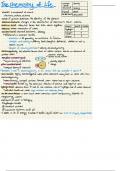
Asymptotes : Vertical : in the a rational function
Holes : Holes form
by canceling a Vertical Asymptote in the bottom
Horizontal : HA :DegreeA_ A CB , the HA is y= 0
A to find
Degree B > B , there is no HA .
Use
polynomial division
its slant asymptote .
A :B divide the leading coefficients
conics
Finding p in a parabolic equation YZ=4px rewrite the number as 4. p
<
2
Distance formula D= ( Xz (y y 1)
✗
1) +
-
-
,
Exponential & Logarithmic Functions
The domain of a log function is Hue
range
of an exponential function .
Exponants Inverse
property logbc __ a ba=c
One to - -
One
property b "=bW it u=w
1. Isolate the exponential
function
"+W=
"
Product rule f- lutw )= f- (a) f- ( w ) so b b + bw -
Try to make the bases =
exponents
then equate the
flu )=¥÷
"
W= b÷w If that doesn't work take
-
-
Quotient rule b
,
-
w so
the 1h of both sides
& use the power
(flu ) )W= (b )W= " W
f- (
" rule
Power rule UW ) so b
1. Isolate the logarithmic
Logs function.
Product rule
logbluw )= logblu ) + logblw ) 2. (a) If convenient, express
both sides as logs with the
same base and equate the
Quotient rule
1ogb(%)= logblu )
-
logblwl arguments
of the log functions.
(b) Otherwise, rewrite the
Power rule
logbluw)= Wlogblul log equation as an
exponential equation.
of base formula
Change change to based :
logba =
10yd (a)
b)
log , /
h k h±k
ogxb
' "
Log tricks :
logbx ± logbx =
logbx so
logx +
log ✗ =/
{
( htk )
{
Distributing logbx =
hlogbxtklogbx note the difference between
these rules !
multiplying arguments logbhk =
logbh +
logbk
Dealing with roots
109b¥ =
109b¥ ntlogbx =
Asymptotes : Vertical : in the a rational function
Holes : Holes form
by canceling a Vertical Asymptote in the bottom
Horizontal : HA :DegreeA_ A CB , the HA is y= 0
A to find
Degree B > B , there is no HA .
Use
polynomial division
its slant asymptote .
A :B divide the leading coefficients
conics
Finding p in a parabolic equation YZ=4px rewrite the number as 4. p
<
2
Distance formula D= ( Xz (y y 1)
✗
1) +
-
-
,
Exponential & Logarithmic Functions
The domain of a log function is Hue
range
of an exponential function .
Exponants Inverse
property logbc __ a ba=c
One to - -
One
property b "=bW it u=w
1. Isolate the exponential
function
"+W=
"
Product rule f- lutw )= f- (a) f- ( w ) so b b + bw -
Try to make the bases =
exponents
then equate the
flu )=¥÷
"
W= b÷w If that doesn't work take
-
-
Quotient rule b
,
-
w so
the 1h of both sides
& use the power
(flu ) )W= (b )W= " W
f- (
" rule
Power rule UW ) so b
1. Isolate the logarithmic
Logs function.
Product rule
logbluw )= logblu ) + logblw ) 2. (a) If convenient, express
both sides as logs with the
same base and equate the
Quotient rule
1ogb(%)= logblu )
-
logblwl arguments
of the log functions.
(b) Otherwise, rewrite the
Power rule
logbluw)= Wlogblul log equation as an
exponential equation.
of base formula
Change change to based :
logba =
10yd (a)
b)
log , /
h k h±k
ogxb
' "
Log tricks :
logbx ± logbx =
logbx so
logx +
log ✗ =/
{
( htk )
{
Distributing logbx =
hlogbxtklogbx note the difference between
these rules !
multiplying arguments logbhk =
logbh +
logbk
Dealing with roots
109b¥ =
109b¥ ntlogbx =