Accounting
Statement of Financial Position
Major Financial Statements
1) Statement of Cash Flows: where does the cash come from and what it gets spent on
2) Income Statement: sales revenue – expenses = profit (or loss)
3) Statement of Financial Position: what the business owns, what it owes, and the
owner’s interest in the business
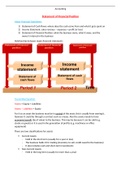
Relationship between major financial statements
Statement of financial Statement of financial Statement of financial
position position position
Income Income
statement statement
Statement of Statement of cash
cash flows flows
Period 1 Period 2 Time
Accounting Equation
Assets = Equity + Liabilities
Assets – Liabilities = Equity
For it to an asset the business must be in control of the asset, this is usually from owning it,
however it could be through a contract such as a lease. Also the assets needs to have
economic benefit (be of value) to the business. This may be because it can be sold (e.g.
stocks or goods) or it is used in the generation of profits (e.g. machinery or office
equipment)
There are two classifications for assets
Current Assets
- Held in the short term (usually for a year or less)
- The business holds it for trading (inventory to sell, credit owed to the business)
- It also includes cash and short-term investments
Non-Current Assets
- Held in the long-term (usually for more than a year)
Statement of Financial Position
Major Financial Statements
1) Statement of Cash Flows: where does the cash come from and what it gets spent on
2) Income Statement: sales revenue – expenses = profit (or loss)
3) Statement of Financial Position: what the business owns, what it owes, and the
owner’s interest in the business
Relationship between major financial statements
Statement of financial Statement of financial Statement of financial
position position position
Income Income
statement statement
Statement of Statement of cash
cash flows flows
Period 1 Period 2 Time
Accounting Equation
Assets = Equity + Liabilities
Assets – Liabilities = Equity
For it to an asset the business must be in control of the asset, this is usually from owning it,
however it could be through a contract such as a lease. Also the assets needs to have
economic benefit (be of value) to the business. This may be because it can be sold (e.g.
stocks or goods) or it is used in the generation of profits (e.g. machinery or office
equipment)
There are two classifications for assets
Current Assets
- Held in the short term (usually for a year or less)
- The business holds it for trading (inventory to sell, credit owed to the business)
- It also includes cash and short-term investments
Non-Current Assets
- Held in the long-term (usually for more than a year)