NRSG 251 STROKE SCALE ANSWERS
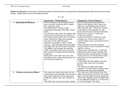
Patient 1 Topic Question Answer Grade Level of Consciousness 1a. Level of Consciousness: The investigator must choose a response, even if a full evaluation is prevented by such obstacles as an endotracheal tube, language barrier, orotracheal trauma/bandages. A 3 is scored only if the patient makes no movement (other than reflexive posturing) in response to noxious stimulation. 0 = Alert; keenly responsive Correct LOC Questions 1b. LOC Questions: The patient is asked the month and his/her age. The answer must be correct there is no partial credit for being close. Aphasic and stuporous patients who do not comprehend the questions will score 2. Patients unable to speak because of endotracheal intubation, orotracheal trauma, severe dysarthria from any cause, language barrier or any other problem not secondary to aphasia are given a 1. It is important that only the initial answer be graded and that the examiner not "help" the patient with verbal or nonverbal cues. 0 = Answers both questions correctly Correct LOC Commands 1c. LOC Commands: The patient is asked to open and close the eyes and then to grip and 0 = Performs both tasks correctly Correct ' release the nonparetic hand. Substitute another one step command if the hands cannot be used. Credit is given if an unequivocal attempt is made but not completed due to weakness. If the patient does not respond to command, the task should be demonstrated to them (pantomime) and score the result (i.e., follows none, one or two commands). Patients with trauma, amputation, or other physical impediments should be given suitable onestep commands. Only the first attempt is scored. Best Gaze 2. Best Gaze: Only horizontal eye movements will be tested.Voluntary or reflexive (oculocephalic) eye movements will be scored but caloric testing is not done. If the patient has a conjugate deviation of the eyes that can be overcome by voluntary or reflexive activity, the score will be 1. If a patient has an isolated peripheral nerve paresis (CN III, IV or VI) score
Written for
- Institution
- NRSG 251
- Course
- NRSG 251
Document information
- Uploaded on
- September 13, 2022
- Number of pages
- 41
- Written in
- 2022/2023
- Type
- Exam (elaborations)
- Contains
- Questions & answers
Subjects
- language barrier
-
nrsg 251 stroke scale answers
-
1a level of consciousness the investigator must choose a response
-
even if a full evaluation is prevented by such obstacles as an endotracheal tube
-
o