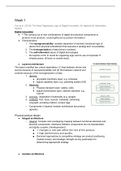
Lecture 1 Introduction lecture:
Weber / 5th dimension Hofstede:
Culture and economy are interrelated, especially in places where globalization plays a huge
role.
- Confucian Dynamism: This is also known as long term orientation, which is a
national culture dimension which describes the extent to which individuals with the
culture focus on the short-term and immediate consequences versus a long term-focus
- With analyzing a country’s economic performance, u should always take culture into
account
What is globalization?:
Economic view:
An international economic integration that can be pursued through policies of openness, the
liberalization of trade, investment and finance, leading to an open economy.
Multidimensional view:
Globalization is the:
- Spatial reorganization of production
- The interpretation of industries across borders
- The spread of financial markets
- The diffusion of identical consumer goods to distant countries
- Massive transfers of population within the South as well from the South to the East to
West
- Resulting in conflicts between immigrant and established communities in formerly
tight neighbourhoods
,Globalization drivers:
- Global brands: Nike, Starbucks, McDonalds
- Access to Internet
- Emerging markets
- Shared R&D
- Interdependence of financial markets
- Increasing role of governments
→ There is a drive for efficiency and economies of scale
The world is becoming faster and smaller:
- Decreasing costs of telecommunication
- Decreasing costs of transport
- Built global workflow platforms
Cosmopolitanism:
The idea that all human beings are members of a single community with different views of
what constitutes this community may include a focus on:
- Moral standards
- Economic practices
- Political structures
- Cultural forms
Now we operate in a world, as a result of globalization we are now confronted with a number
of paradoxes that are cultural but also more and more ethical
Cosmopolitan orientation:
1. Cultural openness: captures individuals receptiveness to immerse in and learn from
other cultures
2. Global prosociality: denotes a sense of collective moral obligation to universally
respect and promote basic human rights
3. Respect for culture diversity: concerns high tolerance and appreciation for cultural
differences
,Ethnocentrism:
The view of things in which one’s own group is the center of everything, and all others are
scaled and rated with reference to it
- Ethnocentrism is a universal phenomenon that is rooted deeply in most areas of inter-
group relations
- The core of ethnocentrism is the tendency for any people to put their own group in a
position of centrality and worth while creating and reinforcing negative attitudes and
behaviours towards other outgroups
Ethnocentrism is based on a pervasive and rigid ingroup-outgroup distinction, it involves
stereotyped:
- Negative imagery and hostile attitudes regarding outgroups
- Positive imagery and submissive attitudes regarding ingroups
- Hierarchical authoritarian view of group interaction in which ingroups rightly
dominant, outgroups subordinate
Ethnorelativism:
No culture is better than the other
Consumer ethnocentrism:
This represents the beliefs held by American consumers about the appropriateness and
morality of purchasing foreign products. Consumer ethnocentrism implies that buying
imports is wrong because it is unpatriotic and detrimental to the domestic economy and
employment.
→ This partially explains why consumers evaluate domestic products ,more favorably
than foreign goods
, Stereotyping:
Social stereotypes:
Social stereotypes are generalizations about the shared attributes of a group of people.
A stereotype is an individual’s set of beliefs about the characteristics or attributes of a group:
- Stereotypes need not be negative
- Stereotypes need not be inaccurate
- Distinguishes a particular group from other groups
- Attributes need not be highly prevalent in a group to be stereotypic
Weber / 5th dimension Hofstede:
Culture and economy are interrelated, especially in places where globalization plays a huge
role.
- Confucian Dynamism: This is also known as long term orientation, which is a
national culture dimension which describes the extent to which individuals with the
culture focus on the short-term and immediate consequences versus a long term-focus
- With analyzing a country’s economic performance, u should always take culture into
account
What is globalization?:
Economic view:
An international economic integration that can be pursued through policies of openness, the
liberalization of trade, investment and finance, leading to an open economy.
Multidimensional view:
Globalization is the:
- Spatial reorganization of production
- The interpretation of industries across borders
- The spread of financial markets
- The diffusion of identical consumer goods to distant countries
- Massive transfers of population within the South as well from the South to the East to
West
- Resulting in conflicts between immigrant and established communities in formerly
tight neighbourhoods
,Globalization drivers:
- Global brands: Nike, Starbucks, McDonalds
- Access to Internet
- Emerging markets
- Shared R&D
- Interdependence of financial markets
- Increasing role of governments
→ There is a drive for efficiency and economies of scale
The world is becoming faster and smaller:
- Decreasing costs of telecommunication
- Decreasing costs of transport
- Built global workflow platforms
Cosmopolitanism:
The idea that all human beings are members of a single community with different views of
what constitutes this community may include a focus on:
- Moral standards
- Economic practices
- Political structures
- Cultural forms
Now we operate in a world, as a result of globalization we are now confronted with a number
of paradoxes that are cultural but also more and more ethical
Cosmopolitan orientation:
1. Cultural openness: captures individuals receptiveness to immerse in and learn from
other cultures
2. Global prosociality: denotes a sense of collective moral obligation to universally
respect and promote basic human rights
3. Respect for culture diversity: concerns high tolerance and appreciation for cultural
differences
,Ethnocentrism:
The view of things in which one’s own group is the center of everything, and all others are
scaled and rated with reference to it
- Ethnocentrism is a universal phenomenon that is rooted deeply in most areas of inter-
group relations
- The core of ethnocentrism is the tendency for any people to put their own group in a
position of centrality and worth while creating and reinforcing negative attitudes and
behaviours towards other outgroups
Ethnocentrism is based on a pervasive and rigid ingroup-outgroup distinction, it involves
stereotyped:
- Negative imagery and hostile attitudes regarding outgroups
- Positive imagery and submissive attitudes regarding ingroups
- Hierarchical authoritarian view of group interaction in which ingroups rightly
dominant, outgroups subordinate
Ethnorelativism:
No culture is better than the other
Consumer ethnocentrism:
This represents the beliefs held by American consumers about the appropriateness and
morality of purchasing foreign products. Consumer ethnocentrism implies that buying
imports is wrong because it is unpatriotic and detrimental to the domestic economy and
employment.
→ This partially explains why consumers evaluate domestic products ,more favorably
than foreign goods
, Stereotyping:
Social stereotypes:
Social stereotypes are generalizations about the shared attributes of a group of people.
A stereotype is an individual’s set of beliefs about the characteristics or attributes of a group:
- Stereotypes need not be negative
- Stereotypes need not be inaccurate
- Distinguishes a particular group from other groups
- Attributes need not be highly prevalent in a group to be stereotypic