Behaviorist Explanations
Area Mental Health (Applied)
Files
Notes
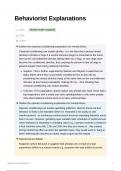
Outline the classical conditioning explanation for mental illness
Classical conditioning can explain phobia - it is the idea that a person would
develop a phobia of dogs if a neutral stimulus (dogs) is presented at the same
time as the unconditioned stimulus (being bitten by a dog), so now dogs have
become the conditioned stimulus, thus causing the person to fear all dogs in
general despite them being relatively harmless.
Support: This is further supported by Watson and Rayner’s experiment on
Baby Albert where they successfully conditioned him to fear rats by
presenting the neutral stimulus (rats) at the same time as the unconditioned
stimulus (a loud noise) repeatedly, making him cry - thus showing that
classical conditioning can explain phobias.
Criticism: This explanation cannot explain why people who have never had a
bad experience with a snake can have ophidiophobia or only some people
who were bullied at school went on to have school phobia.
Outline the operant conditioning explanation for mental illness
Operant conditioning can explain gambling addiction. Skinner found out that
behavior is likely to be repeated when it is rewarded in his study on rats
(reinforcement) - so continuous reinforcement involves rewarding behavior every
time it occurs: However, gambling uses variable ratio schedules of reinforcement
where behavior is rewarded in changing ratios e.g. a person receives a reward in
a fruit machine every 8th, 12th and 25th time they put money in - this creates
strong reinforcing effect as when the gambler loses, they would want to ‘hang in
there’ believing the machine is nearly ready to give out the reward.
Nature/nurture debate
Supports nurture because it suggests that phobias are a result of a bad
experience (which is a nurture event) e.g. a person who was bullied at school
Behaviorist Explanations 1
Area Mental Health (Applied)
Files
Notes
Outline the classical conditioning explanation for mental illness
Classical conditioning can explain phobia - it is the idea that a person would
develop a phobia of dogs if a neutral stimulus (dogs) is presented at the same
time as the unconditioned stimulus (being bitten by a dog), so now dogs have
become the conditioned stimulus, thus causing the person to fear all dogs in
general despite them being relatively harmless.
Support: This is further supported by Watson and Rayner’s experiment on
Baby Albert where they successfully conditioned him to fear rats by
presenting the neutral stimulus (rats) at the same time as the unconditioned
stimulus (a loud noise) repeatedly, making him cry - thus showing that
classical conditioning can explain phobias.
Criticism: This explanation cannot explain why people who have never had a
bad experience with a snake can have ophidiophobia or only some people
who were bullied at school went on to have school phobia.
Outline the operant conditioning explanation for mental illness
Operant conditioning can explain gambling addiction. Skinner found out that
behavior is likely to be repeated when it is rewarded in his study on rats
(reinforcement) - so continuous reinforcement involves rewarding behavior every
time it occurs: However, gambling uses variable ratio schedules of reinforcement
where behavior is rewarded in changing ratios e.g. a person receives a reward in
a fruit machine every 8th, 12th and 25th time they put money in - this creates
strong reinforcing effect as when the gambler loses, they would want to ‘hang in
there’ believing the machine is nearly ready to give out the reward.
Nature/nurture debate
Supports nurture because it suggests that phobias are a result of a bad
experience (which is a nurture event) e.g. a person who was bullied at school
Behaviorist Explanations 1