Theme 1: introduction to the microbial world
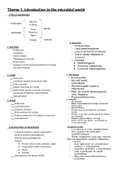
🡪 TYPES OF MICROORGS
1. BACTERIA
- Prokaryotes
- Unicellular
- Several shapes
- Peptidoglycan cell walls
- Binary fission
- In/organic chemicals/photosynthesis for energy
- Can swim (flagella)
3. FUNGI
🍄
- Eukaryotes
- Unicellular (yeasts)/multicellular ( )
- Chitin cell walls
- Organic chemicals for energy
- Multicellular consist of masses of mycelia
(composed of filaments called hyphae)
- Asexual/sexual
5. ALGAE
- Eukaryotes
- Uni/multicellular
- Cellulose cell walls
- Photosynthesis for energy
- Produce molecular O2 & organic compounds
- Asexual/sexual
🡪 CLASSIFICATION OF MICROORGS
- 3 domains based on cellular organization
- Bacteria (contain peptidoglycan)
- Archaea (lack peptidoglycan)
- Eukarya
● Protists (slime molds, protozoa, algae)
● Fungi (yeast, molds, mushroom)
● Plants
● Animals
- Developed by Carl Woese (1978)
,🡪 HISTORY OF MICROBIOLOGY
2. DEBATE OVER SPONTANEOUS GENERATION
SPONTANEOUS GENERATION: the hypothesis that life arises from nonliving matter; a "vital force" is necessary for life
1668 Francesco Redi filled jars w/decaying meat
CONDITIONS RESULTS
Jars covered w/fine net No maggots
Open jars Maggots appeared
Sealed jars No maggots
From where did the maggots come? What was
the purpose of the sealed jars? Spontaneous
generation or biogenesis?
CONDITIONS RESULTS
Nutrient broth heated, Microbial growth
then placed in covered
flask
From where did the microbes come?
Spontaneous generation or biogenesis?
1765 Lazzaro Spallanzani boiled nutrient solutions in
CONDITIONS RESULTS
Nutrient broth placed in flask, Microbial growth
heated, NOT sealed
Nutrient broth placed in flask, No microbial
heated, then immediately sealed growth
Spontaneous generation or biogenesis?
, sealed flasks
CONDITIONS RESULTS
Nutrient broth placed in No microbial growth
flask, sealed, then
heated
Spontaneous generation or biogenesis?
THEORY OF BIOGENISIS
BIOGENESIS: the
hypothesis that living
cells arise only from
pre-existing living cells
(1858) Rudolf Virchow
said cells arise from
pre-existing cells
PRINCIPLES FROM
PASTEUR’S WORK
- Microorganisms = present in air, liquids, solids
- Heat can destroy microorganisms
- Possible to design methods to block airborne contamination
- Developed principles for aseptic techniques, procedures that prevent microbial contamination
3. THE GOLDEN AGE OF MICROBIOLOGY (1857–1914)
- Beginning w/Pasteur's work, discoveries = relationship between microbes & disease, immunity, vaccines 26
- Pasteur showed that microbes = responsible for fermentation
- Fermentation = the microbial conversion of sugar to alcohol in absence of air
- Microbial growth = also responsible for spoilage of food & beverages
- Bacteria that use air spoil wine by turning it to vinegar (acetic acid) 27
- Pasteur demonstrated that these spoilage bacteria could be killed by heat that was not hot enough to evaporate
the alcohol in wine
PASTEURIZATION: is the application of a high heat for a short time to kill harmful bacteria in beverages
🡪 THE GERM THEORY OF DISEASE
1835: Agostino Bassi showed that a silkworm disease was caused by a fungus
1865: Pasteur believed that another silkworm disease was caused by a protozoan parasite
🡪 TYPES OF MICROORGS
1. BACTERIA
- Prokaryotes
- Unicellular
- Several shapes
- Peptidoglycan cell walls
- Binary fission
- In/organic chemicals/photosynthesis for energy
- Can swim (flagella)
3. FUNGI
🍄
- Eukaryotes
- Unicellular (yeasts)/multicellular ( )
- Chitin cell walls
- Organic chemicals for energy
- Multicellular consist of masses of mycelia
(composed of filaments called hyphae)
- Asexual/sexual
5. ALGAE
- Eukaryotes
- Uni/multicellular
- Cellulose cell walls
- Photosynthesis for energy
- Produce molecular O2 & organic compounds
- Asexual/sexual
🡪 CLASSIFICATION OF MICROORGS
- 3 domains based on cellular organization
- Bacteria (contain peptidoglycan)
- Archaea (lack peptidoglycan)
- Eukarya
● Protists (slime molds, protozoa, algae)
● Fungi (yeast, molds, mushroom)
● Plants
● Animals
- Developed by Carl Woese (1978)
,🡪 HISTORY OF MICROBIOLOGY
2. DEBATE OVER SPONTANEOUS GENERATION
SPONTANEOUS GENERATION: the hypothesis that life arises from nonliving matter; a "vital force" is necessary for life
1668 Francesco Redi filled jars w/decaying meat
CONDITIONS RESULTS
Jars covered w/fine net No maggots
Open jars Maggots appeared
Sealed jars No maggots
From where did the maggots come? What was
the purpose of the sealed jars? Spontaneous
generation or biogenesis?
CONDITIONS RESULTS
Nutrient broth heated, Microbial growth
then placed in covered
flask
From where did the microbes come?
Spontaneous generation or biogenesis?
1765 Lazzaro Spallanzani boiled nutrient solutions in
CONDITIONS RESULTS
Nutrient broth placed in flask, Microbial growth
heated, NOT sealed
Nutrient broth placed in flask, No microbial
heated, then immediately sealed growth
Spontaneous generation or biogenesis?
, sealed flasks
CONDITIONS RESULTS
Nutrient broth placed in No microbial growth
flask, sealed, then
heated
Spontaneous generation or biogenesis?
THEORY OF BIOGENISIS
BIOGENESIS: the
hypothesis that living
cells arise only from
pre-existing living cells
(1858) Rudolf Virchow
said cells arise from
pre-existing cells
PRINCIPLES FROM
PASTEUR’S WORK
- Microorganisms = present in air, liquids, solids
- Heat can destroy microorganisms
- Possible to design methods to block airborne contamination
- Developed principles for aseptic techniques, procedures that prevent microbial contamination
3. THE GOLDEN AGE OF MICROBIOLOGY (1857–1914)
- Beginning w/Pasteur's work, discoveries = relationship between microbes & disease, immunity, vaccines 26
- Pasteur showed that microbes = responsible for fermentation
- Fermentation = the microbial conversion of sugar to alcohol in absence of air
- Microbial growth = also responsible for spoilage of food & beverages
- Bacteria that use air spoil wine by turning it to vinegar (acetic acid) 27
- Pasteur demonstrated that these spoilage bacteria could be killed by heat that was not hot enough to evaporate
the alcohol in wine
PASTEURIZATION: is the application of a high heat for a short time to kill harmful bacteria in beverages
🡪 THE GERM THEORY OF DISEASE
1835: Agostino Bassi showed that a silkworm disease was caused by a fungus
1865: Pasteur believed that another silkworm disease was caused by a protozoan parasite