
Biology: Characteristics and classification of
living organisms
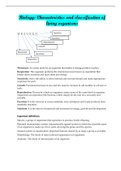
Nutrition
MRSGREN
Excretion
Reproduction
Growth
Movement
Sensitivity
Respiration
Movement: An action made by an organism that makes it change position or place.
Respiration: The organism performs the chemical process known as respiration that
breaks down nutrients and turns them into energy.
Sensitivity: this is the ability to sense internal and external stimuli and make appropriate
responses for each.
Growth: Permanent increase in size and dry mass by increase in cell number or cell size or
both.
Reproduction: Process by which an organism creates more of the same kind of organism.
Organisms can reproduce like bacteria, which simply divide into two, asexually and
sexually.
Excretion: It is the removal of excess materials, toxic substances and waste products from
metabolic reactions.
Nutrition: It is the take-in of materials and nutrients for energy, growth and development.
Important definitions:
Species: a group of organisms that reproduce to produce fertile offspring.
Binomial nomenclature system: internationally agreed system in which the scientific name
of an organism is made up of two parts, showing the genus and the species.
Natural system of classification: important features shared by as large a group as possible.
Morphology: The study of form (outward appearance) of organisms.
Anatomy: The study of internal parts of an organism.
, What is CLASSIFICATION?
Classification is the way of sorting organisms into a meaningful order, usually by
morphology and anatomy, and recently also DNA.
Taxonomy: The science of CLASSIFICATION.
Levels of Classification:
Kingdom
Phylum
Class
Order
Family
Genum
Species
Binomial nomenclature:
The name of the genus (the general name) is placed at the beginning with a capital letter
(Homo) and the species (the specific name) is placed with small letters (sapiens) (Homo
sapiens).
The classification schemes:
The two-kingdom scheme: Linnaeus
Animal Plant
The five-kingdom scheme: Whittaker
Animal Plant Fungus Prokaryote Protoctist
The six-kingdom scheme: Woese
Animal Plant Fungus Eubacteria Archaebacteria Protoctist
The three-domain system:
Eubacteria Archaea Eukarya
The Plant Kingdom
- Multicellular.
- Their cells have a cell wall.
- Many of these cells contain chloroplasts with photosynthetic pigments, e.g.
chlorophyll.
living organisms
Nutrition
MRSGREN
Excretion
Reproduction
Growth
Movement
Sensitivity
Respiration
Movement: An action made by an organism that makes it change position or place.
Respiration: The organism performs the chemical process known as respiration that
breaks down nutrients and turns them into energy.
Sensitivity: this is the ability to sense internal and external stimuli and make appropriate
responses for each.
Growth: Permanent increase in size and dry mass by increase in cell number or cell size or
both.
Reproduction: Process by which an organism creates more of the same kind of organism.
Organisms can reproduce like bacteria, which simply divide into two, asexually and
sexually.
Excretion: It is the removal of excess materials, toxic substances and waste products from
metabolic reactions.
Nutrition: It is the take-in of materials and nutrients for energy, growth and development.
Important definitions:
Species: a group of organisms that reproduce to produce fertile offspring.
Binomial nomenclature system: internationally agreed system in which the scientific name
of an organism is made up of two parts, showing the genus and the species.
Natural system of classification: important features shared by as large a group as possible.
Morphology: The study of form (outward appearance) of organisms.
Anatomy: The study of internal parts of an organism.
, What is CLASSIFICATION?
Classification is the way of sorting organisms into a meaningful order, usually by
morphology and anatomy, and recently also DNA.
Taxonomy: The science of CLASSIFICATION.
Levels of Classification:
Kingdom
Phylum
Class
Order
Family
Genum
Species
Binomial nomenclature:
The name of the genus (the general name) is placed at the beginning with a capital letter
(Homo) and the species (the specific name) is placed with small letters (sapiens) (Homo
sapiens).
The classification schemes:
The two-kingdom scheme: Linnaeus
Animal Plant
The five-kingdom scheme: Whittaker
Animal Plant Fungus Prokaryote Protoctist
The six-kingdom scheme: Woese
Animal Plant Fungus Eubacteria Archaebacteria Protoctist
The three-domain system:
Eubacteria Archaea Eukarya
The Plant Kingdom
- Multicellular.
- Their cells have a cell wall.
- Many of these cells contain chloroplasts with photosynthetic pigments, e.g.
chlorophyll.


