Introduction to psychology & history of psychology
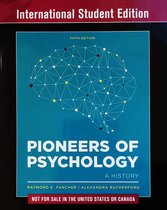
Information in this summary is completely based of:
Fancher, R. E., & Rutherford, A. (2017). Pioneers of psychology: A history. (5th international student
ed.). W. W. Norton.
1
,Chapter 0: Introduction
‘‘Psychology has a long past but only a short history’’ – Hermann Ebbinghaus
Reflexivity: The human ability to become aware of, and reflect upon, one’s own activities.
Historiography: The collective term for the theory, history, methods, and assumptions of writing
history.
-> The body of historical work (like a discography for musicians).
Internalism (specific): Focusing on internal factors when writing history.
Externalism (mainstream): Focusing on external factors when writing history.
Great man approach: History told through the contributions of eminent people (individualistic and
celebratory).
Zeitgeist approach: The approach that the spirit of time has affected a certain person, and his or her
ideas, to take hold and become historically significant.
Presentism: The format that takes a look at the psychological past and relating it to psychology today
to show how it became that way.
Historicism: The format of looking to the past without relating it to the present in any way.
Sophisticated presentism: Assumes you can never escape the present when writing history.
New history of psychology or Critical history of psychology: Moving beyond ceremonial or
celebratory aims, in which the history of psychology is recounted as a progressive series of great
accomplishments.
Origin myth process: History is selectively written to make it appear as though psychology has
progressed triumphantly from one great discovery to the next, with little sense of the complexity,
messiness, or controversy that might have occurred along the way.
Continuity-discontinuity debate: How continuous (or discontinuous) are the concepts within the
study of psychology of psychology?
e.g. When Binet developed his early intelligence scales, was he measuring something Plato and Aristotle might
also have recognized as intelligence, or would the very concept have meant something different in their time
and place?
Indigenization: The process whereby local (or national) contexts affect the development of
psychology, including how ideas from elsewhere are imported and changed in response to local
conditions.
Chapter 1: Foundational ideas from antiquity
Psyche: Present in the living, absent in the dead (soul).
-> Later turned into the ‘mind’.
2
,Presocratic philosophers:
- Thales – Astronomy, meteorology (+ water is the most important element).
- Pythagoras – Mathematics.
- Heraclitus – Generation after Pythagoras (mathematics).
‘A road going upwards is also a road going downwards.’ -> Different points of view.
- Zeno – Philosopher (resolved Achilles and the tortoise paradox).
- Protagoras – Sophist, favored a focus on purely human experience and behavior.
- Hippocrates – A sophist, but whereas other sophists were lawyers and politicians, he was a great
physician. He wrote with his own dedicated school the Hippocratic Corpus with an extensive
body of medical writings.
-> Humoral theory: A theory to explain health and illness as the result of balance and
imbalance based on the humors (blood, yellow bile, black bile, and phlegm).
Sophist: Specialized in teaching the skills of rhetoric and public speaking that would enable their
students to express and promote their political and social views most effectively.
Socrates (nativism) -> Plato (rationalism) -> Aristotle (empiricism)
Socrates (470 – 399 B.C.)
His greatest wisdom lay in knowing how much he did not know.
Nativism: Knowledge lies within the psyche (innate).
e.g. the Meno dialogue of Plato
-> Uneducated slave boy can still solve a riddle without getting the answer.
Nativism was the greatest legacy Socrates left to his student Plato.
‘‘The mind contains capacities for interpretation that go further than the passive experience of the
stimulus.’’
Another student was Xenophon (he became a famous historian).
Plato (424 – 347 B.C.)
Student of Socrates (also wrote the Socratic dialogues).
The dialogues became foundational statements of nativism and rationalism.
-> Plato was also a nativist.
In his 30s he established the Academy (philosophy, mathematics and astronomy).
-> Where Aristotle had his education.
His notion of an appearance referred to a person’s actual conscious experience of something.
General and ideal forms representing the essences of all trees, all dogs.
So behind every day sensory experiences there lies something fundamental and ultimate.
-> Referred to as Idealism.
Allegory of the cave: Plato’s most famous work
The shadows are like the appearances whereas the real events are his ideal forms.
3
, The mind had three separate innate capacities that govern:
-> The appetites: (needs for physical gratification); courage; and reason.
He further believed everyone had these innate capacities and the proportions of them decided in
what class you would be within society.
Aristotle (384 – 322 B.C.)
Tutor of Alexander the Great, after he became king Aristotle became the director of his own school
called the Lyceum (which was broader in subjects than the Academy).
- Aristotle became a Mr. Know It All
Became the first proponent of empiricism.
-> We get knowledge from observation, classification and taxonomy.
They did careful and extensive observations, followed by classification.
-> Beginning of taxonomy
Theophrastus was his livelong colleague and friend.
Peri psyche (on the soul)
Scale of nature
The mind has four fundamental functions:
- Reason (humans) -> Rational soul,
- Imagination, memory (complex animals) -> Sensitive soul.
- Sensation, movement (simple animals).
- Reproduction, nourishment (plants) -> Vegetative soul.
Fundamental innate categorizations made by human rational soul in which memories and ideas of
empirical experiences are classified and organized.
- Substance, quantity, quality, location, time, relation, activity.
->These theories sum up the Aristotelian logic and has been very important for Western
philosophy.
Later developments
Atomic theory (Democritus) -> The laughing philosopher.
- Says there is a limit to the divisibility of all material objects (atoma = uncuttable).
Building on the teachings of Leucippus.
-> Everything consists out of atoms, and they influence each other according to the laws of nature
(no magic).
Greeks believed in causality: Every event has a purpose.
This was provided with Aristotle’s viewpoint that all caused events had to have four essential
components:
- Material cause (material).
- Formal cause (the idea or plan).
- Efficient cause (the actions or interactions that bring the caused thing into being).
- Final cause (the purpose for which the thing is caused).
-> However Democritus thought every event to be random.
4
Information in this summary is completely based of:
Fancher, R. E., & Rutherford, A. (2017). Pioneers of psychology: A history. (5th international student
ed.). W. W. Norton.
1
,Chapter 0: Introduction
‘‘Psychology has a long past but only a short history’’ – Hermann Ebbinghaus
Reflexivity: The human ability to become aware of, and reflect upon, one’s own activities.
Historiography: The collective term for the theory, history, methods, and assumptions of writing
history.
-> The body of historical work (like a discography for musicians).
Internalism (specific): Focusing on internal factors when writing history.
Externalism (mainstream): Focusing on external factors when writing history.
Great man approach: History told through the contributions of eminent people (individualistic and
celebratory).
Zeitgeist approach: The approach that the spirit of time has affected a certain person, and his or her
ideas, to take hold and become historically significant.
Presentism: The format that takes a look at the psychological past and relating it to psychology today
to show how it became that way.
Historicism: The format of looking to the past without relating it to the present in any way.
Sophisticated presentism: Assumes you can never escape the present when writing history.
New history of psychology or Critical history of psychology: Moving beyond ceremonial or
celebratory aims, in which the history of psychology is recounted as a progressive series of great
accomplishments.
Origin myth process: History is selectively written to make it appear as though psychology has
progressed triumphantly from one great discovery to the next, with little sense of the complexity,
messiness, or controversy that might have occurred along the way.
Continuity-discontinuity debate: How continuous (or discontinuous) are the concepts within the
study of psychology of psychology?
e.g. When Binet developed his early intelligence scales, was he measuring something Plato and Aristotle might
also have recognized as intelligence, or would the very concept have meant something different in their time
and place?
Indigenization: The process whereby local (or national) contexts affect the development of
psychology, including how ideas from elsewhere are imported and changed in response to local
conditions.
Chapter 1: Foundational ideas from antiquity
Psyche: Present in the living, absent in the dead (soul).
-> Later turned into the ‘mind’.
2
,Presocratic philosophers:
- Thales – Astronomy, meteorology (+ water is the most important element).
- Pythagoras – Mathematics.
- Heraclitus – Generation after Pythagoras (mathematics).
‘A road going upwards is also a road going downwards.’ -> Different points of view.
- Zeno – Philosopher (resolved Achilles and the tortoise paradox).
- Protagoras – Sophist, favored a focus on purely human experience and behavior.
- Hippocrates – A sophist, but whereas other sophists were lawyers and politicians, he was a great
physician. He wrote with his own dedicated school the Hippocratic Corpus with an extensive
body of medical writings.
-> Humoral theory: A theory to explain health and illness as the result of balance and
imbalance based on the humors (blood, yellow bile, black bile, and phlegm).
Sophist: Specialized in teaching the skills of rhetoric and public speaking that would enable their
students to express and promote their political and social views most effectively.
Socrates (nativism) -> Plato (rationalism) -> Aristotle (empiricism)
Socrates (470 – 399 B.C.)
His greatest wisdom lay in knowing how much he did not know.
Nativism: Knowledge lies within the psyche (innate).
e.g. the Meno dialogue of Plato
-> Uneducated slave boy can still solve a riddle without getting the answer.
Nativism was the greatest legacy Socrates left to his student Plato.
‘‘The mind contains capacities for interpretation that go further than the passive experience of the
stimulus.’’
Another student was Xenophon (he became a famous historian).
Plato (424 – 347 B.C.)
Student of Socrates (also wrote the Socratic dialogues).
The dialogues became foundational statements of nativism and rationalism.
-> Plato was also a nativist.
In his 30s he established the Academy (philosophy, mathematics and astronomy).
-> Where Aristotle had his education.
His notion of an appearance referred to a person’s actual conscious experience of something.
General and ideal forms representing the essences of all trees, all dogs.
So behind every day sensory experiences there lies something fundamental and ultimate.
-> Referred to as Idealism.
Allegory of the cave: Plato’s most famous work
The shadows are like the appearances whereas the real events are his ideal forms.
3
, The mind had three separate innate capacities that govern:
-> The appetites: (needs for physical gratification); courage; and reason.
He further believed everyone had these innate capacities and the proportions of them decided in
what class you would be within society.
Aristotle (384 – 322 B.C.)
Tutor of Alexander the Great, after he became king Aristotle became the director of his own school
called the Lyceum (which was broader in subjects than the Academy).
- Aristotle became a Mr. Know It All
Became the first proponent of empiricism.
-> We get knowledge from observation, classification and taxonomy.
They did careful and extensive observations, followed by classification.
-> Beginning of taxonomy
Theophrastus was his livelong colleague and friend.
Peri psyche (on the soul)
Scale of nature
The mind has four fundamental functions:
- Reason (humans) -> Rational soul,
- Imagination, memory (complex animals) -> Sensitive soul.
- Sensation, movement (simple animals).
- Reproduction, nourishment (plants) -> Vegetative soul.
Fundamental innate categorizations made by human rational soul in which memories and ideas of
empirical experiences are classified and organized.
- Substance, quantity, quality, location, time, relation, activity.
->These theories sum up the Aristotelian logic and has been very important for Western
philosophy.
Later developments
Atomic theory (Democritus) -> The laughing philosopher.
- Says there is a limit to the divisibility of all material objects (atoma = uncuttable).
Building on the teachings of Leucippus.
-> Everything consists out of atoms, and they influence each other according to the laws of nature
(no magic).
Greeks believed in causality: Every event has a purpose.
This was provided with Aristotle’s viewpoint that all caused events had to have four essential
components:
- Material cause (material).
- Formal cause (the idea or plan).
- Efficient cause (the actions or interactions that bring the caused thing into being).
- Final cause (the purpose for which the thing is caused).
-> However Democritus thought every event to be random.
4