Internal and external financial
reporting
1. Conceptual framework
Financial accounting ( external reporting): Financial accounting is a specific branch of accounting
involving a process of recording, summarizing, and reporting the myriad of transactions resulting
from business operations over a period of time in order to give the external stakeholders and insight
in the financial position of the company.w
Management accounting ( internal reporting): Management accounting is the process of
preparing reports about business operations that help managers make short-term and long-term
decisions. It helps a business pursue its goals by identifying, measuring, analyzing, interpreting and
communicating information to managers.
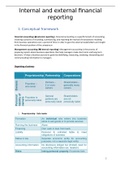
Organizing a business
1. Proprietorship - Sole trader
1
, 2. Partnership
3. Limited liability company
3 types:
Private limited company (Ltd): prohibited by law from offering its shares to the general public
Public limited company (plc): permitted to offer its shares to the general public
Listed company
Advantages
Limited liability
Separation of ownership and management
Ease of transfer of ownership
Ease in raising capital
Continuity of existence
Accounting standards
2
, 1. Understanding content: It ensures the same information is presented in the same way.
2. Comparing companies: Accounting standards create a level ground to compare companies in
an equal way.
Challenge: Global differences / Globalization
Solution: Global standards like IFRS.
IASB: Issues the IFRS and exposure drafts.
Exposure drafts: Preliminary versions on which
can be commented and given feedback.
Changes in the exposure drafts can be made on
request.
FS
Objective
Provide information about the reporting entity that is useful to present and potential equity
investors, lenders and other creditors in their capacity as capital providers.
Users
Employees
Suppliers
Creditors
Managers
Owners
Customers
Shareholders
Governments and public interest
Usefulness
Understandability
Relevance
Reliability
Comparability
3
, Constraints
Timeliness
Balance between qualitative characteristics
Benefits versus Cost
Assumptions
Accrual accounting: is an accounting method where revenue or expenses are recorded when
a transaction occurs rather than when payment is received or made.
Going concern: is an accounting term for a company that has the resources needed to
continue operating indefinitely until it provides evidence to the contrary. This term also
refers to a company's ability to make enough money to stay afloat or to avoid bankruptcy.
Structure of the Belgian balance sheet
Conclusion:
ASSETS = EQUITY + LIABILITIES
ASSETS – LIABILITIES = EQUITY
4
reporting
1. Conceptual framework
Financial accounting ( external reporting): Financial accounting is a specific branch of accounting
involving a process of recording, summarizing, and reporting the myriad of transactions resulting
from business operations over a period of time in order to give the external stakeholders and insight
in the financial position of the company.w
Management accounting ( internal reporting): Management accounting is the process of
preparing reports about business operations that help managers make short-term and long-term
decisions. It helps a business pursue its goals by identifying, measuring, analyzing, interpreting and
communicating information to managers.
Organizing a business
1. Proprietorship - Sole trader
1
, 2. Partnership
3. Limited liability company
3 types:
Private limited company (Ltd): prohibited by law from offering its shares to the general public
Public limited company (plc): permitted to offer its shares to the general public
Listed company
Advantages
Limited liability
Separation of ownership and management
Ease of transfer of ownership
Ease in raising capital
Continuity of existence
Accounting standards
2
, 1. Understanding content: It ensures the same information is presented in the same way.
2. Comparing companies: Accounting standards create a level ground to compare companies in
an equal way.
Challenge: Global differences / Globalization
Solution: Global standards like IFRS.
IASB: Issues the IFRS and exposure drafts.
Exposure drafts: Preliminary versions on which
can be commented and given feedback.
Changes in the exposure drafts can be made on
request.
FS
Objective
Provide information about the reporting entity that is useful to present and potential equity
investors, lenders and other creditors in their capacity as capital providers.
Users
Employees
Suppliers
Creditors
Managers
Owners
Customers
Shareholders
Governments and public interest
Usefulness
Understandability
Relevance
Reliability
Comparability
3
, Constraints
Timeliness
Balance between qualitative characteristics
Benefits versus Cost
Assumptions
Accrual accounting: is an accounting method where revenue or expenses are recorded when
a transaction occurs rather than when payment is received or made.
Going concern: is an accounting term for a company that has the resources needed to
continue operating indefinitely until it provides evidence to the contrary. This term also
refers to a company's ability to make enough money to stay afloat or to avoid bankruptcy.
Structure of the Belgian balance sheet
Conclusion:
ASSETS = EQUITY + LIABILITIES
ASSETS – LIABILITIES = EQUITY
4