

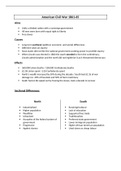
American Civil War 1861-65
Aims
Unify a divided nation with a sovereign government
All men were born with equal right to liberty
Free slaves
Causes
Long term sectional (political, economic, and social) differences
Different views on slavery
Slave states did not like the national government wanting power to prohibit slavery
When Lincoln was elected in 1860 the south seceded to form the confederacy,
Lincoln administration and the north did not legitimise it as it threatened democracy
Effects
360,000 Union deaths / 258,000 Confederate deaths
$2.3b Union spent / $1b Confederate spent
North’s wealth increased by 50% during the decade / South had $1.1b of war
damage inc. 40% of livestock and 50% of farm machinery
South had $1.6b wiped out by freeing the slaves, took a decade to recover
Sectional Differences
North South
Industrialised Rural/Agricultural
Higher population Lack of education
Wealthier Supported free trade
Urbanised Traditionalists
Acceptive of the federal system of Preferred state government
government Lower immigrant population
Progressive Higher African American population
Against slavery Used slaves as cheap labour
, Political system: Checks and balances
Three branches of government: Executive, Legislative and Judiciary
Executive – The President
Elected every 4 years by the electoral college
Powers to nominate supreme justices and cabinet positions but must be ratified by
congress
Powers to call special sessions of congress, can recommend legislation or veto bills
Commander-in-chief of the armed forces
Legislative – Congress
Senate House of Representatives
2 senators per state Members represent constituencies
6-year term but 1/3 up for re-election based on population
every 2 years Elected every 2 years
Congress
Both houses must agree before a law can be passed
Declares war
Oversees the president’s work and can impeach one
Controls the country’s finances
Judiciary – The Supreme Court
Appointed by the president under congress approval on a lifetime term
Approves laws passed by congress and the president
Can overturn legislation passed by congress and the president if deems
unconstitutional
Senate
Presidential Reconstruction
Aims
Unify a divided nation with a sovereign government
All men were born with equal right to liberty
Free slaves
Causes
Long term sectional (political, economic, and social) differences
Different views on slavery
Slave states did not like the national government wanting power to prohibit slavery
When Lincoln was elected in 1860 the south seceded to form the confederacy,
Lincoln administration and the north did not legitimise it as it threatened democracy
Effects
360,000 Union deaths / 258,000 Confederate deaths
$2.3b Union spent / $1b Confederate spent
North’s wealth increased by 50% during the decade / South had $1.1b of war
damage inc. 40% of livestock and 50% of farm machinery
South had $1.6b wiped out by freeing the slaves, took a decade to recover
Sectional Differences
North South
Industrialised Rural/Agricultural
Higher population Lack of education
Wealthier Supported free trade
Urbanised Traditionalists
Acceptive of the federal system of Preferred state government
government Lower immigrant population
Progressive Higher African American population
Against slavery Used slaves as cheap labour
, Political system: Checks and balances
Three branches of government: Executive, Legislative and Judiciary
Executive – The President
Elected every 4 years by the electoral college
Powers to nominate supreme justices and cabinet positions but must be ratified by
congress
Powers to call special sessions of congress, can recommend legislation or veto bills
Commander-in-chief of the armed forces
Legislative – Congress
Senate House of Representatives
2 senators per state Members represent constituencies
6-year term but 1/3 up for re-election based on population
every 2 years Elected every 2 years
Congress
Both houses must agree before a law can be passed
Declares war
Oversees the president’s work and can impeach one
Controls the country’s finances
Judiciary – The Supreme Court
Appointed by the president under congress approval on a lifetime term
Approves laws passed by congress and the president
Can overturn legislation passed by congress and the president if deems
unconstitutional
Senate
Presidential Reconstruction


