Biology
Paper 1
Cell Biology:
● Animal cells:
○ Nucleus - controls the activities of the cell and contains the genetic material
○ Cytoplasm - in which most chemical reactions take place
○ Cell membrane - controls the passage of substances into and out of the cell
○ Mitochondria - where aerobic respiration takes place
○ Ribosomes - where proteins are synthesised
● Plant cells:
○ All sub cellular structures found in plant cells
○ Cell wall - made of cellulose, which strengthens the cell
○ Permanent vacuole - filled with cell sap, to support the plant
○ Chloroplasts - to absorb light to make food by photosynthesis
● Animal, plant and fungal cells are eukaryotic
● Bacterial cells are prokaryotic
● Prokaryotic cells:
○ Much smaller in size
○ The genetic material is not enclosed in a nucleus
○ The genetic material is a single loop of DNA, and there may be one or more small rings of DNA called
plasmids
○ They do not contain chloroplasts or mitochondria
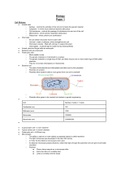
● Bacterial cell:
○ The roles of mitochondria and chloroplasts are taken over by the cytoplasm
○ Plasmids are present
○ Plasmids allow bacterial cells to move genes from one cell to another#
○
○ Plasmids allow genes to be inserted into bacteria in genetic engineering
●
Unit Number of units in 1 metre
Centimetre (cm) 100
Millimetre (mm) 1000
Micrometre 1000000
Nanometre (nm) 1000000000
●
● A typical plant cell = 0.1mm diameter
● Typical animal cell = 0.02mm diameter
● Prokaryotic cell = 0.002mm long
● Microscopes:
○ The ability to see two or more objects as separate objects is called resolution
○ The light microscope was developed in the late 16th century
○ In 1933, the first electron microscopes were used
○ An electron microscope passes electrons, rather than light, through the specimen and can give much better
resolution
○ Practical:
■ Place a tissue sample on a microscope slide
■ Add a few drips of a suitable stain
■ Lower a coverslip onto the tissue
, ■ Place the slide on the microscope stage and focus on the cells using low power
■ Change to high power and refocus
■ Draw any types of cells that can be seen
■ Add a scale line to the diagram
■
○ Magnification - how many times larger the image is than the real object
○ Magnification = size of image / size of real object
● Growing microorganisms:
○ Bacteria divide by binary fission, a form of aesexual reproduction
○ If they have enough nutrients and a suitable temperature, they can multiply every 20 minutes
○ The Petri dishes and agar must be sterilised before use, so that unwanted organisms are killed
○ An inoculating loop is sterilised by passing it through a flame
○ He cooled inoculating loop is used to transfer bacteria to the agr
○ The lid of the Petri dish must be quickly removed and replaced when transferring bacteria and secured with
tape to stop it coming off
○ The dish is stored upside down to stop condensation dripping onto the agar surface
○ The process uses aseptic techniques
○ Incubation temperature should be 25 degrees celsius
● Chromosomes:
○ The nucleus of a cell contains chromosomes made of DNA
○ Each chromosome carries many genes
○ Different genes contain the code to make different proteins and so control the development of different
characteristics
○ In body cells, chromosomes are found in paris
● Mitosis and the cell cycle:
, ○
○ Cell cycle:
■ DNA is copied and new chromosomes are made
■ Mitosis
■ Each cell grows and makes new sub-cellular structures
○ Cell division by mitosis is important because it makes new cells for:
■ Growth and development of multicellular organisms
■ Repairing damaged tissues
■ Aesexual reproduction
● Stem cells:
○ Stem cells are undifferentiated, so they can divide to make different types of cell
○ Stem cells are found in human embryos, in the umbilical cord of a newborn baby and in some
organs/tissues
○ Stem cells from embryos are called embryonic stem cells
○ Adult stem cells are found in some organs and tissues, like bone marrow. But they can only specialise into
some cells
● Uses of stem cells:
○ Stem cells can be used in the treatment of diabetes and paralysis, where cells are damaged or not working
properly
○ A cloned embryo of the patient may be made and used as a source of stem cells, this is called therapeutic
cloning
○ Stem, cells from the cloned embryo will not be rejected by the patient’s body
○ Some people are against using stem cells from cloned embryos:
■ There may be risks, such as the transfer of viral infection
■ They may be ethical or religious objections
○ In plants, stem cells are found in the meristem
○ The meristem allows plants to make new cells for growth
○ The stem cells can be used to produce clones of plants quickly
○ This could be useful:
■ Are pieces can be cloned to protect them from extinction
■ Large numbers of identical crop plants with special features, such as disease resistance, can be
made
● Diffusion:
○ Diffusion is the net movement of particles from an area of higher concentration to an area of lower
concentration
○ Examples;
Oxygen and carbon dioxide diffuse during gas exchange in lungs, gills and plant leaves
Paper 1
Cell Biology:
● Animal cells:
○ Nucleus - controls the activities of the cell and contains the genetic material
○ Cytoplasm - in which most chemical reactions take place
○ Cell membrane - controls the passage of substances into and out of the cell
○ Mitochondria - where aerobic respiration takes place
○ Ribosomes - where proteins are synthesised
● Plant cells:
○ All sub cellular structures found in plant cells
○ Cell wall - made of cellulose, which strengthens the cell
○ Permanent vacuole - filled with cell sap, to support the plant
○ Chloroplasts - to absorb light to make food by photosynthesis
● Animal, plant and fungal cells are eukaryotic
● Bacterial cells are prokaryotic
● Prokaryotic cells:
○ Much smaller in size
○ The genetic material is not enclosed in a nucleus
○ The genetic material is a single loop of DNA, and there may be one or more small rings of DNA called
plasmids
○ They do not contain chloroplasts or mitochondria
● Bacterial cell:
○ The roles of mitochondria and chloroplasts are taken over by the cytoplasm
○ Plasmids are present
○ Plasmids allow bacterial cells to move genes from one cell to another#
○
○ Plasmids allow genes to be inserted into bacteria in genetic engineering
●
Unit Number of units in 1 metre
Centimetre (cm) 100
Millimetre (mm) 1000
Micrometre 1000000
Nanometre (nm) 1000000000
●
● A typical plant cell = 0.1mm diameter
● Typical animal cell = 0.02mm diameter
● Prokaryotic cell = 0.002mm long
● Microscopes:
○ The ability to see two or more objects as separate objects is called resolution
○ The light microscope was developed in the late 16th century
○ In 1933, the first electron microscopes were used
○ An electron microscope passes electrons, rather than light, through the specimen and can give much better
resolution
○ Practical:
■ Place a tissue sample on a microscope slide
■ Add a few drips of a suitable stain
■ Lower a coverslip onto the tissue
, ■ Place the slide on the microscope stage and focus on the cells using low power
■ Change to high power and refocus
■ Draw any types of cells that can be seen
■ Add a scale line to the diagram
■
○ Magnification - how many times larger the image is than the real object
○ Magnification = size of image / size of real object
● Growing microorganisms:
○ Bacteria divide by binary fission, a form of aesexual reproduction
○ If they have enough nutrients and a suitable temperature, they can multiply every 20 minutes
○ The Petri dishes and agar must be sterilised before use, so that unwanted organisms are killed
○ An inoculating loop is sterilised by passing it through a flame
○ He cooled inoculating loop is used to transfer bacteria to the agr
○ The lid of the Petri dish must be quickly removed and replaced when transferring bacteria and secured with
tape to stop it coming off
○ The dish is stored upside down to stop condensation dripping onto the agar surface
○ The process uses aseptic techniques
○ Incubation temperature should be 25 degrees celsius
● Chromosomes:
○ The nucleus of a cell contains chromosomes made of DNA
○ Each chromosome carries many genes
○ Different genes contain the code to make different proteins and so control the development of different
characteristics
○ In body cells, chromosomes are found in paris
● Mitosis and the cell cycle:
, ○
○ Cell cycle:
■ DNA is copied and new chromosomes are made
■ Mitosis
■ Each cell grows and makes new sub-cellular structures
○ Cell division by mitosis is important because it makes new cells for:
■ Growth and development of multicellular organisms
■ Repairing damaged tissues
■ Aesexual reproduction
● Stem cells:
○ Stem cells are undifferentiated, so they can divide to make different types of cell
○ Stem cells are found in human embryos, in the umbilical cord of a newborn baby and in some
organs/tissues
○ Stem cells from embryos are called embryonic stem cells
○ Adult stem cells are found in some organs and tissues, like bone marrow. But they can only specialise into
some cells
● Uses of stem cells:
○ Stem cells can be used in the treatment of diabetes and paralysis, where cells are damaged or not working
properly
○ A cloned embryo of the patient may be made and used as a source of stem cells, this is called therapeutic
cloning
○ Stem, cells from the cloned embryo will not be rejected by the patient’s body
○ Some people are against using stem cells from cloned embryos:
■ There may be risks, such as the transfer of viral infection
■ They may be ethical or religious objections
○ In plants, stem cells are found in the meristem
○ The meristem allows plants to make new cells for growth
○ The stem cells can be used to produce clones of plants quickly
○ This could be useful:
■ Are pieces can be cloned to protect them from extinction
■ Large numbers of identical crop plants with special features, such as disease resistance, can be
made
● Diffusion:
○ Diffusion is the net movement of particles from an area of higher concentration to an area of lower
concentration
○ Examples;
Oxygen and carbon dioxide diffuse during gas exchange in lungs, gills and plant leaves