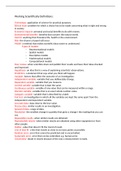
Working Scientifically Definitions:
Technology- application of science for practical purposes.
Ethical issue- problem for which a choice has to be made concerning what is right and wrong
in society.
Economic impacts- personal and social benefits to do with money.
Environmental benefits- benefits that concern the natural world.
Hazard- anything that threatens life, health or the environment.
Risk- the chance a hazard will occur.
Model- a method that makes scientific ideas easier to understand.
Types of models:
Representational models
Spatial models
Descriptive models
Mathematical models
Computational models
Peer review- when scientists share and publish their results and have their ideas checked
and improved.
Hypothesis- an idea that is a way of explaining scientists’ observations.
Prediction- a statement that says what you think will happen.
Variable- factors that affect the outcome of an investigation.
Independent variable- variable that you deliberately change.
Dependent variable- variable that you measure.
Control variable- variable that is kept the same.
Continuous variable- variable of any value that can be measured within a range.
Discrete variable- variable that is an exact whole number value.
Categoric variable- variable that is described by a label.
Fair test- an investigation in which all the variables are kept the same apart from the
independent and dependent variable.
Accurate data- data close to the true value.
Precise data- similar results in an investigation.
Spread of data- range of data.
Resolution- the smallest change in quantity that gives a change I the reading that you can
see.
Repeatable results- when similar results are obtained.
Reproducible results- when similar results are obtained using other equipment or from
other people.
Outlier- value that doesn’t fit the trend of result.
Line of best fit- a line that travels as close to as many points as possible.
Random error- error that cannot be predicted and is uncontrolled.
Systematic error- error that can be controlled, e.g. human error.
Uncertainty- doubt in results because of the way a measurement is made.
Technology- application of science for practical purposes.
Ethical issue- problem for which a choice has to be made concerning what is right and wrong
in society.
Economic impacts- personal and social benefits to do with money.
Environmental benefits- benefits that concern the natural world.
Hazard- anything that threatens life, health or the environment.
Risk- the chance a hazard will occur.
Model- a method that makes scientific ideas easier to understand.
Types of models:
Representational models
Spatial models
Descriptive models
Mathematical models
Computational models
Peer review- when scientists share and publish their results and have their ideas checked
and improved.
Hypothesis- an idea that is a way of explaining scientists’ observations.
Prediction- a statement that says what you think will happen.
Variable- factors that affect the outcome of an investigation.
Independent variable- variable that you deliberately change.
Dependent variable- variable that you measure.
Control variable- variable that is kept the same.
Continuous variable- variable of any value that can be measured within a range.
Discrete variable- variable that is an exact whole number value.
Categoric variable- variable that is described by a label.
Fair test- an investigation in which all the variables are kept the same apart from the
independent and dependent variable.
Accurate data- data close to the true value.
Precise data- similar results in an investigation.
Spread of data- range of data.
Resolution- the smallest change in quantity that gives a change I the reading that you can
see.
Repeatable results- when similar results are obtained.
Reproducible results- when similar results are obtained using other equipment or from
other people.
Outlier- value that doesn’t fit the trend of result.
Line of best fit- a line that travels as close to as many points as possible.
Random error- error that cannot be predicted and is uncontrolled.
Systematic error- error that can be controlled, e.g. human error.
Uncertainty- doubt in results because of the way a measurement is made.